



Is ‘Fragrance’ in Cleaning Products Safe? What Companies Don’t Tell You

When you smell a certain scent, does it take you back to your childhood or spark an emotional memory?
Maybe it’s a certain musk your grandfather used to wear, a fragrant air freshener regularly sprayed to “freshen” up a room, or, maybe it’s a certain laundry detergent or fabric softener used to clean your clothes.
You breathe in, and the smell takes you back.
There’s a reason for that!
Our body, the nasal cavity, to be exact, is made up of millions of electrical charges and receptors that activate and trigger the brain to associate certain smells with times past and present.
The problem? If that scent comes from a synthetic fragranced product, what you smell, isn’t what you think it is.
Unfortunately, fragrance found in cleaning products, personal care products, candles, and many other items is extremely harmful to your health and the air you breathe.
So the question becomes: Is “fragrance” in cleaning products really doing what I think it is? And better yet, is “fragrance” in cleaning products safe?
In this article, we take a deep dive into what the ingredient “fragrance” really means, why and how it’s harmful to your health and indoor air quality, and how you can avoid the ‘dirty’ little secret companies are keeping from you.
Key Takeaways
- The ingredient “fragrance” isn’t what you think it is. Proprietary fragrance recipes are often made up of undisclosed synthetic chemicals from a library of over 5,000, which are harmful to your health and indoor air quality.
- Fragrance in cleaning products exposes you and your home to a wide variety of toxins, including asthmagens, carcinogens, obesogens, neurotoxins, endocrine disruptors, and more.
- Even “natural fragrance” and unscented products may contain harmful chemicals and should be avoided.
- Toss fragranced cleaning products and choose human-safe, effective, fragrance-free options like Branch Basics.
What Does the Ingredient “Fragrance” Really Mean?
Fragrance is much more than just a sweet, lovely scent that makes your house smell good. The ingredients in “fragrance” and “parfum” hold a dirty little secret.
Merriam-Webster Dictionary defines the word “fragrance” as “something (such as a perfume) compounded to give off a sweet or pleasant odor.” [1]
If you dig deeper into the word “odor,” it is defined as “a quality of something that stimulates the olfactory organ.” [2]
In The Emotional Attachment To Fragrance, we talk about why we feel attached to scents and fragrances, noting that synthetic chemicals used in fragrance recipes have a narcotic-like effect on our physical and emotional states.
Even the dictionary tips its hat at the science behind fragrances, or odors, including the fact that odors stimulate, or trigger, our olfactory organ – the organ within the nasal cavity used to detect smells.
How does the olfactory organ work?
When a fragrance or scent is sprayed, the tiny odor molecules travel into the nasal cavity and land on a bit of tissue called the “olfactory epithelium.” This tissue houses millions of tiny receptor neurons and microscopic hairs (cilia) that activate when they detect fragrance molecules.
It is documented that the use of fragrances, like perfumes and air fresheners, on our olfactory organ plays a significant role in our “mood, stress, and working capacity.” [3]
The problem is that using synthetic fragrances in our homes is quite detrimental to our health and indoor air quality.
Why Hidden Fragrance Ingredients Matter To Your Health
As a society, we have been conditioned to associate scented products with cleanliness; think clean cotton and citrus fragrances. But really, this is just a way to mask smells and can compromise indoor air quality, ultimately undermining our health.
The issue with synthetic fragrance in cleaning products (or any product in your home for that matter) is that companies are not required to disclose the chemicals they use to create the “fragrance” ingredient you see on the label.
This lack of transparency is hazardous to human health.
When you see the word “fragrance” on an ingredient list, that should raise a red flag. Why? Because “fragrance” or “parfum” often indicates a proprietary toxic concoction of synthetic chemicals.
But it goes deeper. The chemicals used to make the fragrance recipe because they are trade secrets. So, you’ll never know which chemicals, from a library of over 5,000, have been added to the products in your home.[4]
When you use scented cleaning products, you’re potentially exposing yourself, your family, and your pets to:
-
Asthmagens: Synthetic chemicals act as respiratory irritants, especially in those with asthma. Chemicals with VOCs and phthalates are common culprits.
-
Carcinogens: Several hidden ingredients found in fragrance cocktail recipes are considered potential or known carcinogens, yet companies still choose to include them. These chemicals may include styrene, benzophenone, and acetaldehyde.
-
Endocrine disruptors: These hormone-disrupting chemicals, often found in perfumes and fragranced personal care products like lotions and soaps, include phthalates, synthetic musks, and butylated hydroxytoluene (BHT).[5, 6]
-
Neurotoxins: Chemicals like certain petrochemical solvents, terpenes, and phthalates have been linked to chronic headaches, migraines, vertigo, and cognitive fatigue. [7]
- Obesogens: Interestingly, fragrance chemicals like phthalates, diethyl phthalate (DEP), and synthetic musks play a role in increased health issues like obesity and diabetes. [8]
These chemicals might be developed to “smell good,” but as you can see, they are incredibly harmful to your health.
So, to answer the question, “Is fragrance in cleaning products safe?” The answer is a flat-out “no!”
Learn more in Fragrance Is The New Secondhand Smoke | Eliminate Synthetic Fragrance To Improve Your Health.
How Synthetic Fragrance Compromises Your Indoor Air Quality
The chemicals in fragranced products are known to pollute and affect indoor air quality.
The American Lung Association (ALA) warns about this, stating that “fragrances are made from a mixture of chemicals, many of which evaporate into the air. These chemicals can pollute indoor air and affect people’s health.” [9]
The ALA continues, stating that fragrances can affect indoor air quality, cause health symptoms, and affect those who are more sensitive than others. This includes people with asthma, allergies, COPD, migraines, or chemical sensitivities.
To protect your indoor air, the best course of action is to remove all fragranced products from the home. They affect your air quality even when you are not using them and even when they are in a closed, sealed bottle.
We have a few tips for that!
Check out How to Remove Fragrance from Clothes & Hand-Me-Downs and How To Remove Synthetic Fragrance From Your Home.
Even “Natural Fragrance” & Unscented Products Can Be A Concern
As consumers have gotten more savvy about their health and the negative effects of fragranced products in the home, chemical cleaning companies have ramped up their “smart” marketing tactics.
Unfortunately, cleaning products labeled with “natural fragrance,” “essential oils,” or “unscented” can be just as harmful as those made with “fragrance.”
Many “unscented” products, for example, may still contain toxic ingredients, including scent-masking chemicals, many of which are used in fragrances!
Then there’s the issue of “natural fragrance” and added essential oils.
A recent study analyzed 25 fragranced products, including air fresheners, laundry detergents, lotions, all-purpose cleaners, and more, that are advertised as “green,” “natural,” or “organic.” The study found that these products emitted as many hazardous chemicals as standard ones. [10]
Many of the tested natural products also contained essential oils. Testing showed that these products, all labeled as non-toxic. contained solvents, plasticizers, and endocrine-disrupting chemicals, not included on the ingredient lists. It was determined that the processing methods contaminate products, especially those with essential oils.
Why? If the essential oils were processed using solvents, the solvents became a part of the ingredients. Even if the essential oils were not processed with solvents and were organic or wildcrafted, processing them through plastic tubing could introduce phthalates and other plasticizers into the products.
Phthalates are chemicals that are asthmagens, neurotoxins, obesogens, carcinogens,s and hormone disruptors.
How to Choose Truly Safe and Fragrance-Free Cleaning Products
Going fragrance-free is an intentional and rewarding process. It’s a step towards creating a healthier, human-safe home.
The first step is to take inventory of the scented products in your home and remove anything that contains fragrances.
Next, replace those products with safer alternatives. This can take some time, so be patient with yourself as you work to create a truly fragrance-free home.
Learn more in The Best Fragrance-Free Cleaning Products & Alternatives.
Here’s how:
Step 1: Look For and Remove Products That Contain Synthetic Fragrances From Your Home
To begin, choose one room, complete this step, then move on to the next. Doing this will help prevent overwhelm and keep you moving forward.
Here’s what to do:
Bring a cardboard box or bag into the room you’re working in. As you go through products, add products with fragrance (even essential oils) to the box.
What you’re looking for:
- Scented candles
- Air fresheners
- Scented cleaning products
- Personal care products with “fragrance”, “parfum”, or essential oils listed in the ingredients
- Scented items like trash bags, magazine inserts, stationery, toilet paper, baby wipes, etc.
- Scented laundry products like detergent, fabric softener, and dryer sheets
If the ingredient list on any scented product includes “fragrance,” “parfum,” essential oils, or any of the chemicals listed above in the “Why Hidden Fragrance Ingredients Matter to Your Health” section, add it to the box.
When this step is complete – you’ve gone through your entire home and purged fragranced products from your cabinets and shelves – it’s time to “Toss the Toxins.” In other words, throw them away.
Then, move on to step two.
Step 2: Replace Fragranced Items with Safe Fragrance-Free Alternatives
After you’ve purged your home of harmful fragrances, replace them with safe, healthier options (some of which are inexpensive and available at your local convenience store).
Below are a few examples:
- If you love the glow and comfort of a lit candle, consider swapping conventional chemically scented options for pure, clean, and healthy Beeswax Candles.
- Fragranced air and car fresheners compromise indoor air quality. Instead, try these 7 Non-Toxic & Fragrance-Free Air Fresheners.
- Replace scented cleaning products, including bleach, with safer alternatives like Branch Basics. At Branch Basics, we have your fragrance-free cleaning products covered. Check out our Branch Basics Starter Kits to get started.
- Conventional personal care products are good at hiding fragrance chemicals in the ingredient list. To help you avoid them, we put together this list of Our Favorite Non-Toxic Personal Care Products.
- Laundry products are notorious for loading up on harmful scents and perfumes that mask odors. But they’re unnecessary! Instead, opt for products like Branch Basics Laundry Detergent, Oxygen Boost, and Wool Dryer Balls.
When you’re shopping and looking for fragrance-free products, follow these two simple steps:
- Avoid buying products with “fragrance,” “parfum,” essential oils, or “natural fragrance” on the bottle and ingredient list.
- Invest in fragrance-free, human-safe products, like the options listed above.
For more on going fragrance-free, check out How To Remove Synthetic Fragrance From Your Home.
Give Branch Basics a Try! Your New Go-To for Fragrance-Free Cleaning Products
At Branch Basics, we prioritize ingredient transparency so you can rest assured the cleaning products used in your home are human-safe, fragrance-free, natural, and effective.
All of our products are crafted with plant and mineral-based ingredients, formulated with the most sensitive in mind. Our consciously clean formulas are EWG Verified®, MADE SAFE® certified, Leaping Bunny certified, and have undergone rigorous third-party end-product testing.
Learn more in End-Product Testing: How Branch Basics Is Changing the Cleaning Industry.
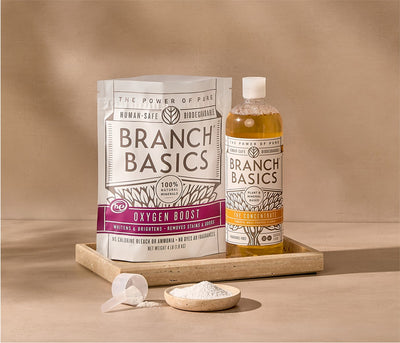
Branch Basics Premium Starter Kits (available in refillable plastic or glass) are the best place to start on your human-safe cleaning journey. These kits come with a bag of Oxygen Boost, our all-in-one, human-safe Concentrate, and refillable bottles to make the following fragrance-free cleaning products:
-
All-Purpose for cleaning surfaces, removing stains, and general cleaning.
-
Bathroom is our most concentrated dilution, for use on tubs, showers, grout, sinks, surfaces, drains, soap scum, hard water deposits, toilets, and anywhere else you need a powerful clean.
- Note: Pair Bathroom with Oxygen Boost for tougher cleaning jobs including mildew and stain removal.
- Note: Pair Bathroom with Oxygen Boost for tougher cleaning jobs including mildew and stain removal.
-
Streak Free is a safe and effective dilution for cleaning glass and mirrors. Added bonus – it takes only one drop of Concentrate mixed with water.
-
Foaming Wash is wonderful for hand-washing, dishes, pets, makeup and eye makeup removal, a relaxing bubble bath, shaving, and much more.
- Laundry dilution, can be used for hand-washing delicates, or in HE or traditional washing machines. One bottle cleans at least 64 loads of laundry and is safe for even the most sensitive of skin. Add a scoop of Oxygen Boost (a natural bleach alternative) for added stain removal, deodorizing, or brightening whites.
You can also use Branch Basics Concentrate to make your own fragrance-free floor and carpet cleaner, pet shampoo, furniture cleaner, and so much more.
For all the great uses around the home, check out Everything You Can Clean With BB Guide.
Or, if you’re ready to dive “all in” on fragrance-free cleaning, we recommend checking out our Ultimate Starter Kits (also available in refillable plastic or glass). These kits come with everything listed above (minus the Laundry bottle), plus the following:
- Our new powdered Laundry Detergent. With just one scoop, our biodegradable formula effectively lifts stains and removes odors. It’s also fragrance-free, safe for sensitive skin, and free from 1,4-dioxane, phosphates, sulfates, ethoxylates, optical brighteners, harmful preservatives, VOCs or SVOCs, bleach, ammonia, and dyes.
- Branch Basics plastic-free Dishwasher Tablets power through dirt, grease, and stuck-on food without any harmful synthetic chemicals, including fragrances and perfumes.
As you can see, going fragrance-free really is that easy! All it takes is a little bit of information and the right products to create a healthier, truly human-safe home.
To learn more about fragrance and how to go fragrance-free, be sure to check out:
-
The Emotional Attachment To Fragrance
-
How To Remove Synthetic Fragrance From Your Home
-
The Best Fragrance-Free Cleaning Products & Alternatives
-
How to Remove Fragrance from Clothes & Hand-Me-Downs
-
Fragrance Is The New Secondhand Smoke | Eliminate Synthetic Fragrance To Improve Your Health
Resources
1. https://www.merriam-webster.com/dictionary/fragrance
2. https://www.merriam-webster.com/dictionary/odor
3 https://pmc.ncbi.nlm.nih.gov/articles/PMC5198031/
4. https://www.huffpost.com/entry/toxic-chemicals_b_625648
5. https://pmc.ncbi.nlm.nih.gov/articles/PMC12425936/
6. https://endocrinedisruption.org/assets/media/documents/EDC%20Fact%20Sheet%2020180130.pdf
7. https://pmc.ncbi.nlm.nih.gov/articles/PMC10051690/
8. https://dieteticswithdriessens.org/s/stories/how-to-avoid-obesogens-and-lose-excess-weight/
9. https://www.lung.org/clean-air/indoor-air/indoor-air-pollutants/fragrances
10. https://pmc.ncbi.nlm.nih.gov/articles/PMC3018511/

Marilee Nelson
Marilee Nelson is an Environmental Toxins expert who has spent nearly 30 years advocating for the chemically-sensitive and chronically-ill. She is a Board Certified Nutritionist, Certified Bau-Biologist and Bau-Biology Inspector and specializes in Food As Medicine. She has helped thousands of families and individuals identify, heal and recover from toxic exposures and is on a mission to revolutionize the way American families view their health.