

Cleaning Products Without Harmful VOCs: Why We Avoid Them in Branch Basics

VOCs, also known as volatile organic compounds, are compounds emitted as gases from various solid and liquid substances. Some are synthetic, and some are natural.
You can detect VOCs through smells. From the pleasing scent of fresh spring blossoms or essential oils to the off-putting smell of new vinyl flooring or chlorine bleach, all are examples of VOCs.
Not all VOCs are harmful, especially if they come from whole, natural substances. The problem comes from synthetic (human-made) VOCs, such as bleach, ammonia, plastics, vinyl, electronics, fabrics, gasoline, petroleum products, solvents, acetone, and others, especially when inhaled frequently indoors and without proper ventilation.
These are the VOCs that create sick building syndrome, headaches, organ damage, chronic illness, reproductive and fertility issues, developmental toxicity, asthma, respiratory ailments, cancers, and so much more.
And one of the most common sources of toxic VOCs in homes is cleaning products, fragrances, and laundry products!
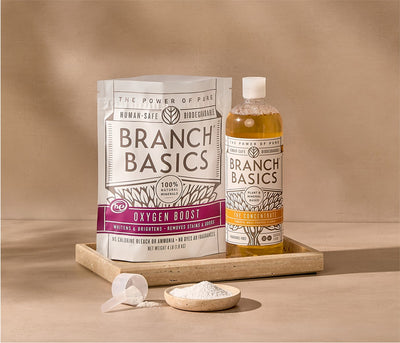
This is why Branch Basics has been formulated to contain no harmful VOCs or other toxic ingredients. Let’s unpack this further.
Key Takeaways
- VOCs, also known as volatile organic compounds, come from any substance, natural or synthetic, that has a smell.
- Concentration, chemical makeup, and ventilation all play a role in VOC toxicity
- Toxic VOCs are found in many synthetic cleaning and laundry products, especially those with strong scents and ingredients such as fragrance, bleach, ammonia, and disinfectant chemicals.
What Role Do VOCs Play In Cleaning Products?
You won’t find the term “VOC” listed under the ingredients label of cleaning or laundry products.
That’s because VOCs aren’t exactly an ingredient but a category of ingredients or ingredient by-products that become airborne and eventually evaporate.
Some examples of chemicals with harmful VOCs used in cleaning products include:
- Chlorine bleach
- Ammonia
- Acetone
- Fragrance
- Formaldehyde donors (preservatives that release small amounts of formaldehyde over time)
- Essential oils processed with solvents or through plastic tubing
- Alcohols
- Benzene
- Toluene
- Detergents
- Disinfectants
Which cleaning products contain the most VOCs?
Research shows that bleach-based cleaners, glass cleaners, spray cleaners, disinfectants, ammonia-based cleaners, and toilet bowl cleaners emit the highest concentrations of VOCs.[1]
Though the EPA monitors VOCs in outdoor environments, it cannot monitor indoor concentrations, where higher levels often occur.
High levels of VOCs in homes, offices, schools, or other buildings can cause various ill health effects, many of which are difficult to trace back to indoor air pollution.
Why Are They Harmful to Your Health?
As mentioned previously, VOCs are not always harmful to your health, and many natural scents have been proven beneficial!
However, high concentrations of VOCs from various chemicals, especially in poorly ventilated areas, can make you feel off, sick, or very sick!
Common symptoms of VOC exposure include nausea, headaches, dizziness, eye, nose, throat, and respiratory irritation, coughing, wheezing, and even vomiting.
VOC exposure has also been linked to:[2-4]
- Sick building syndrome
- Allergic skin reactions
- Brain fog or cognitive impairments
- Damage to the liver, kidneys, and central nervous system
- Dyspnea
- Loss of coordination
- Nosebleeds
- Respiratory issues, especially for those with asthma or other lung conditions
- Shortness of breath
- Long-term exposure has been linked to chronic and degenerative illnesses, including certain types of cancer, chronic lung disease, bone marrow disorders, hormone disruption, metabolic disorders, asthma, and central nervous system damage and toxicity.
VOCs are also problematic during pregnancy, due to their known and unknown effects on unborn babies and the endocrine-disruptive effects on the mother.
Again, it’s important to keep in mind that concentration, ventilation, and chemical composition determine whether VOCs are toxic or harmless.
Generally, if a scent comes from something natural, like a flower, a freshly peeled orange, or something cooking in your kitchen, it’s safe.
However, if it’s unpleasant, off-putting, strong, and/or comes from something synthetic (human-made) like cleaning products, laundry products, new furniture, appliances, fragranced products (air fresheners, candles, skin care products, trash bags, etc.), or building materials, it’s probably toxic and should be avoided or handled with caution.
Why Branch Basics Doesn’t Have Chemicals With Harmful VOCs
At Branch Basics, our brand promise is to create products that are human-safe and environmentally safe.
That means our products contain no harmful chemical ingredients, including those that emit harmful VOCs.
We’ve gone to great lengths to achieve this, and even had our products third-party verified for safety and purity by MADE SAFE, EWG, Leaping Bunny, and our own independent third-party testing, which shows our Concentrate is not a skin, eye, or lung irritant.
One way we avoid VOCs is by using zero fragrance in our products, including those from natural sources like essential oils or natural fragrance.
We even went so far as to source an Organic Chamomile Flower Extract (a star ingredient in our Concentrate) that is certified to not be a fragrance.
Branch Basics also does not contain chlorine bleach, ammonia, petroleum products, harsh detergents or surfactants, formaldehyde donors, alcohol, sulfates, synthetic preservatives, toluene, or ingredients that can form harmful by-products such as 1,4-dioxane or chloroform.
Why Are VOCs Commonly Included In Cleaning Products?
Chemicals that emit harmful VOCs are not necessary in cleaning products.
However, cleaning companies use them to disinfect, sanitize, degrease, dissolve dirt, reduce the surface tension of water, create a pleasant scent, or mask unpleasant scents.
Despite what many of us have been led to believe, it is absolutely possible to clean and even disinfect without using harmful VOC-emitting chemicals.
We discuss this at length in various articles, including our Toss The Toxins Online Course.
What’s Marilee’s Take On VOCs?
Our co-founder, Marilee Nelson, spent decades helping thousands of chronically ill clients create healthy homes after her son fully recovered from what doctors said was irreversible brain and immune system damage.
His recovery was considered a medical miracle. She realized that products in the home with harmful VOCs, even when not being used, were hijacking his ability to heal. Once she learned what ingredients were and were not safe, she saw clearly that non-toxic on a label is not enough.
“Sadly, most people are completely unaware that seemingly harmless chemical scents, such as new car smell, fragrance from air fresheners, candles, or skin care products, and even the smell of new furniture, toys, or a vinyl shower curtain, are polluting their indoor air and making them sick.
“And even fewer people realize that VOCs are much more prominent indoors than outdoors, which means it’s up to us to take steps to reduce VOC pollution at home.
“I had to learn this the hard way when I was recovering my son from his debilitating pesticide injury, which forced us to remove all harmful products that emitted harmful VOCs, from our home. This wasn’t easy, especially 30+ years ago, but it forced me to dig in and learn about the ingredients being used even in non-toxic products.
This also inspired Marilee’s work as a Bau Biologist, a building specialist who helps people choose low-tox, healthier building materials for their homes.
Marilee’s work recovering her son (who is now a healthy father of three) and helping clients with chronic illness create healthy homes was the inspiration that drove the Branch Basic founders to offer a human-safe cleaning line free of harmful VOCs that could replace every toxic cleaning and laundry product in the home.
“It took nearly 100 product formulation iterations, but we finally landed on a formula that was naturally fragrance-free, free of harmful VOCs, and was not a skin, eye, or lung irritant, that also worked amazingly well on all types of cleaning jobs, from surfaces to stains, handwashing, and laundry to carpet cleaning and windows.
So no matter what type of cleaning job you need to tackle, you can rest easy knowing Branch Basics will not only work extremely well but also won't release any harmful VOCs or other substances that can make you sick or degrade indoor air quality.
There’s so much more to say about VOCs, and Marilee encourages everyone to check out our existing content and take advantage of our free Toss The Toxins Online Course. to help you identify, remove, and replace harmful products in your home.
Learn more in: What Are VOCs? The Dangers + What You Need to Know
VOCs FAQs
Don’t you love double-acronyms? Let’s answer some FAQs.
Q: Do Many Cleaning Products Contain VOCs?
A: Yes. Unfortunately, nearly all conventional cleaning products, and many “green” cleaning products, contain and emit toxic VOCs.
Unscented products may emit less, but unless they’re free from VOC-emitting chemicals, like bleach, ammonia, and their by-products, they still contain VOCs.
Q: Is Vinegar Considered A VOC?
A: Since vinegar has a strong smell, it does contain VOCs, which come from its naturally occurring acetic acid.[5]
The American Lung Association states that acetic acid is a lung irritant when aerosolized. We always recommend spraying vinegar only in a well-ventilated area and avoiding its use around babies, young children, older people, and anyone with respiratory issues or chronic illness.
Bottom line: Vinegar is a natural substance that emits acetic acid. There is no problem when vinegar is not sprayed, such as when used in washing machines or poured onto surfaces.
Use common sense, and it’s typically very safe.
See Why We Recommend These Substitutes for Vinegar in Cleaning for more options.
Q: What Household Items Emit Harmful VOCs?
A: Many household items emit VOCs, including:
- Cleaning products
- Anything scented
- Some types of furniture, including plastic, vinyl, and particle board varieties
- Synthetic carpets
- Synthetic rugs
- Certain types of flooring, including laminate, vinyl, composite, engineered hardwood, and LVP, and some types of treated hardwood
- Note: Not all flooring brands or materials contain the same concentration of VOCs. Look for low- or no-VOC brands.
- Laundry detergent and products
- Paint
- Art supplies
- Glues
- Vinyl shower curtains, flooring, etc.
- Plastics (toys, kitchen supplies, etc.)
- New clothing
- Outdoor gear
- Cookware, especially non-stick varieties
- Varnishes
- Air fresheners
- Scented candles
- Scented trash bags
- Electronics
The good news is that you can reduce VOCs in the home by choosing low- or no-VOC products and by off-gassing new products, which helps speed the evaporation of harmful VOCs.
Learn more in: How to Outgass (Offgas) & Remove VOCs Naturally: Take Advantage of the Summertime Sun
References:
- https://iaqscience.lbl.gov/vocs-cleaning-product
- https://www.epa.gov/indoor-air-quality-iaq/technical-overview-volatile-organic-compounds#3
- https://www.epa.gov/indoor-air-quality-iaq/volatile-organic-compounds-impact-indoor-air-quality
- https://www.lung.org/clean-air/indoor-air/indoor-air-pollutants/volatile-organic-compounds
- https://www.frontiersin.org/journals/microbiology/articles/10.3389/fmicb.2022.907883/full

Marilee Nelson
Marilee Nelson is an Environmental Toxins expert who has spent nearly 30 years advocating for the chemically-sensitive and chronically-ill. She is a Board Certified Nutritionist, Certified Bau-Biologist and Bau-Biology Inspector and specializes in Food As Medicine. She has helped thousands of families and individuals identify, heal and recover from toxic exposures and is on a mission to revolutionize the way American families view their health.