

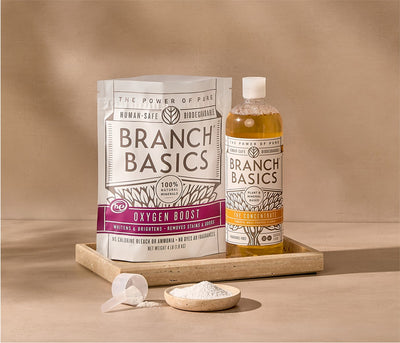


Cleaning Products Without Fragrance: Why It’s Not Included in Branch Basics

Looking for cleaning products without fragrance? It can be challenging, especially if you’re also avoiding natural fragrances and essential oils, which are often used in green cleaners.
At Branch Basics, fragrance-free is at the heart of our human-safe formulas, which contain no synthetic or natural fragrance, including essential oils.
This article explains why we’ve chosen to be completely fragrance-free, why this matters, why unscented vs. fragrance-free products aren’t necessarily safe, and tips on how to remove fragrance from your home.
Key Takeaways
- Fragrances are pulled from a reservoir of over 5000 synthetic chemicals, none of which have ever been properly safety tested
- Several of these chemicals, such as phthalates, styrene, and benzophenone, are known or suspected carcinogens
- Branch Basics is, and always has been, naturally fragrance-free by design
What is Fragrance in Cleaning Products?
With names like “meadow fresh”, “spring rain”, and “lavender relax”, fragrances allure us into believing we’re using something wholesome, exotic, and cleansing, when in reality, the opposite is true.
Despite their luxe reputation, the truth is fragrances are made from a bank of over 5000 synthetic chemicals,[1] none of which have been properly tested for safety and many of which are known carcinogens, endocrine (hormone) disruptors, asthmagens, obesegens, neurotoxins, and VOCs, all of which can cause a variety of acute and chronic health conditions, which we’ll discuss more in the next section.[2-5]
Some of these ingredients include:
-
Phthalates: Endocrine-disrupting chemicals found in plastics and fragrances linked to reproductive toxicity in all sexes, hormonal imbalance, heart disease, metabolic disruption, and developmental toxicity in fetuses, including congenital abnormalities.[6-8]
-
Benzophenone: A suspected carcinogen and endocrine disruptor linked to eye and skin irritation, gastrointestinal damage, liver damage, respiratory irritation, and/or damage.[9]
-
Styrene: A reasonably anticipated human carcinogen linked to nervous system damage, allergic skin, eye, and throat reactions, depression, headaches, weakness, respiratory damage, liver damage, reproductive toxicity and miscarriage, and a potentially higher risk of pancreatic and esophageal tumors.[10]
-
Benzyl alcohol: A strong skin irritant linked to most skin reactions from fragrance.[11]
-
Limonene: This naturally occurring substance from lemons is safe in its whole, natural context. However, once isolated as a natural or synthetic fragrance, it can cause allergic skin reactions.[12]
-
Musk ketone and galaxolide: These chemicals are bioaccumulative, meaning the body cannot detoxify them easily. They’re also endocrine disruptors linked to skin issues, reproductive toxicity, wildlife and environmental toxicity, and a potentially higher risk of breast cancer.[13][14]
-
Parabens: Endocrine disruptors linked to reproductive toxicity and infertility in men and women.[15][16]
- Chemical solvents, such as methanol, are linked to nervous system damage and environmental pollution.[17]
The real kicker is that one signature fragrance, in a laundry detergent or air freshener, for example, may contain dozens of undisclosed chemicals neatly nestled under the label “fragrance” or “natural fragrance”.
Sadly, green cleaning products aren’t immune to these harmful fragrance chemicals.
For example, one study of the 25 top-selling cleaning products revealed the “green”, natural, and organic fragranced products emitted just as many hazardous chemicals as regular fragranced products![18]
How can this be? Although the researchers didn’t speculate, it’s likely due to many factors, including how essential oils are processed and the synthetic chemicals used in so-called “natural fragrances.”
We invite you to learn more about this in: Fragrance Is The New Secondhand Smoke | Eliminate Synthetic Fragrance To Improve Your Health and Is Natural Fragrance Safe?.
Why Branch Basics Doesn’t Use Fragrance
There are so many reasons Branch Basics doesn’t use fragrance. We’ve even gone so far as to source ingredients, like Organic Chamomile Flower Extract, that are certified not to contain fragrance.
But the main reason is that our products are formulated to be safe for even the most sensitive individuals, including babies, children, older people, pets, people with chemical sensitivities, and those with chronic illness.
Synthetic fragrance recipes are not safe for everyone, or anyone, in our opinion, and have been linked to various ill health effects, including:[19-26]
- ADHD
- Asthma
- Diabetes
- Cancer
- Cognitive issues
- Fatigue
- Headaches
- Hormonal disruption
- Metabolic disruption
- Mental health issues
- Respiratory issues
- Sick building syndrome
- Sleep problems
We’ve also chosen not to include essential oils in our products, as Marilee found that essential oils had to be removed from the homes of her clients with chronic illness for them to experience a full recovery.
People didn’t realize they were reacting to them until they were removed. Marilee knew that essential oils are natural and can be very therapeutic when used wisely, so she researched this.
What she discovered was that most essential oils in consumer products are processed with a toxic solvent.
In addition, if the processing involves plastic tubing, the oils become contaminated with lipophilic (fat-loving) plasticizing chemicals, which are known endocrine disruptors, neurotoxins, asthmagens, obesogens, and carcinogens.
Also, some varieties of essential oils have been shown to be endocrine-disruptive, while terpene-containing varieties react with ozone, forming carcinogenic by-products, such as formaldehyde.[27][28]
Ultimately, we recommend going fragrance-free when creating a healthy home.
If everyone in the home is vibrantly healthy, and using an essential oil is desired, bring in carefully chosen wildcrafted or organic essential oils processed without solvents or plastic tubing, and see how everyone in the family responds.
Learn more about the risks of fragrance in:
Unscented vs. Fragrance Free: What’s The Difference?
Unscented and fragrance-free may sound like two sides of the same coin, but they don’t always mean the same thing.
Fragrance-free means a product is completely free of fragrance chemicals. This is the label you want to go by if you want to avoid fragrance or have a fragrance allergy or sensitivity.
Unscented, on the other hand, can mean a product has scent-masking chemicals added to cover up the smell of various chemicals, including those used in detergents.
These scent-masking chemicals are often as bad as fragrance chemicals, and are sometimes used in fragrances, so they should be avoided.
This is common in laundry detergents, and something to watch out for.
Key takeaway: Look for fragrance-free or naturally fragrance-free products and skip the unscented varieties.
Why Is Fragrance Commonly Included In Cleaning Products?
Fragrance is typically used in cleaning products for three reasons: one is obvious, the other two less so:
1: To mask the smell of other chemicals in the formula. Except for unscented products, which use scent-masking chemicals, as previously mentioned.
2: To make the product more appealing, and so you remember it constantly, every time you smell a towel, clean your home, or spray air freshener
3: To create scent addiction so you’ll buy more. Although less discussed than other health effects, synthetic and natural fragrances can be addictive on several levels.
Firstly, scents create nostalgia and can transport us back to childhood or happier times. This is why many of us continue to use the same scented products our mothers used, for instance.
Secondly, fragrance chemicals impact the same brain chemicals linked to addiction, much like food additives, leaving us wanting more.
This is why it can be so hard to give up your favorite scents; many times, they’re emotionally addictive.
How to Remove Fragrance From Your Home
We’ve covered this at length in other articles and our Toss The Toxins Online Course.
To get started, remove the following products from your home:
- Scented cleaning products
- Air fresheners (sprays, plug-ins, etc.)
- Scented laundry products, including detergents, fabric softener, dryer sheets, scented
- bleach (and bleach in general), scent beads, and scented stain removers
- Scented trash bags
- Scented dish soap
- Scented toilet paper
- Scented skin, hair, and personal care products
- Potpurri
- Scented dryer sheets
If you’re very attached to these products, just remember fragrances can be addictive, especially if they invoke memories, and it’s not your fault. Instead of throwing them away, put them in a sealed plastic bin, and place them outside the home, such as in a garage or shed.
The next step is to replace them with safe, plant- and mineral-based, fragrance-free products, like Branch Basics for cleaning, laundry, and more.
Get more tips on human safe replacements in:
Fragrance FAQs
Now that you have the dirt on fragrance, we’ll cover some FAQs.
Is A Fragrance-Free Cleaner Better?
Yes! Although ideally we’d want everyone using human-safe, plant- and mineral-based cleaners, even a fragrance-free synthetic cleaner is better than a scented synthetic cleaner.
That’s not to say they won’t have other harmful chemical ingredients, but at least you’ll avoid the fragrance chemicals.
The same goes for natural and green cleaners; always choose fragrance-free, even if it says “natural fragrance”.
Even essential oils-scented cleaners can be sketchy due to concerns over endocrine disruption and how essential oils react with plastic packaging. That said, if you must have a scented product, that’s usually the safest choice.
Is Fragrance-Free The Same As Unscented?
No. As mentioned previously, fragrance-free means a product contains no fragrance chemicals, whereas unscented products typically contain scent-masking chemicals.
Always choose fragrance-free over unscented.
What Does it Mean For A Product to be Truly Fragrance-Free?
A truly fragrance-free product must be free of synthetic and natural fragrance chemicals, as well as scent-masking chemicals.
References:
-
https://www.sciencedirect.com/topics/materials-science/fragrance
-
https://pmc.ncbi.nlm.nih.gov/articles/PMC12425936/
-
https://pmc.ncbi.nlm.nih.gov/articles/PMC7218126/
-
https://www.ncbi.nlm.nih.gov/books/NBK587442/
-
https://www.sciencedirect.com/topics/materials-science/fragrance
-
https://pubmed.ncbi.nlm.nih.gov/27424259/
-
https://pubmed.ncbi.nlm.nih.gov/28898934/
-
https://pmc.ncbi.nlm.nih.gov/articles/PMC2873014/
-
https://pubchem.ncbi.nlm.nih.gov/compound/3102#section=Consolidated-References
-
https://pubchem.ncbi.nlm.nih.gov/compound/7501#section=Toxicity-Summary
-
https://pubchem.ncbi.nlm.nih.gov/compound/118268830#section=GHS-Classification
-
https://www.sciencedirect.com/science/article/abs/pii/S0278691518304976
-
https://www.ewg.org/sites/humantoxome/chemicals/chemical.php?chemid=100380
-
https://pubmed.ncbi.nlm.nih.gov/11434209/
-
https://pubmed.ncbi.nlm.nih.gov/38876430/
-
https://www.sciencedirect.com/science/article/pii/S0147651323009570
- https://pubchem.ncbi.nlm.nih.gov/compound/887
-
https://pmc.ncbi.nlm.nih.gov/articles/PMC3018511/
-
https://pmc.ncbi.nlm.nih.gov/articles/PMC5093181/
-
https://www.mdpi.com/2673-396X/5/3/27
-
https://pmc.ncbi.nlm.nih.gov/articles/PMC3404651/
-
https://nypost.com/2024/12/03/health/perfume-ingredient-can-lead-to-heart-issues-and-infertility-say-doctors/
-
https://pmc.ncbi.nlm.nih.gov/articles/PMC9163252/
-
https://www.nature.com/articles/s41370-024-00693-8
-
http://www.ewg.org/enviroblog/2014/08/expert-panel-confirms-fragrance-ingredient-can-cause-cancer
-
https://pmc.ncbi.nlm.nih.gov/articles/PMC7218126/
-
https://www.medicalnewstoday.com/articles/321262
- https://ww2.arb.ca.gov/resources/fact-sheets/cleaning-products-indoor-air-quality
Categories

Marilee Nelson
Marilee Nelson is an Environmental Toxins expert who has spent nearly 30 years advocating for the chemically-sensitive and chronically-ill. She is a Board Certified Nutritionist, Certified Bau-Biologist and Bau-Biology Inspector and specializes in Food As Medicine. She has helped thousands of families and individuals identify, heal and recover from toxic exposures and is on a mission to revolutionize the way American families view their health.


