

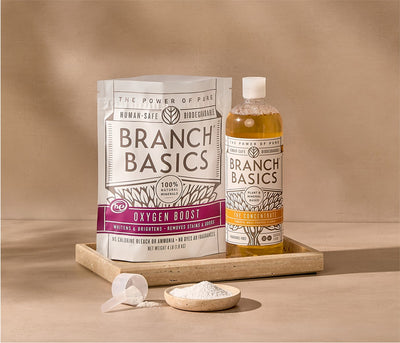


Branch Basics Ingredient: Coco Glucoside

One of our company's missions is to help educate and empower people to know exactly what ingredients are in their household products, including ours!
Today, we’re focusing on one of our core ingredients in Branch Basics Concentrate: Coco Glucoside.
Specifically, what it is, where it comes from, how it’s made, what it does in Branch Basics products, and why it’s considered a human-safe and biodegradable ingredient.
Let’s dig in!
Key Takeaways
- Coco Glucoside is an ultra-gentle, human-safe surfactant safe for babies, sensitive skin, and sensitive individuals
- It’s Ecocert and COSMOS approved for certified organic formulations and biodegradable
- No petrochemical ethoxylation
- When combined with decyl glucoside, it offers incredible foaming power, stability, and cleaning performance
Table of Contents
Add a table of contents with jump links to the sections below.
Why Does Branch Basics Use Coco Glucoside?
Coco Glucoside is a plant-based non-ionic surfactant, a type of ingredient that helps reduce the surface tension of water, allowing for the removal of germs, dirt, grime, soap scum, and other messes.
Synthetic, natural, and plant-based surfactants are widely used in cleaning products, personal care products, skin care products, and detergents as foaming agents, thickeners, conditioners, and stabilizers.
Natural soap is the most well-known type of surfactant, but there are many others of varying efficacy, safety, and toxicity.
Basically, if you see suds and foam, that’s a surfactant at work.
So, why did we choose Coco Glucoside?
We chose from the family of alkyl polyglucosides (APGs), Coco Glucoside and Decyl Glucosides, were the only surfactants certified for baby shampoo and delicate, sensitive skin..
These two surfactants have a synergistic relationship, helping each other create more stable foam and lather, while enhancing cleaning power.
Here are some other reasons we chose Coco Glucoside:
- It’s natural and non-GMO
- It comes from 100% renewable, biodegradable, vegan resources
- It’s Ecocert and COSMOS approved for certified organic formulations
- It does not bioaccumulate or harm the environment or waterways
- It’s not ethoxylated - production produces no contaminant by-products like 1,4-dioxane
- Unlike saponified natural soaps, Coco Glucoside leaves no film or residue
- It’s gentle, mild, and non-drying, even for the most delicate skin
- It’s non-irritating, non-allergenic, and non-carcinogenic
- EWG (the Environmental Working Group) rates it a “2”, meaning it is of “low concern” in terms of any safety issues
- It’s safe enough for babies and pets! (verified not to be a skin or eye irritant by independent third-party testing)
- It can be combined with other human-safe surfactants to enhance cleaning power
To learn more about surfactants, check out: Are Surfactants Toxic? The Dangers + Safe and Natural Alternatives
How Does Coco Glucoside Work In Branch Basics?
Coco Glucoside combined with Decyl Glucoside allow our products to deliver exceptional cleaning and stain-removal power, along with consistent, long-lasting foam, while remaining gentle enough for the most sensitive skin and individuals.
Coco Glucoside also has skin-conditioning properties, making it ideal for handwashing, body wash, makeup removal, pet washing, etc.
What Is Coco Glucoside Made Of?
Coco Glucoside is made by mixing plant-based alcohols with a plant-based sugar, glucose, or glucose polymer from coconuts, potatoes, or corn.[1]
As previously mentioned, ours comes from coconuts, which are not genetically modified.
Once this reaction occurs, it produces a gentle, human-safe, naturally derived synthetic surfactant* suitable for use in skin, body, haircare, baby products, and cleaners, like Branch Basics.
*If the word “synthetic” in the description gives you pause, that means you’re thinking critically about ingredients! Let us explain.
The alkyl glucosides, including Decyl and Coco Glucoside, are identified as naturally derived synthetic surfactants and also natural surfactants.
Why is this?
The word synthetic in the description does not mean they are derived from a petroleum or unnatural product and are highly processed. Rather, it’s used because of the number of steps taken to process the natural source, in this case, coconuts, to create the surfactant.
This is comparable to using the term “processed or refined food” to refer to simple processing techniques, such as grinding grain or nuts into flour, extracting oil from olives, or dehydrating fruit.
That step of grinding, extraction, or dehydration creates processed food, but not an unnatural or unhealthy one.
The Environmental Impact Of Coco Glucoside
Unlike other surfactant categories, Coco Glucoside does not negatively impact the environment, including waterways, aquatic life, and wildlife.
Unfortunately, other synthetic surfactants and detergents, such as PFAS-based (forever chemicals) anionic surfactants, cationic surfactants, and amphoteric surfactants, are serious environmental hazards, especially for aquatic life and the ecosystems in our oceans, streams, lakes, and rivers.[2]
Just think about how many foaming products are rinsed down the sink, tub, dishwasher, and washing machine daily, and you can imagine the impact.
Unfortunately, most people aren’t aware of the environmental dangers of certain surfactants, which is why information like this is so valuable (pass it on!).
What Harmful Ingredients Does Coco Glucoside Replace?
Coco Glucoside replaces saponified natural soap and other synthetic and harsher plant-based surfactants used in cleaning and personal care products.
Some examples include:
-
Alkylphenol ethoxylated (APE) surfactants: Banned in European countries due to the harmful by-product, octophenol, linked to breast cancer, neurological development in children, and wildlife and environmental harms.[3][4]
-
Cationic Surfactants: Such as antibacterial Quaternary Ammonium Compounds (Quats), linked to microbiome disruption, developmental toxicity, reproductive toxicity, neurodevelopmental issues, lung irritation and asthma, and more.[5-8]
-
Amphoteric Surfactants: Such as cocamidopropyl betaine, a gentler synthetic surfactant and potential skin irritant, possibly due to contamination with 3-dimethylaminopropylamine.[9]
-
PFAS-containing anionic surfactants: These forever chemicals are endocrine-disrupting and linked to immunotoxicity, reproductive toxicity, developmental toxicity, thyroid disruption, cancers, and cardiovascular issues in humans and animals.[10]
-
Sodium laurel sulfate (SLS): A skin, eye, mouth, and lung irritant.[11]
-
Sodium laureth sulfate (SLES): Commonly used as an SLS replacement, SLES may be contaminated with ethoxylates, such as 1,4-dioxane.[12]
- Natural soaps: Such as liquid castile soap, which is an excellent, biodegradable, natural cleanser and DIY cleaning ingredient, but can leave a film on glass and surfaces, potentially irritate the lungs when sprayed, is an eye irritant, and can be drying to the skin.
Related reading: 5 Effective Natural Surfactants for Household Products
What’s Marilee’s Take on Coco Glucoside?
“Our original goal when formulating Branch Basics was to create a pure, natural fragrance-free, human-safe saponified soap-based cleaner that didn’t leave a soap scum residue or film, and was completely non-irritating when aerosolized (sprayed).
“We almost made that happen, but realized we were asking the impossible. Our chemists help us see that natural soaps will always irritate the eyes and lungs when sprayed and leave behind soap scum.”
Disappointed but still determined, Marilee, Allison, and Kelly went with plan B: 100% whole-plant, natural surfactants.
“Next, we tested out products using natural surfactants like soap nuts, quillaja, and yucca. However, we discovered that although these plants are great for DIY products, they just couldn’t offer the consistency, foaming power, and cleaning performance required for a professional human-safe product.”
The next step was to consider other naturally-derived synthetic surfactants.
Says Marilee, “I was convinced to try these out after seeing the COSMOS/ECOCERT’S declaration that alkyl glucosides (Coco and Decyl) are the only surfactants allowed for baby products and sensitive skin in European cosmetics. And that they function effectively as the de facto standard for “safe surfactants” in natural and babycare formulations.”
After months of research, formulating, testing, and reformulating, the founders settled on Coco and Decyl Glucoside as the safest, highest-performing, non-irritating, beneficial, and most natural surfactants for Branch Basics products.
Coco Glucoside FAQs
We hope all this information has helped you understand why we use Coco Glucoside and why it’s safe for you and your family, even the ultra-sensitive, very young, very old, and chronically ill.
Still, as label-reading aficionados, you probably have more questions, so here are some FAQs.
Is Coco Glucoside Safe for Kids?
Absolutely! As mentioned previously, Coco Glucoside and Decyl Glucoside are considered the safest surfactants for babies, toddlers, and those with sensitive skin.
Is Coco Glucoside Natural?
Yes, Coco Glucoside is derived from non-GMO coconuts, making it a natural ingredient. It’s also considered a synthetic substance due to the number of steps required for processing.
See the previous section “What Is Coco Glucoside Made Of?” for more information.
How Does Coco Glucoside Support Branch Basics' “Human Safe” Standard?
The alkyl glucosides, including Coco Glucoside, are considered one of the safest and gentlest surfactant types and are the only ones approved for use in baby products and those for sensitive skin in Europe.
They’re non-irritating, nourishing to the skin, non-bioaccumulative, non-endocrine disruptors, non-carcinogenic, and Ecocert and COSMOS approved for certified organic formulations.
They are the safest surfactants available, even more so than natural soaps, which can cause eye and lung irritation.
Is Coco Glucoside A Surfactant?
Yes, Coco Glucoside is a plant-derived surfactant.
References:
1. http://www.cir-safety.org/sites/default/files/decylg122011FRx.pdf
2. https://pmc.ncbi.nlm.nih.gov/articles/PMC8480275/#CR120
3. https://www.epa.gov/assessing-and-managing-chemicals-under-tsca/fact-sheet-nonylphenols-and-nonylphenol-ethoxylates
4. https://www.sfei.org/sites/default/files/biblio_files/Alkylphenol_Ethoxylates_profile_final.pdf
5. https://pmc.ncbi.nlm.nih.gov/articles/PMC8706950/
6. https://www.ewg.org/cleaners/substance_groups/61-Esterquats/
7. https://pmc.ncbi.nlm.nih.gov/articles/PMC10210541/
8. https://www.ewg.org/cleaners/substance_groups/66-DialkyldimethylammoniumchloridesDDAC/
9. https://www.ewg.org/skindeep/ingredients/701520-COCAMIDOPROPYL_BETAINE/
10. https://www.sciencedirect.com/science/article/pii/S0048969723053895
11. https://pmc.ncbi.nlm.nih.gov/articles/PMC4651417/#sec3
12: https://www.ewg.org/skindeep/ingredients/706089-SODIUM_LAURETH_SULFATE/


