



Branch Basics Ingredient: Sodium Citrate

At Branch Basics, we are committed to using only human-safe, environmentally friendly ingredients in all our products.
We’re also on a mission to help educate, empower, and inspire you to know exactly what ingredients are in your household products, how they work, and where they come from.
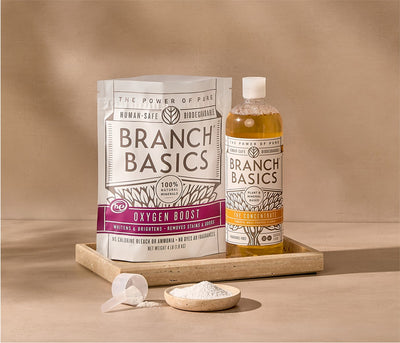
Today, we’re focusing on Sodium Citrate, a mineral salt used in Branch Basics Concentrate and Dishwasher Tablets to cut grease, boost cleaning performance, and soften water.
Key Takeaways
- Sodium Citrate is a natural substance found in citrus, molasses, and corn
- In cleaning products, it’s used as a pH regulator, chelator (prevents mineral buildup), natural preservative, water softener, and mild alkali
- We use it in Branch Basics Concentrate and Dishwasher Tablets to replace harsh preservatives and acidifiers, caustic water, and softeners
Sodium Citrate is a sodium salt of citric acid, a natural compound found in citrus fruits, corn, or molasses.
It’s widely used as a cleaning agent, water softener, pH regulator, preservative, and descaling agent in foods, drinks, skin care, oral care, baby care, haircare, cosmetics, medical products,
Add a table of contents with jump links to the sections below.
H2: What is Sodium Citrate?
Sodium Citrate is a sodium salt of citric acid, a natural compound found in citrus fruits, corn, or molasses.
It’s widely used as a cleaning agent, water softener, pH regulator, preservative, and descaling agent in foods, drinks, skin care, oral care, baby care, haircare, cosmetics, medical products, and cleaning products.
In cleaning products, specifically, it’s used as a descaler, chelator, and mild alkali, which breaks down grease, dirt, and grime by preventing ions from clinging to surfaces.
Baking soda, aka sodium bicarbonate, is another example of a mild alkali.
Why Does Branch Basics Use Sodium Citrate?
We chose Sodium Citrate for Branch Basics Concentrate and Dishwasher Tablets for similar reasons:
In Branch Basics Concentrate, it’s used to:
- Help break up and dissolve grease, dirt, and grime
- As a water softener and laundry sequestrant in our Laundry dilution
- A laundry sequesterant is an ingredient that helps bind to metal ions in water, increasing cleaning power
- A laundry sequesterant is an ingredient that helps bind to metal ions in water, increasing cleaning power
- Acts as a natural preservative
In Dishwasher Tablets, it
- Dissolves stuck-on food and grease
Acts as a water softener
Acts as a natural preservative
We also chose it because it’s a natural, human-safe ingredient that’s biodegradable, non-irritating when used as directed, and is rated “1” on EWG SkinDeep, the best possible ingredient score.[1][2]
How Does Sodium Citrate Work in Branch Basics?
As mentioned previously, Sodium Citrate works as a grease, dirt, and grime buster, water softener, and natural preservative.
Is Sodium Citrate Safe?
Sodium Citrate is considered a safe ingredient when used as directed.
It’s also Generally Recognized As Safe (GRAS) by the FDA*, deemed safe for use in cosmetics by The Cosmetics Ingredient Review (an independent group that evaluates the cosmetic product and ingredient safety), and is approved for MadeSafe Certified products (like Branch Basics). [1-5]
As noted in previous articles, not all GRAS ingredients are truly safe, so always do your own research.
What Harmful Ingredients Does Sodium Citrate Replace?
Our company promises that every ingredient in our formulas meets the strictest standards for human and environmental safety.
Sodium citrate was a no-brainer for us, because it replaces so many toxic and potentially toxic ingredients, including:
-
Phosphates, like Sodium tripolyphosphate (STTP): These act as water softeners, mineral removers, and degreasers, but can irritate the skin and lungs and are linked to endocrine disruption, kidney issues, thyroid dysfunction, cardiovascular problems, premature aging, and more. They are also highly toxic to aquatic systems and life.[6-9]
-
EDTAs (disodium EDTA, tetrasodium EDTA): These are used to bind to metals and stabilize products, and are a persistent environmental pollutant linked to ill health effects, such as enhancing the toxicity of heavy metals, like cadmium.[10]
-
NTA (nitrilotriacetic acid): A chelator reasonably considered a human carcinogen (cancer-causing) with known adverse effects on kidney and urinary system function.[12-14]
-
Caustic alkalis: Like sodium metasilicate and sodium carbonate (washing soda), which can cause severe skin and eye burns and irritate or damage the respiratory tract.[12][15]
-
Harsh acids: Such as phosphoric acid and sulfamic acid, which are highly corrosive and can cause severe irritation of the skin, eyes, and respiratory tract. They are also an environmental threat.[16][17]
- Toxic preservatives: Although not a full-spectrum preservative, Sodium Citrate’s pH buffering and chelating properties can help replace endocrine-disrupting parabens, STTP, EDTA, formaldehyde donors (DMDM Hydantoin), isothiazolinones, phenoxyethanol, and others.
Click the links above to learn more about these ingredients.
What’s Marilee’s Take?
Branch Basics co-founder, Marilee Nelson, weighs in on the decision to use Sodium Citrate:
“We chose Sodium Citrate because it was one of the safest, food-based, biodegradable chelator, degreaser, and natural preservative boosters we could find that met our human-safe and environmentally-friendly standards.
“In the Concentrate, it provides extra cleaning power both on surfaces and for our Laundry dilution, while helping make our product self-preserving. It is also essential in our plastic-free Dishwasher Tablets to enable them to power through stuck-on food and grease without harsh phosphates or alkalis, or leaving any harmful residue.
Regarding preservative selection, Marilee recounted her experience years ago bringing home a popular eco-friendly, green cleaning product.
“I thought this was a safe brand and product, so I was shocked that after I brought it into the house, my son had a level 10 meltdown. He quickly developed a migraine headache, sensitivity to light and sound, and swollen lymph nodes in the neck!
"I took the product out of the house, and the reaction started to subside. I researched the ingredients and discovered it contained isothiazolinones as a preservative. The isothiazolinone family of chemicals are potent skin sensitizers and neurotoxins that many non-toxic and “green” detergents use today. That was the moment I realized that “Non-Toxic” on a label was not enough. My deep dive into ingredient safety had begun!
“Even though our Concentrate and Dishwasher Tablets required many iterations, it was worth it to keep ingredients like that out.”
Sodium Citrate FAQs
Now that you know the basics of what Sodium Citrate is and why we use it, let’s dig a little deeper and answer some FAQs.
Is Sodium Citrate Harmful?
No. When used as directed, Sodium Citrate is a non-irritant, approved for use in food products, and considered a human-safe ingredient.
Branch Basics determines ingredient safety based on Marilee’s research during her son’s recovery and over thirty years of client experiences. Sodium citrate was never red flagged in a product.
In our Toss the Toxins Course we recommend that the ingredients in products kept in the home be rated a 1-2 on EWG Skin Deep. Sodium Citrate is rated a 1 on EWG Skin Deep.[2]
Is Sodium Citrate Natural?
Yes, Sodium Citrate is a mineral salt from citric acid, a natural compound found in citrus fruits, corn, or molasses.
Citric acid is the reason lemon juice works so well on grease, grime, and stains. It’s a natural cleanser, degreaser, and pH regulator.
What Is Sodium Citrate Used For?
Sodium citrate is used as a pH buffer, mild alkali, degreaser, detergent booster, chelator, and natural preservative.
Is Sodium Citrate The Same As Salt?
No. Although they sound the same, they are different substances. Table salt is sodium chloride or NaCl; Sodium Citrate’s formula is Na3C6H6O7.
References:
- https://pubmed.ncbi.nlm.nih.gov/24861367/
- https://www.ewg.org/skindeep/ingredients/706027-SODIUM_CITRATE/
-
https://www.ecfr.gov/current/title-21/chapter-I/subchapter-B/part-184/subpart-B/section-184.1751
-
https://www.cir-safety.org
-
https://madesafe.org/
-
https://www.ncbi.nlm.nih.gov/pmc/articles/PMC3120105/
-
https://www.sciencedirect.com/science/article/pii/S0085253816301375
-
https://www.ewg.org/cleaners/substances/5653-SODIUMPHOSPHATE/
-
https://health.clevelandclinic.org/household-cleaning-products-can-be-dangerous-to-kids-heres-how-to-use-them-safely
-
https://www.nature.com/articles/239231b0
-
https://journals.sagepub.com/doi/pdf/10.1191/0960327102ht273oa
-
https://www.ncbi.nlm.nih.gov/books/NBK590775/
-
https://www.epa.gov/sites/default/files/2015-06/documents/ny_hh_732_w_09011991.pdf
-
https://pubmed.ncbi.nlm.nih.gov/15981734/
-
https://pubchem.ncbi.nlm.nih.gov/compound/Sodium-carbonate
-
https://www.sciencedirect.com/science/article/abs/pii/S1074909803001618
- https://www.sciencedirect.com/science/chapter/edited-volume/abs/pii/B9780323952354000827


