

Cleaning Products Without Triclosan: Why We Avoid It in Branch Basics

As you may know, triclosan is a strong antibacterial chemical that was once widely used in hand sanitizers, antibacterial cleaners, oral care products, and skincare products.
Thankfully, in 2016, the FDA banned its use in hand sanitizers and soaps, due to mounting evidence of its environmental and human health hazards, including hormonal, microbiome, and thyroid disruption.
Unfortunately, it hasn’t been banned across all product categories. Although most companies have voluntarily removed triclosan, it can still be found lurking in some antibacterial detergents and personal care products.
Today, we’ll explore where you’ll find triclosan, how to avoid it, and why we’ve never used it in Branch Basics.
Key Takeaways
- Triclosan is still used as an antibacterial chemical in some antibacterial detergent-based cleaning products.
- We, along with public health officials, recommend avoiding triclosan due to its proven negative effects on the endocrine (hormonal) system, liver, microbiome, thyroid, reproductive system, and the environment, as a bioaccumulative toxin.
- The best human-safe alternatives to triclosan include plant- and mineral-based cleaners that remove germs, rather than killing them.
Why Is Triclosan Still Included In Some Cleaning Products?
As mentioned previously, most household cleaning brands have voluntarily removed triclosan from their products due to public pressure.
Although we applaud this, we also know that most commercial cleaning and personal care brands simply replaced it with other harmful antibacterial chemicals, such as Quats, bleach, ammonia, alcohols, and other harsh antimicrobial surfactants.
Despite its widespread removal, some brands still use triclosan in their products. Particularly, detergent-based products, such as antibacterial dish soaps and foaming cleaners.
Triclosan is also still used (and not banned) in personal care products, such as antibacterial body washes, shaving creams, deodorants, cosmetics, acne products, and moisturizers.[1]
Unfortunately, cleaning companies are not required to list all their ingredients on labels, leaving consumers guessing about which antibacterial cleaners are truly safe.
Our advice is to skip the harsh, synthetic antibacterial cleaners and instead, use products that remove germs, such as natural soap or a plant- and mineral-based surfactant cleaner like Branch Basics.
According to the FDA and other health officials, plain soap and water are recommended for safely removing germs, not antibacterial products.[2]
Then, if disinfecting is required, follow up with 3% hydrogen peroxide, natural steam, or a safer natural antimicrobial product.
Learn more in: 8 Best Natural Disinfectants For Home Use
Why Branch Basics Doesn’t Use Triclosan
At Branch Basics, our commitment has always been to create the safest, plant- and mineral-based cleaning products suitable for even the most sensitive individuals.
We call this our Human Safe Brand Promise, and it applies to our entire line.
Like other harsh chemicals, triclosan does not fit our human-safe criterion, and is therefore not used (and never has been used) in Branch Basics products.
It’s now well-known that disinfectants and antibacterial cleaners, including triclosan, are linked to various ill health effects, including:[3-6]
- Microbiome disruption
- Cardiovascular damager
- Fertility issues
- Cancer
- Endocrine (hormone) disruption
- Reproductive issues
- Developmental defects
- Organ damage
- Respiratory issues, including asthma
- Obesity
- Metabolic dysfunction
- Thyroid disruption
- And various environmental issues, including bioaccumulation, toxicity to aquatic and wildlife
Why risk it when you can use something safer that still gets the job done?
Branch Basics is not antibacterial or a disinfectant. Rather, it works like natural soap (only gentler) to break down the lipid layer of germs, trapping and lifting them, along with dirt and grime, so that they can be removed from surfaces, floors, fabrics, stainless steel, mirrors, toilets, and more.
This is the safest way to clean because it removes germs without exposing you, your family, your pets, or the environment to the harms of harsh chemicals, like triclosan, bleach, quats, ammonia, or formaldehyde.
Related reading: Triclosan Alternative: Natural Swaps
Our Favorite Triclosan-Free Cleaning Products
The best triclosan-free cleaning products for your home and body remove germs while protecting surfaces and your skin.
Here are some of our favorites for cleaning and handwashing.
1. Branch Basics Gel Hand Soap
If you want a luxurious hand soap that’s concentrated yet ultra-gentle, Branch Basics Gel Hand Soap will be your new go-to.
This ultra-gentle, hydrating hand soap is free of synthetic antibacterial chemicals, making it safe for the whole family.
The star ingredients in our Gel Hand Soap include:
-
Aloe Vera: Acts as a natural humectant (moisture magnet) and anti-inflammatory, keeping skin soft and supple while boosting hydration and calming irritation.
-
Decyl glucoside: This natural, plant-based surfactant from coconuts or non-GMO corn is commonly used in natural baby products for its ultra-gentle, non-irritating cleansing properties.
-
Meadowfoam Oil: This plant-based oil seals in moisture, keeping skin soft, protected, and hydrated.
- Organic Chamomile: Nature’s ultimate cleanser, calmer, and protector, chamomile gently cleanses without stripping your hands while its natural antioxidants protect the skin barrier.
Just a dime-sized amount is all you need to thoroughly clean your hands and wash away bacteria, germs, and dirt.
2. Branch Basics Foaming Wash
Our original hand soap, which also works as a body wash, shampoo, pet wash, baby wash, dish soap, and make-up remover, is a perfect way to remove germs.
And since it's made with Branch Basics Concentrate + Water, it’s super convenient and economical.
Simply mix the recommended amount of Branch Basics Concentrate from your Starter Kit into the refillable plastic or glass bottle, add the recommended amount of water, shake, and you’re ready to wash and/or clean.
Foaming wash is one of the five core human-safe triclosan-free cleaners you can make using Branch Basics Concentrate plus water using Branch Basics Starter Kits.
Learn more in: How To Use Branch Basics Foaming Wash: Complete Guide
3. Branch Basics Starter Kits
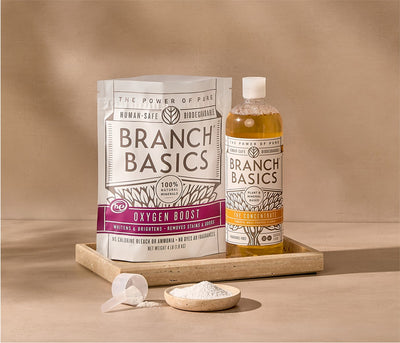
Branch Basics all-in-one Starter Kits are made using Branch Basics' signature Concentrate, a triclosan-free, plant- and mineral-based cleaning concentrate, plus water.
Our Concentrate is made with only the safest ingredients and zero harmful synthetic chemicals.
Here’s a peek at our formula:
-
Purified Water: Reverse Osmosis
-
Decyl Glucoside: A naturally-derived, ultra-gentle, non-irritating surfactant cleanser derived from coconut and/or corn.
-
Chamomile Flower Extract: Our star ingredient! This organic flower extract has Allergen (IFRA) Certifications, confirming it is nonallergenic and not a fragrance. It’s also anti-irritant, anti-septic, anti-bacterial, anti-fungal, and anti-inflammatory, and helps power our self-preserving formula.
-
Coco Glucoside: Another naturally derived surfactant from coconuts, coco glucoside is one of the most gentle cleansing agents available. It works with decyl glucoside to enhance foaming and cleaning power.
-
Sodium Citrate: A plant-derived, food-grade, biodegradable sodium salt that acts as a water softener and natural preservative.
-
Sodium Bicarbonate: Also known as baking soda, this is a mineral-based water softener.
- Sodium Phytate: Phytic acid is a natural plant chelator found in plant seeds and is also used as a natural antioxidant preservative.
Our Concentrate is designed to be diluted with water to make All-Purpose, Bathroom, Foaming Wash, Streak-Free, Laundry, and custom dilutions for floors, cars, and more.
To learn more, check out: How To Use The Branch Basics Starter Kit.
Shop Branch Basics Starter Kits.
4. Branch Basics Dishwasher Tablets & All-Purpose
Some synthetic antibacterial dish detergents still contain triclosan, along with some of the most harmful, caustic chemicals in the cleaning industry.
Protect yourself by using an effective human-safe dishwashing detergent, like Branch Basics Dishwasher Tablets and Branch Basics All-Purpose dilution for handwashing dishes.
Our Dishwasher Tablets are 100% plastic-free, enzyme-powered, and free of triclosan and other harmful detergent chemicals, such as sulfates, chlorine, and fragrance.
All-Purpose, or Bathroom dilution for tough jobs, works amazingly for handwashing dishes. Either spray directly onto dishes or add a few sprays to a sinkful of water for loads of powerful lather.
Learn more in: Human-Safe Dishwashing: How to Hand Wash, Soak, and Load Without Harmful Chemicals
5. DIY Castile Soap
100% pure castile soap is another excellent DIY alternative to conventional hand soaps, sanitizers, and cleaning products.
Like Branch Basics, it works by breaking down the lipid layer of germs, allowing for their speedy and effective removal from hands, body, and surfaces.
The great thing about liquid castile soap is its versatility—you can use it for everything from hand washing and shampooing to DIY cleaning products and dishwashing.
The only thing to watch out for is castile soap brands that also include synthetic ingredients, such as fragrance.
Pure castile soap has a simple ingredient list that typically includes:
-
Vegetable oils: For moisture, viscosity, and texture.
-
Alkali (like Sodium hydroxide): Creates the foamy, natural surfactant properties of soap, and is not found in the end-product.
-
Water: Necessary for liquid versions.
-
Essential oils: For a natural scent.
- Note: We recommend choosing unscented liquid castile soap, like Dr. Bronner’s Baby, as it’s impossible to know the quality of the essential oils used across brands. If you really want a scent, check with the manufacturer about where they source their essential oils to ensure they’re using 100% pure essential oils that are preferably organic and/or wildcrafted and steam-distilled
One final note, liquid castile soap can leave a cloudy film on surfaces. Branch Basics does not leave a film.
What’s Marilee’s Take On Triclosan?
Our co-founder, Marilee Nelson, is the ultimate stickler for clean ingredients.
A 40+ year pioneer in helping thousands of clients recover from chemical injuries, toxicity, and chronic illness by identifying harmful chemicals in their homes, Nelson shares her thoughts on triclosan.
“In my practice, I spent decades witnessing the dramatic changes in my clients’ health from removing harmful chemicals, like triclosan, from their homes.
“Triclosan stands out because it was once so ubiquitous in cleaning products and skincare products, and people thought they needed it to be safe and healthy. At the turn of the century, for example, when we didn’t know as much about superbugs and the microbiome, it was unthinkable for most people not to have antibacterial hand soap in their kitchen and bathrooms.
“So it took a lot of education and really personal experience with the results, to help people change their minds about antibacterial products. But once they would notice the difference in their health after a few weeks without it, they never went back.”
Nelson also noted how vindicating and rewarding it was to have witnessed the popularity of triclosan and, finally, its demise as word of its harms spread.
“We knew for years this stuff was very harmful, and we even had the data! But it was so well marketed, and it was harder to share that data back then without the internet. So it took time for people to understand why they shouldn’t use it. But thankfully, the truth always comes out.”
Triclosan FAQs
By now, you should be feeling pretty confident about why and how to avoid triclosan in cleaning products.
Want to go deeper? Let’s answer some FAQs.
Why Is Triclosan Used As A Cleaning Agent?
Triclosan became popular in cleaning and personal care products due to its antibacterial properties.
What Are The Potential Side Effects Of Triclosan?
Research suggests triclosan can disrupt endocrine/hormonal function and microbiome function, leading to a variety of illnesses.
See the previous section on Why Branch Basics Doesn’t Use Triclosan for a list of potential side effects.
Is Triclosan Safe For Pregnancy?
No. Although many women used triclosan-based products during pregnancy for years, we do not recommend triclosan due to its proven effects on the hormonal, thyroid, and reproductive systems.[7]
The same goes for other harsh disinfectants, which the CDC recognizes are linked to fertility issues and pregnancy complications, including preterm birth.[8]
Looking for a safe way to disinfect while pregnant and around babies? See 8 Best Natural Disinfectants For Home Use.
For pregnancy-safe skin and personal care products, see: Pregnancy Safe Skin Care: Products To Use And Avoid.
What Toothpaste Is Free Of Triclosan?
Oh, great question, as many oral care products, including toothpastes, still contain triclosan!
Some of our recommendations for triclosan-free, SLS-free, fluoride-free toothpastes include:
-
Boka
-
Brittanie’s Thyme Teeth Whitening Powder
-
Earthpowder
-
Himalaya Botanique - Whitening Complete Care Toothpaste
- Lily & Lush
See Triclosan Alternative: Natural Swaps for more recommendations on triclosan-free personal care products.
References:
-
https://www.epa.gov/ingredients-used-pesticide-products/triclosan
-
https://www.fda.gov/consumers/consumer-updates/skip-antibacterial-soap-use-plain-soap-and-water?receiptful=64cc3df06b92e4003e88467d&receiptfultype=newsletter
- https://www.ewg.org/skindeep/ingredients/706622-TRICLOCARBAN/
-
https://pmc.ncbi.nlm.nih.gov/articles/PMC9570035/#sec7-ijms-23-11427
-
https://www.cdc.gov/niosh/reproductive-health/prevention/disinfectants.html
-
https://www.sciencedirect.com/science/article/pii/S004896972301687X
-
https://www.cdc.gov/niosh/reproductive-health/prevention/disinfectants.html

Marilee Nelson
Marilee Nelson is an Environmental Toxins expert who has spent nearly 30 years advocating for the chemically-sensitive and chronically-ill. She is a Board Certified Nutritionist, Certified Bau-Biologist and Bau-Biology Inspector and specializes in Food As Medicine. She has helped thousands of families and individuals identify, heal and recover from toxic exposures and is on a mission to revolutionize the way American families view their health.