

Our Guide to Natural, Non-Toxic Bedding (Best Organic Sheets & Linens)

Even though we’ll spend at least one-third of our lives in bed, few of us think much about the safety and purity of our bedding. While news has gotten out about the deplorable amount of harmful chemicals allowed in mattresses, there’s still not much awareness about toxins hidden in bed linens. You read right; sheets, quilts, duvets, feather beds, pillows, mattress covers and more all have the potential to contain harmful chemicals (like formaldehyde) that disrupt your health while you sleep! At Branch Basics, we believe creating a healthier home starts with removing harmful chemicals and replacing them with safer alternatives.
While this may be disheartening to hear, the good news is it only takes a little knowledge and shopper-savvy to learn how to spot toxic bedding.
Key Takeaways
-
Non-toxic bedding made from natural fibers like organic cotton, linen, silk, and wool helps reduce exposure to harmful chemicals while you sleep.
-
Many conventional sheets are treated with chemicals such as formaldehyde or wrinkle-resistant finishes, which may irritate the skin and disrupt sleep.
-
Choosing organic or chemical-free bedding creates a healthier sleep environment, especially for babies, children, and people with sensitivities.
Why Non-Toxic Bedding Matters
When it comes to improving our health, sleep quality plays a crucial role.
Sleep is when the body performs many of its most important restorative processes, including detoxification, tissue repair, and immune system support.
However, the materials we sleep on can impact how well those processes work.
Research shows that the skin can absorb substances it comes into contact with, meaning that chemically treated bedding may expose the body to toxins night after night.
Combine this with synthetic fragrances from laundry detergents and cleaning products, and your sleep environment may be less supportive than you think.
Why Worry about Bed Linens?
With everything we have to think about when it comes to health, bed linens may seem like a low-priority.
However, creating a safe haven during sleep is crucial, as this is when our bodies heal and rejuvenate. Now, imagine you’re doing everything you can to get more sleep, maybe you even invested in a non-toxic mattress, but you’re still having trouble sleeping and/or waking up feeling weak or like you need more sleep.
This could be a symptom of a body stuck in detoxification-mode when it’s supposed to be healing. How does this happen? Science has proven that our skin absorbs the toxins it comes into contact at an average rate of 64% absorption.
Thus, when your skin is covered in chemically-treated sheets while you sleep, your body is forced to process those toxins night after night. Add in the chemicals or fragrances you’re also breathing in from laundry detergents, etc., and it explains why so many of us wake up feeling exhausted despite our best efforts to eat well, exercise, etc.
So yes, if you’re waking up feeling less than energetic, then your bed linens are definitely worth a second-look!

How to Choose the Safest, Natural Bedding
Choose only 100% natural fibers to sleep in, including: cotton, linen, silk and wool. These allow your skin to breathe while naturally wicking moisture away from your body.
Avoid synthetic fibers, like satin sheets for example, which may feel good to the touch but are treated with chemicals and do not allow your skin to breathe. They also create static electricity that affects the electro-climate of your bedroom.
Avoid mixed/blended fibers. These might look and feel like cotton or silk, but often they’re mixed with synthetic fibers to improve the texture and reduce costs for the manufacturer.
Avoid all chemically-treated sheets which bear the names:
- Anti-static
- Easy-care, wrinkle-free, or shrinkage-free—these garments release toxic formaldehyde. Formaldehyde is a “complete carcinogen”, meaning it affects tumor cells at all stages of development, and has been linked to an increased risk of cancer of the nose and accessory sinuses, nasopharyngeal and oropharyngeal cancer, and lung cancer in humans. It also causes contact dermatitis which may present in either subtle or extreme skin flare ups.

Our Favorite Natural Bedding Brands
Just like with food, organics are your best bet for non-toxic bed linens; and they’re a lot more affordable than they used to be.
For example, you can get a beautiful set of organic cotton, 300-thread-count, twin-size sheets at Target for under $30.00!
Here are some of our favorite brands for every budget:
- SOL Organics—sheets from $99.00
- The Company Store—bedding from $25.00
- Coyuchi—sheets, bedding and duvets from $48.00
- Piglet in Bed - we love their Linen bundler
- Gray Heron— we love supporting small businesses and Sarah's organic muslin quilts and throws make sleeping luxurious.
- Life Giving Linen - exquisite linen products to be passed down
- Bed Bath and Beyond—organic cotton sheets from $49.00
- Lifekind—sheets from $82.50 plus a variety of non-toxic linens like rubber pillows, mattress pads, towels, etc.
- Savvy Rest—organic cotton blankets, duvet covers, sheets, etc.
- Pact—organic tee sheets (and more) from $90.00
- Target — organic cotton ssheets from $26.59
- Hearth and Hand with Magnolia—from Target, sheets from $27.99
For the best quality sleep, we highly recommend sleeping in 100% natural and organic materials. This is especially important for anyone with existing health challenges, sleeping disorders, pregnant mothers, babies, and children.
Plus, when you choose natural and organic bedding you’re also making a safer choice for the environment...a win-win for everyone’s health!
Create Healthier Homes
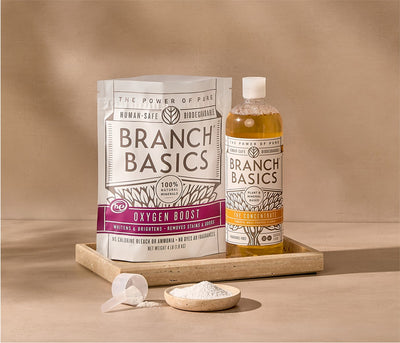
Choosing natural, non-toxic bedding is more than just a lifestyle choice—it's a crucial step in protecting your health and well-being. By being mindful of the materials we sleep on, we can create a healing sanctuary that supports our body's natural recovery processes. Create healthier homes by using human-safe cleaning products, such as the Branch Basics Starter Kits. Try it out today!
FAQs
Is organic bedding worth it?
Yes. Organic bedding is made without harmful pesticides or chemical treatments, making it a safer choice for your health and the environment.
Why are wrinkle-free sheets harmful?
Wrinkle-resistant sheets are often treated with formaldehyde-based finishes, which can release chemical vapors and cause skin irritation or respiratory issues.
What is the safest bedding material?
The safest bedding materials are generally organic cotton, linen, silk, and wool, as they are breathable and less likely to contain chemical treatments.
Sources
- https://www.ncbi.nlm.nih.gov/pubmed/21056174
- https://ajph.aphapublications.org/doi/abs/10.2105/AJPH.74.5.479
- https://www.gao.gov/new.items/d10875.pdf
- https://www.sciencedirect.com/topics/pharmacology-toxicology-and-pharmaceutical-science/carcinogen
- https://www.osha.gov/laws-regs/regulations/standardnumber/1910/1910.1048AppC
Categories
Marilee Nelson
Marilee Nelson is an Environmental Toxins expert who has spent nearly 30 years advocating for the chemically-sensitive and chronically-ill. She is a Board Certified Nutritionist, Certified Bau-Biologist and Bau-Biology Inspector and specializes in Food As Medicine. She has helped thousands of families and individuals identify, heal and recover from toxic exposures and is on a mission to revolutionize the way American families view their health.