



Why We Don't Put Dyes In Our Cleaning Products

When choosing human-safe cleaning products, what's left out matters as much as what's included. At Branch Basics, we intentionally leave harsh chemicals and additives out of our formulas, including dyes and artificial colorants.
Let’s explore what dyes and colorants do in cleaning products—and why it’s best to avoid them.
Key Takeaways
-
Artificial dyes are added to most conventional cleaners even though they don’t provide a functional benefit.
-
At Branch Basics, we purposely exclude dyes and colorants because they pose risks to human health without doing anything to increase efficacy.
-
All of our products are 100% dye free and formulated without harmful chemicals, fragrance, or hormone disruptors.
What Are Synthetic Dyes?
Synthetic dyes are man-made chemicals made from either petroleum or coal tar derivatives. They contain compounds such as auxochromes which help the dye bond to surfaces—think of that neon-green dish soap that stays bright in the bottle for as long as you have it.
Companies add these dyes to their products to impart color, but they have no actual bearing on the efficacy of the product.
Wait…If They Don’t Serve a Function, Why Are Dyes Used in Cleaning Products?
Unfortunately, the reason for adding dyes to a product has nothing to do with making it more powerful (or safe) for use, and everything to do with consumer psychology.
We’ve been conditioned through decades of advertising to believe that a vivid color implies something is powerful or effective. It can also help a product maintain its look on a shelf. Whereas natural, plant- and mineral-based ingredients will experience some color variation from bottle to bottle, products with artificial dyes will maintain a consistent look and appearance, something that can help sell a product.
Companies will also add artificial colors or dyes to a product to make it match the scent profile they’ve created, which opens up another can of worms: synthetic fragrance.
We’ve written at length about the health impacts of added fragrance, from respiratory issues to hormone disruption. Since added fragrance and dyes often go hand in hand, consider this a simple way to weed out products that may be undermining your health: avoid both!
Why Branch Basics Doesn’t Use Dyes
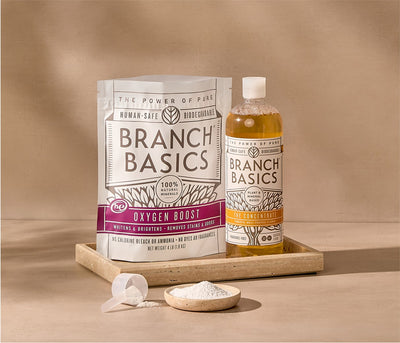
Our first priority for our products is human safety. That’s why we focus on plant- and mineral-based ingredients. The color of our Concentrate comes strictly from natural plant and mineral components, like organic chamomile flower extract. And because natural ingredients change in color depending on the crop, the liquid may have some slight variation in color from pale yellow to deep amber, without any artificial dyes.
Synthetic dyes also pose risks to human health and the environment. Here are just a few of the researched dangers of synthetic dyes:
-
Skin irritation: Synthetic dyes in cleaning products can aggravate skin sensitivities such as rashes and eczema, or cause new issues like contact dermatitis.
-
Respiratory issues: Airborne particles and VOCs from certain dyes can irritate airways and exacerbate conditions like asthma, especially in groups like children or the elderly.
-
Endocrine disruption: Some petroleum-based dyes break down into potentially carcinogenic compounds that pose health risks such as endocrine disruption and organ stress.
-
Environmental impact: Synthetic dyes don’t break down easily, making them less-than-ideal for the planet and for your home. Some dyes may also be toxic to aquatic life, posing long-term risks to fish and other wildlife.
Thankfully, maintaining a clean home does not require the use of synthetic dyes or chemicals!
Where to Look for Hidden Dyes in Cleaning Products
If a product you’re using is a bright, intense color, it’s probably a safe bet to assume it is made with synthetic dyes or colorants. Sometimes, however, cleaning bottles are not transparent, and you may not know until you use them. Here’s a quick primer on common places synthetic dyes may be hiding in the world of conventional cleaning products.
-
Dishwasher Pods or Liquids: Many dishwasher pods contain synthetic dyes. They’re often dyed vivid green or blue to imply that they’re particularly effective—when instead they leave behind chemical residue.
-
Laundry Detergent: Some detergents are colored blue to signify stain-fighting power.
-
Toilet bowl cleaners: These are often dyed blue or green to make water appear more sanitized.
-
All-Purpose cleanersL Some multi-use surface sprays are dyed to match the scent profile of a synthetic fragrance that’s included.
Reading the labels on your cleaning products is the first step to noticing the ingredients you’re bringing into your home. Many products list dyes with names like FD&C Blue No 1, or D&C Yellow No 5.
Natural alternatives to synthetic dyes
Here’s the good news: you don’t need synthetic dyes to clean effectively, and now that you know how to avoid them, you can shop for natural alternatives instead. Look for products that are made without added dyes or colorants, fragrance, or other harmful chemicals.
From our laundry detergent and dishwasher tablets to our surface cleaners, Branch Basics makes plant- and mineral-based formulas that are free of dyes, fragrance, or other harmful chemicals.
Dyes FAQs
Where can I get dye-free cleaning products?
Branch Basics offers dye-free cleaning products made without harmful chemicals. Our plant- and mineral-based formulas prioritize human health—so you can achieve an effective clean without compromising your standards.
Shop our products right here, or find us at Target or on Amazon.
Are artificial dyes in cleaning products bad for you?
Artificial dyes have been shown to pose risks to human health, from skin and respiratory irritation, to endocrine disruption. These risks may be amplified for particularly sensitive groups like small children, the elderly, or anyone dealing with a chronic illness or sensitivity.
Can laundry detergent dyes cause skin irritation or eczema flare-ups?
Yes! Unfortunately, synthetic chemicals and dyes in laundry products are a major source of skin irritation—and one that can go unnoticed if you don’t know what to look for. Whether you’re dealing with an eczema flare-up or another skin sensitivity, choosing a laundry detergent that’s made without synthetic dyes or fragrances is a smart step.
How can I tell if a cleaning product contains dyes?
If a cleaning product has a vivid color such as bright green or blue, there’s a high chance it contains artificial dyes. However, the best thing you can do is learn to become your own label detective. Check the labels on every product you bring into your home. The biggest red flags for dyes are the obvious ones: words like FD&C Blue No 1, or D&C Yellow No 5.
Since dyes are just one of many potentially harmful chemicals you want to avoid, we recommend checking things against EWG and Made Safe standards—both of which Branch Basics has earned certifications from.
Our Promise: No Artificial Dyes, No Hidden Chemicals
Branch Basics screens against thousands of harmful chemicals, putting human health first and raising the bar for the entire cleaning industry.
All of our products are made without artificial dyes, fragrance, phthalates, or other harmful chemicals because we believe that each ingredient should be safe for human health and serve a legitimate function. Artificial dyes do nothing to increase the efficacy of a cleaning product, and they might end up hurting your health.
Ready to try plant- and mineral-based formulas that get the job done without compromising your health? Get started with one of our kits here!
PS: For more great tips and info, add Branch Basics as a preferred source in Google search results.
Categories

Marilee Nelson
Marilee Nelson is an Environmental Toxins expert who has spent nearly 30 years advocating for the chemically-sensitive and chronically-ill. She is a Board Certified Nutritionist, Certified Bau-Biologist and Bau-Biology Inspector and specializes in Food As Medicine. She has helped thousands of families and individuals identify, heal and recover from toxic exposures and is on a mission to revolutionize the way American families view their health.


