



How to Get Blood Stains Out of Clothes

Whether from an accidental cut, skinned knee, or that pesky monthly visitor, finding a blood stain on your clothing, towels, or linens can be panic-inducing. Blood stains are notoriously harder to remove than other types, but that doesn’t mean you have to reach for harsh chemicals or irritants to get the job done.
Read on to discover how to get blood stains out of clothing the natural way.
Key takeaways
-
The sooner you treat a blood stain, the better. Fresh blood stains may rinse out with just cold water!
-
To treat blood stains, remember that cold water and a little patience are your best friends. Avoid hot water and the dryer until the stain is fully removed.
-
Instead of using bleach and ammonia, you can use human-safe alternatives like Branch Basics All-Purpose Spray plus Oxygen Boost.
-
Treating dried blood stains may require more dwell time and the addition of Oxygen Boost to fully lift the stain.
Why Blood Stains Are Different (And Why Heat Makes Things Worse)
Blood stains have a reputation for being one of the toughest laundry challenges to tackle—and if you've ever accidentally thrown a bloodstained shirt in the laundry on a hot cycle, you know why. But the truth is, blood isn't actually hard to remove. It's just more likely to settle into your fabric or clothing at specific temperatures.
Here’s the science behind what makes blood stains different, and how to make sure you don’t accidentally set a blood stain in fabric.
The chemistry of blood as a protein stain
Blood stains are harder to treat than other stains because they contain sticky proteins like hemoglobin and fibrin that chemically bind and lock into fabric fibers. Other stains that behave similarly are milk stains or egg stains.
Why heat makes things worse…
Hot water can set protein stains since heat causes the proteins to denature. This means their coiled structure unravels and re-tangles into a new, permanent shape. It’s the exact same reaction that turns a clear, liquid egg white into an opaque, solid one when you cook it.
When hot water hits a blood stain, that same cooking reaction happens to the proteins in the blood, and they essentially bond themselves into the fabric fibers.
…but cold water is your BFF
Cold water, on the other hand, prevents the proteins from binding to the fabric by reducing the chemical attraction between the protein molecules and the fabric. Translation? It makes it harder for a stain to sink deeper into your clothes.
What You Need (No Bleach, Ammonia, or Hydrogen Peroxide Required)
To treat blood stains effectively, you don’t need any harsh chemicals—just a few simple products. Here’s what we recommend having on hand:
-
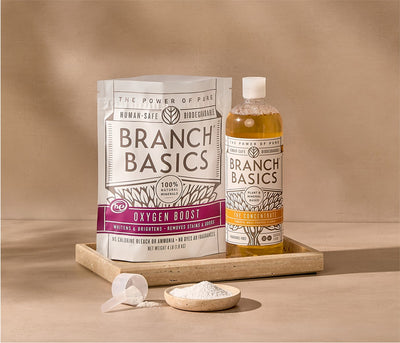
Branch Basics All-Purpose Cleaner: Our multi-tasking cleaning hero, this spray can be used on just about any surface, including fabrics to treat stains.
-
Oxygen Boost: Our natural cleaning powder that gives an extra boost of power for tougher, set-in stains.
-
What's left out and why: There’s no need to use bleach, ammonia, or hydrogen peroxide when treating a blood stain. These ingredients can cause adverse effects to human health and there’s no need to use them when there are human-safe methods that are just as effective.
How to Get Fresh Blood Out of Clothes: Step by Step
Getting a fresh blood stain out of clothing is fairly straightforward. Treating it as soon as you notice it will help ensure you can lift the stain effectively.
1. Lightly blot excess blood with a clean cloth
Do not rub, as this will drive the blood into the fabric.
2. Rinse stain with cold water immediately
Turn the garment inside out and flush it with cold water to drive the stain out rather than pushing it more deeply into the fiber. If you act quickly (within 5-10 minutes) cold water may be all that is needed.
3. Spray with All-Purpose Cleaner
If the stain is still present, spray with Branch Basics All-Purpose Cleaner, covering the stained area completely, and let sit for a few minutes.
4. Avoid agitating or scrubbing the stain
Agitating the stained area can drive a fresh blood stain into the fabric.
5. Rinse with cold water
As soon as the stain has had a chance to absorb the All-Purpose Cleaner, rinse the garment inside out with cold water. If possible, put the stain under the tap and just let the cold water run through it.
6. Double check before drying
If you can still see the stain, do not place the garment in the dryer. The heat from the dryer will make the stain more permanent.
Before you dry it, treat it again and rewash. You may also use Oxygen Boost on white fabrics by first spraying with All-Purpose or Stain Remover, sprinkling some Oxygen Boost on the stain, and wetting the Oxygen Boost with another spray of All-Purpose. Let it sit a few minutes before rinsing with cold water again.
If your garment is colored, we recommend spraying All-Purpose on the stain, adding ½ scoop Oxygen Boost to a bowl of water, adding the garment, gently swishing the water, and soaking for 15-30 minutes to overnight. Rinse with cold water.
Check out How To Remove 7 Of The Toughest Stains Naturally for more ideas.
How to Get Dried or Set-In Blood Out of Clothes
Treating a dried or set-in blood stain requires a little more effort, but it’s not impossible. While the protein in blood quickly binds to fabric fibers, adding Oxygen Boost can help lift stubborn stains out.
To remove older blood stains:
-
Start by scraping any dried blood off the fabric
-
Spray with Branch Basics All-Purpose Cleaner and let sit for 5-10 minutes
-
Soak overnight in a mixture of cold water and ½ scoop Oxygen Boost
-
Agitate the water gently.
-
Repeat if necessary (it may take several attempts)
-
Do not dry until stain has lifted
How to Get Blood Out of Sheets, Mattresses, Carpet, and Upholstery
What do you do if there’s a blood stain on mattresses, carpets, or upholstery—things you can’t pick up and put under running cold water?
Look for care tags on carpet and upholstery before applying cleaning solutions:
-
W: Water-based cleaners are safe. Always avoid overwetting.
-
S: Solvent-based cleaners designed for upholstery
-
W/S: Use water or solvent-based cleaners
-
X: Vacuum only or call a professional
Note: Always spot-test all products to be used in a hidden area, on carpets or upholstery, to ensure compatibility.
-
Act quickly if it is a fresh stain. Use a white cloth dampened with cold water to dab the stain. Continue until the cloth is soiled. (Using too much water can spread the stain)
-
Repeat the blotting process with a fresh cloth until the stain is removed, or no more blood is being removed.
-
Spray the stained area with All-Purpose. Let sit a few minutes.
-
Dab, do not rub, with a white cloth dampened with cold water.
-
Repeat, or add Oxygen Boost to the stain, wet with a spray of All-Purpose Cleaner, let sit a few minutes.
-
Dab again with a white cloth dampened with cold water.
-
Repeat if necessary or try options below.
Do Other Popular Blood Stain Hacks Actually Work? Hydrogen Peroxide, Club Soda, Vinegar, Baking Soda, Toothpaste, Salt, and Dish Soap
There are plenty of different stain removal tips people suggest—but do they really work? Here’s our honest take on some other at-home hacks:
Hydrogen Peroxide: Can be effective on white or light fabrics. It bubbles on contact and helps lift the stain.
Club Soda: May work on fresh stains. The fizzing bubbles help lift the stain
Vinegar: Vinegar can work decently on light, fresh stains, but it’s not reliable on set-in or large stains. It also has some drawbacks, including its smell, acidic nature, and the fact that it can irritate sensitive airways when sprayed.
Baking soda: Mostly a deodorizer and mild abrasive, baking soda on its own isn’t really a stain remover. However, our Oxygen Boost combines baking soda (Sodium Bicarbonate) with Sodium Percarbonate, which gives it the extra boost it needs to lift stains.
Toothpaste: Nope, don’t try this one at home! The abrasives in many conventional toothpaste brands can actually damage fabric fibers without lifting the stain much.
Salt: This is an old-fashioned trick that can help draw out fresh blood when mixed into cold water, but it’s unreliable on anything but light, fresh stains.
How Branch Basics Removes Blood Stains Without Harsh Chemicals
Getting blood out of fabric can seem tricky, but with a few simple tools and a little patience, you can wave goodbye to unsightly stains. Our All-Purpose Cleaner, built around our plant- and mineral-based Concentrate, is effective at cleaning and treating stains without harsh chemicals. For stubborn or set-in stains, adding Oxygen Boost can give you the extra stain-fighting power you need.
Interested in learning more? Try one of our Starter Kits and discover the power of pure for yourself.
Blood Stain Removal FAQs
Can you get dried blood out of clothes?
Yes, you can. While dried blood means the proteins are more solidly attached to the fabric, with a little persistence, it’s possible to remove dried-on blood. See the instructions above for how to get dried or set-in blood out of clothing.
Does cold or hot water remove blood?
Cold water should only be used on blood stains. That’s because hot water will set or spread a protein-based stain further into the fabric.
How long can a blood stain sit before it's permanent?
If a garment has gone through the dryer with a set-on blood stain, it will be virtually impossible to lift it entirely, as the heat has now set the stain into the garment. However, you may be able to lift some of it by using the All-Purpose + Oxygen Boost method for removing dried blood.
Will blood come out after washing and drying?
If you’ve already dried the garment that has the stain, it’s more likely to be set. That’s why it’s important to try and make sure you get the stain out (even if it takes a few cycles of treating or soaking) before throwing it into the dryer.
Can I use Branch Basics on blood without bleach?
Yes! Branch Basics products are plant- and mineral-based, and do not contain bleach, ammonia, or other harsh chemicals.
Does Oxygen Boost damage colors?
Oxygen Boost can be used on colored fabrics. In general, do not let Oxygen Boost sit on top of colored fabrics, but instead make a mixture of cold water and ½ - 1 scoop of Oxygen Boost to soak the fabric in for 15-30 minutes or overnight.
Learn How to Remove Other Stains with Branch Basics
Want more tips on how to remove stains? See our Complete Stain Removal Guide, or check out these specific tips:

Marilee Nelson
Marilee Nelson is an Environmental Toxins expert who has spent nearly 30 years advocating for the chemically-sensitive and chronically-ill. She is a Board Certified Nutritionist, Certified Bau-Biologist and Bau-Biology Inspector and specializes in Food As Medicine. She has helped thousands of families and individuals identify, heal and recover from toxic exposures and is on a mission to revolutionize the way American families view their health.


