



How to Find a Baby-Safe Floor Cleaner

Becoming a parent means looking at everything a little differently—the food your baby eats, the clothes they wear, and yes, the products you use to clean your home. That last one is easy to overlook, but it matters more than you might think.
When it comes to what you clean your floors with, this is especially true. Babies spend a lot of time on the floor; they crawl, they touch, and they put things in their mouths.
Plus, with immune systems that are still developing, babies are extra sensitive to the chemicals they come in contact with. Finding a baby-safe floor cleaner is a crucial step in ensuring you’re creating a healthy home environment for your little one.
But here’s the problem: even careful, label-reading parents can get fooled. Greenwashing is rampant in the cleaning industry, and plenty of products marketed as "natural" or "safe" still contain synthetic fragrances, dyes, hormone disruptors, and other ingredients you'd never knowingly expose your baby to.
We had the same concerns—it’s part of why we started Branch Basics. Below, we'll walk through how to tell whether a floor cleaner is actually safe for your family, and why we built our company around that standard from day one.
Key takeaways
-
For a product to be safe to use around babies, it should meet strict ingredient requirements. It’s not enough for a product to have the word “safe” or “natural” on the label.
-
We’ll walk you through a specific checklist of things to look for on the label if you want to buy a baby-safe floor product—and provide you with the tools you need to become your own product advocate.
-
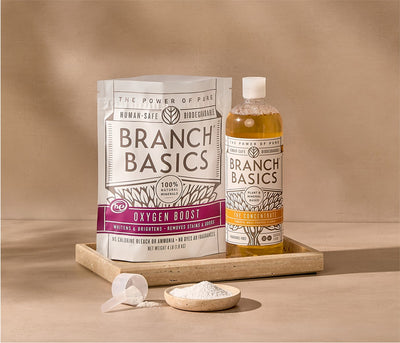
Branch Basics' Concentrate is a human-safe floor cleaner created to use around even the most sensitive groups, including babies, kids, and pets.
How to Evaluate Floor Cleaners For Human Safety
Unfortunately, companies can throw a lot of marketing terms on their labels that don’t mean much. The practice of greenwashing has become more prevalent than ever, which makes it hard as a consumer and a parent to understand what products are truly safe for your family.
As it stands today, the terms “baby-safe” and “natural” are unregulated marketing terms. For a cleaner to truly be safe, it should adhere to strict standards.
Use this checklist to evaluate any product before it touches your floors:
1. Do they list their ingredients?
Cleaning products are not required to list their ingredients—meaning you don't know exactly what's coming into your home. Look for brands that list every ingredient by name.
2. What's actually in the bottle?
In terms of what is listed on the label, there are many chemicals that can be harmful to human health—especially little ones who are constantly crawling on the floor and putting their hands in their mouths. When reading ingredient labels, steer clear of anything containing:
-
Bleach
-
Ammonia
-
Sulfates (SLS or SLA)
-
Phthalates
-
PEG
-
Polyethylene, polyethylene glycol, or polyoxyethylene
-
Oxynol
-
Sodium laureth sulfate
-
Polysorbate
-
Glycerides
-
Polyglycerides
-
Ethoxylated ingredients (contain the toxic byproduct 1,4-Dioxane)
-
Parabens
-
Fragrance, including essential oils*
*Skip anything with the term “fragrance," “parfum," or essential oils on the label. The words fragrance and parfum indicate a proprietary fragrance recipe that may contain from 50 - 300 chemicals chosen from a master palette of over 3,600 ingredients that have never been tested for safety. Essential oils may contain solvents from processing or phthalates from the tubing used to process them, and because they are highly concentrated, they should not be used in a product intended for cleaning floors.
A simple way to be your own product advocate
Our Toss the Toxins course sets a standard of safety for products used in the home based on over thirty years of working with the canaries in the mine (babies, children, and adults with chronic illness), who are warning us that ingredients matter! Reviewing each ingredient in a product is the best way to ensure that the products in your home are safe.
Of course, it's not always easy to do this. Luckily, there's a way to quickly verify ingredient safety. Visit the EWG Skin Deep database and search for the ingredient you want to check. The ingredients are rated 1-10, with 1 being the least toxic and 10 the most toxic. We recommend that products kept in the home have all ingredients rated a 1 or 2.
For more information, see 3 Tools You Need to Become Your Own Product Advocate!
3. How effective is this product?
Not only does your family deserve a floor cleaner that’s free from harmful chemicals, but it also needs to work! A baby-safe formula should still tackle everyday spills, dirt, and grime effectively—without leaving residue. It should also be compatible with your specific floor type, whether hardwood, tile, laminate, or other.
4. Is this versatile and cost-effective?
Multi-purpose cleaners that work on floors and beyond often offer better long-term value than single-use products.
Branch Basics: One Human-Safe Concentrate for Floors and Every Other Surface
The Branch Basics line of cleaners is built around our powerful, plant- and mineral-based Concentrate. Because of our rigorous product standards, it took us many years to perfect this formula to ensure it was both human-safe and effective.
Plus, it’s a powerful multi-tasker that can be used to clean just about anything when diluted with water at different ratios. Let’s break down exactly what makes our Concentrate safe for all humans—including the littlest ones.
-
Certifications: Made Safe® certified and EWG Verified, our formula is gentle enough to clean a baby’s sensitive skin and strong enough to clean an oven and cut grease and grime.
-
Dilution ratios for different cleaning needs: Our Concentrate is diluted with water at different ratios to make our line of surface cleaners, ensuring you always get the right formula for different surfaces and rooms in your house. (We’ll walk you through how to use our Concentrate to clean your floors in the next section.)
-
Plant and mineral-based ingredients: Our Concentrate contains just seven ingredients, and does NOT include any of the harmful chemicals we listed above. Plus all of our ingredients are rated 1 or 2 by EWG Skin Deep. Here’s what’s in the bottle:
-
Purified Water: reverse osmosis purified
-
-
-
Decyl Glucoside: A naturally derived surfactant cleanser derived from coconut and/or corn. It’s often used in skincare products and baby products as well as fruit and veggie sprays, as it will not harm the delicate skin on berries. Learn more about Decyl Glucoside here.
-
Chamomile Flower Extract: An organic flower extract with Allergen Certifications, which certifies it is nonallergenic and is not a fragrance. Its anti-irritant, antiseptic, anti-bacterial, anti-fungal and anti-inflammatory properties to its nourishing and skin-soothing characteristics make it a star ingredient.
-
Coco Glucoside: A naturally-derived surfactant derived from coconut, coco glucoside is one of the most gentle cleansing agents available and is a natural alternative to the harsher cocamidopropyl betaine and sulfates.
-
Sodium Citrate: A plant-derived, biodegradable sodium salt that acts as a water softener. It’s also used as an acidity regulator in food and drinks (think club soda!) and as an emulsifier.
-
Sodium Bicarbonate: A mineral-based water softener, also known as baking soda.
-
Sodium Gluconate: A phosphate-free chelating agent, pH regulator, and stabilizer .
-
How to Mop Your Floors with Branch Basics (By Floor Type)
Before mopping your floors, we recommend HEPA vacuuming or dry microfiber mopping to remove dirt and debris that could scratch your floors when mopping.
Each of these methods use some combination of either our Concentrate or our All-Purpose Cleaner (which is our Concentrate diluted with water). We also suggest Oxygen Boost for stuck-on grime or grout on tiles.
In general, apply cleaning solutions to the mop to avoid potential over-wetting instead of cleaning floors with the mop and bucket approach. The exception would be cleaning floors applied over slab on grade where there is no danger of excess moisture causing mold issues. Hardwood floors are unique—always avoid directly wetting a hardwood floor even over a concrete slab.
Dilutions for floors are not amounts set in stone. Too high a concentration may leave the floor sticky.
Hardwood Floors (Synthetic Wood Finishes Only)
Hardwood floors can be tricky because some cleaners are too strong for their protective finish. But actually, you don’t need much soap to get a hardwood floor clean!
How to:
-
Use a dilution ratio of ⅛-¼ teaspoon of Concentrate per 4 cups of distilled water.
-
Instead of a mop and bucket, spray the soap mixture on a slightly damp microfiber mop or dry unscented Swiffer and mop rather than directly spraying the floor.
Tips:
-
If the floor looks wet (not damp) after cleaning, follow up with a dish towel to dry off any wet spots, as leaving a hardwood floor wet can damage the floor.
-
Always test the diluted soap solution in a hidden area before cleaning the entire floor to make sure it doesn’t affect the finish on the floor.
Note: Branch Basics works well on most urethane / acrylic / polyurethane / UV-cured synthetic floor finishes. But hardwood floors with a natural oil or wax finish should only be cleaned with the manufacturer’s recommended cleaner as Branch Basics is likely to remove natural finishes.
Vinyl & Linoleum
To avoid sticky vinyl or linoleum floors, we also recommend a more diluted version of our soap.
How to:
-
Try a mixture of ½ - 1 teaspoon of the Concentrate per 2 -4 cups of water. If the floor is sticky when dried, dilute more.
-
Instead of a mop and bucket, spray the soap mixture on a slightly damp microfiber mop or dry unscented Swiffer and mop rather than spraying the solution directly on the floor.
-
For tiled linoleum floors, use a soft brush to agitate the grout.
Tips:
-
Be sure to never leave any standing water on a linoleum floor, as it will warp the floor, destroy the glue, and cause it to look dingy, even when clean. When in doubt, buff dry with a clean towel after you’ve finished washing the floor.
LVP
Vinyl plank flooring, also known as luxury vinyl plank flooring, has become a popular flooring option due to its low price-point and durability. Branch Basics works wonders on vinyl plank flooring as a custom spray or for bucket mopping.
How to:
-
Dilute ½ - 1 teaspoon Concentrate to 2-4 cups water or 1 - 2 teaspoons Branch Basics Concentrate to 1 gallon of water.
-
The exact amount will vary based on the finish of your floors. If it feels sticky when dry, use less Concentrate.
-
Add solution to a spray bottle, spray mop, or bucket.
Spray-as-you-go method:
-
With a clean, damp mop, rag, or dish towel, wipe each area as you spray it until you’ve cleaned the entire room.
-
Follow with a dry towel to soak up extra moisture.
Bucket & mop method:
-
Fill a bucket with the diluted mixture above.
-
Wet the mop with the soapy water and wring out well.
-
Mop the floor, then allow it to air-dry.
-
Wipe dry any wet spots.
Tile
Ceramic and porcelain tile floors, as well as natural stone floors, especially applied over a concrete slab, are easy to clean with Branch Basics.
How to:
-
Use a mixture of ¼ - ½teaspoon of the Concentrate per 2 -4 cups of water or 1 - 2 teaspoons Branch Basics Concentrate to 1 gallon of water.
-
If the floor is sticky when dried, dilute more.
-
To clean the grout, spray with All-Purpose and let sit for 5 minutes. Use a soft brush to agitate, then wipe clean.
-
If the grout is particularly grimy, sprinkle Branch Basics Oxygen Boost onto the area and then spray liberally with All-Purpose. Let site a couple of minutes
-
Scrub the grout, rinse, and wipe clean.
Spray Mopping:
-
Spray the soap mixture on a slightly damp microfiber mop or dry unscented Swiffer and mop, or
-
Use a spray mop using ¼-½ teaspoon Concentrate per 2 -4 cups water..
Bucket & mop method:
-
Fill a bucket with the diluted mixture above.
-
Wet the mop with the soapy water and wring out well.
-
Mop the floor, then allow it to air-dry.
-
Wipe dry any wet spots.
Tips:
-
Tile floors often look dirtier than they are because the porous grout easily absorbs stains and grease, and quickly darkens.
Carpet
Many conventional carpet cleaning solutions rely on harmful chemicals to break down dirt, stains, and odors. Thankfully, you can still achieve those results with our plant-and mineral-based products.
How to:
-
If using a carpet cleaning machine, swap out the conventional carpet cleaning soap with Branch Basics Concentrate in dilution of 1-2 teaspoons of Concentrate per gallon of water. (We recommend distilled water).
-
Pour the solution into the carpet cleaner according to the manufacturer’s instructions.
-
Turn the machine on and clean.
-
To remove a stain, spray All-Purpose directly on the spot and allow to sit for 1-5 minutes. Agitate the area with a brush or rag until the stain disappears.
-
Make sure to ventilate and use fans to fully dry the carpet out after cleaning.
Tips:
-
Always test Branch Basics soap in a hidden area first for colorfastness and compatibility.
Other Baby Safe Floor Cleaner Options to Consider
Looking for other baby-safe ways to clean your floors? We’ve got you covered.
Dry Steam Mopping
A Ladybug Dry Steam Cleaner is a wise investment that can clean and sanitize all floor types, including carpets, without harmful chemicals. It is also the ultimate quick and easy grout cleaner! If you have years of ground-in dirt in your white or light grout, using a dry steam cleaner may reveal an entirely new look to your floor. Follow the manufacturer's instructions and always test natural stone and marble floors in an inconspicuous area.
-
The Ladybug qualifies as a disinfection device* for the EPA. It disinfects* virtually any hard surface (through proprietary TANCS® technology) better than the standard that chemical disinfectants must meet to qualify as an EPA registered disinfectant. Unlike chemical disinfectants that require dwell times where surfaces must remain visibly wet for minutes in order to kill germs, the Ladybug kills a very broad range of bacteria and viruses like MRSA, C. diff, norovirus, C. parvo, and COVID-19 in seven seconds or less while leaving no residue behind that promotes new microbial growth. It is also proven by scientific studies to eradicate hard-to-kill biofilms in three seconds. Strong chemical disinfectants such as bleach are no match!
-
* How is mechanical disinfection different from chemical disinfecting? We have known for years that the overuse of chemical sanitizers and disinfectants has created a superbug issue where the germs become resistant both to the cleansers and to antibiotics. Mechanical disinfection with the Ladybug does not create superbugs as there is no chance for a germ to mutate to the point that it can resist the heat.
Note: Due to the extreme heat of the dry steam mop, only use when babies or children are not in the vicinity.
Steam Mopping
A steam mop is another cleaning option that can clean and sanitize nearly any hard floor type with zero harmful chemicals. We like the Hoover brand steam mops for performance and durability. Follow the manufacturer’s instructions, and always use distilled water to extend the life of the mop.
If you purchase a new steam mop, we recommend using the sunning method to speed up the outgassing of VOCs before use.
Generally, steam mopping is appropriate for all types of hard surface flooring, but check with the manufacturer to confirm. We do not recommend steam mopping for carpet because of the drying time required.
Note: Due to the extreme heat of the steam mop, only use when babies or children are not in the vicinity.
Direct the reader to check out more hypoallergenic floor cleaner ideas.
Beyond the Floor: The Other Products a Crawling Baby Contacts Every Day
Finding a baby-safe floor cleaner is important, but floors are just the start when it comes to what a crawling baby will touch on a given day. From toys and stuffed animals to high chairs and baby bottles, you can use Branch Basics to clean virtually any surface or object in your home:
-
Clothes, bedding, and stuffed animals: Looking for a baby-safe laundry detergent? We recommend our liquid Branch Basics’ Laundry Detergent as the mildest, most gentle option that can be used to keep your baby's clothes, bedding and stuffed friends clean and fresh without added fragrance or chemicals.
-
Baby bottles: To clean baby bottles, spray Branch Basics All-Purpose Cleaner directly into the bottle, scrub, rinse well, and sterilize as needed.
-
Highchairs, toys, and other surfaces: Use Branch Basics All-Purpose spray to clean up everyday messes on highchairs, surfaces, and baby toys.
Frequently Asked Questions About Baby Safe Floor Cleaners
Do baby-safe floor cleaners disinfect?
No. Branch Basics is neither a sanitizer nor a disinfectant. Instead it relies on safe surfactants to remove germs instead of using harsh chemicals that kill germs but often leave some left behind.
The exceptions are dry steam cleaners and steam cleaners that use a mechanical action for sanitizing and disinfecting.
Is vinegar safe for hardwood floors?
It’s typically not recommended to use vinegar on waxed hardwood floors because it’s an acid, which means it can break down the finish on your wood over time.
Are essential oils safe for babies?
We recommend going fragrance-free when creating a healthy home, and that includes essential oils. Even the purest, most natural forms have been associated with respiratory issues and certain risks to skin and other developing organs and systems.
Essential oils are very concentrated and powerful and have been used medicinally for centuries. Unfortunately, if processed using solvents or through plastic tubing, harmful chemicals become a part of the ingredient list. In addition, we know certain essential oils are endocrine disruptors and should not be used around children.
After years of working with babies, children, and people with chronic illness, the removal of essential oils has been a game changer in many cases for their health.
A Worry-Free Way to Clean Your Floors with Branch Basics
When it comes to cleaning up after your little one, you shouldn't have to choose between an effective clean and peace of mind. Branch Basics products are formulated to be human-safe, meaning they're gentle enough for the most vulnerable members of your family—babies included.
Made with plant- and mineral-based ingredients like coco glucoside and organic chamomile flower extract—and free from fragrances, sulfates, phthalates, and other harsh chemicals—our formulas let you clean your floors (and everything else) without worrying about what's left behind. So go ahead and let your baby crawl, play, and explore; you deserve a worry-free way to keep your home clean and healthy.
Ready to experience the power of pure? Explore our Starter Kits here.

Marilee Nelson
Marilee Nelson is an Environmental Toxins expert who has spent nearly 30 years advocating for the chemically-sensitive and chronically-ill. She is a Board Certified Nutritionist, Certified Bau-Biologist and Bau-Biology Inspector and specializes in Food As Medicine. She has helped thousands of families and individuals identify, heal and recover from toxic exposures and is on a mission to revolutionize the way American families view their health.


