



3 Homemade Cleaning Solutions For A Healthier Home

Homemade cleaning solutions made from human-safe, natural ingredients are an excellent alternative to harsh chemical cleaners.
They’re also super economical and easy to make with just a few simple ingredients.
We know because homemade cleaners were our go-tos before creating Branch Basics all-in-one human-safe cleaning system!
And we still keep plenty of DIY staples, like vinegar, peroxide, and baking soda, around our homes.
Here, you’ll learn about three of our favorite homemade cleaning solutions, including a basic surface cleaner, glass cleaner, and soft scouring cleaner, all made with safe and natural ingredients.
Key Takeaways
- Homemade cleaning solutions are excellent alternatives to harsh chemical cleaners
- All it takes is just 1-3 ingredients to create a multipurpose cleaner
- Branch Basics is also an excellent semi-DIY, human-safe cleaning option
Why Make A Homemade Cleaning Solution?
There are many reasons to make your own homemade cleaning solutions, including:
- To reduce toxin exposure
- To save money
- To simplify your cleaning routine
- To create a healthier home
- To keep toxic chemicals away from your children, pets, and the chronically ill
- To improve your health
- To create an asthma-safe home
There are also loads of recipes for making various cleaners—some work, some work OK, and some aren’t even worth trying (and we’ve tried a bunch).
It’s also important to note that just because a cleaning solution is homemade doesn’t necessarily make it safe.
If creating a low-tox, human-safe, and natural cleaner is your goal, be sure to avoid harsh chemicals, including:
- Ammonia
- Bleach
- Borax (there are safe ways to use it, but due to concerns about inhaled toxicity, it’s best to leave it out)
- Synthetic fragrances
- Natural fragrances
- Fabric softeners
- Harsh detergents
- Mixing vinegar and peroxide or vinegar and bleach
- Rubbing alcohol
- Essential oils*: we recommend creating a fragrance-free, healthy home in our Toss the Toxins online course.
*Initially, in our Toss the Toxins course, we recommend removing all products with harmful ingredients from the home. This removal includes all products with synthetic fragrance, non-organic essential oils processed with solvents, and, temporarily, even wildcrafted and organic essential oils processed without solvents.
Essential oils are so concentrated that they can cause an inflammatory response and have been shown to hijack the healing process.
In addition, end-product testing has revealed that if essential oils pass through plastic tubing during processing, phthalates from the soft plastic can contaminate the oils. Phthalates are asthmagens, obesogens, neurotoxins, hormone disruptors, and carcinogens.
After at least a month to six weeks of avoiding all fragrance (if everyone in the family is healthy), quality products with wildcrafted or organic essential oils processed without solvents can be introduced to see if they are tolerated.
So, what should you use? We’ll discuss that next.
The Anatomy Of A Human-Safe Homemade Cleaning Solution
Despite what you may have been taught, the truth is that an effective homemade cleaning solution does not need to contain harmful chemicals.
What you want are ingredients that degrease, remove germs, neutralize odors, break up and dissolve dirt and grime, and help lift stains.
This can be accomplished with several natural, plant- and mineral-based household ingredients, including:
-
Vinegar and lemon juice: These acidic substances are excellent at degreasing, removing stains, killing certain germs, natural bleaching, breaking up dirt and grime, removing germs, and deodorizing
- Note: Studies have shown vinegar also has natural sanitizing properties against E. Coli, Salmonella, and Listeria, though it is not technically a disinfectant and should not be used in place of a disinfectant, as it won’t kill all germs[1-2]
- Also, do not mix a natural soap with vinegar or lemon juice. Natural soaps and surfactant based cleaners are more alkaline, vinegar and lemon juice are acidic. They cancel each other out when mixed in a cleaning solution.
- Note: Studies have shown vinegar also has natural sanitizing properties against E. Coli, Salmonella, and Listeria, though it is not technically a disinfectant and should not be used in place of a disinfectant, as it won’t kill all germs[1-2]
-
Baking soda: This natural mineral is an excellent bleach alternative, a gentle scouring agent, an oil absorber, a germ remover, a fabric softener, a water softener, a deodorizer, and a mold remover
-
Fragrance-Free Liquid Castile Soap: This pure, natural, and ultra-versatile soap is nature’s original surfactant, excellent for reducing water's surface tension and helping remove dirt, grime, and germs. It can also be diluted and used in various cleaning solutions.
-
3% hydrogen peroxide: This inexpensive solution is one of the best biodegradable, human-safe disinfectants available, and also works on mirrors and glass, and as a bleach alternative in cleaners and laundry
- Note: Never mix hydrogen peroxide and vinegar, or store them in the same bottle, as this can create toxic gas. It’s fine to use them separately, using one, wiping a surface, then using the other, but DO NOT MIX.
- Note: Never mix hydrogen peroxide and vinegar, or store them in the same bottle, as this can create toxic gas. It’s fine to use them separately, using one, wiping a surface, then using the other, but DO NOT MIX.
- Cornstarch: This is an excellent addition to window and glass cleaners and can work wonders on absorbing grease and oil stains.
We’ll use several of these ingredients in these 3 homemade cleaning solutions that really work.
3 Homemade Cleaning Solutions That Really Work
When it comes to human-safe cleaning, we’re all about keeping things as simple as possible!
In that spirit, we bring you these three homemade cleaning solutions made using just a few of the natural, plant- and mineral-based ingredients listed above.
These formulas are easy to make, inexpensive, and really work.
A few notes before we get started:
- Although some recipes call for it, we don’t recommend combining baking soda with vinegar or lemon juice, as their acid/alkaline properties cancel each other out. The exception is when cleaning drains, as you want this fizzing reaction.
-
Never mix 3% peroxide with any type of vinegar, as this can create toxic fumes.
- Although it’s a natural product, vinegar contains acetic acid, which is a lung irritant when sprayed. If you or anyone in your home has respiratory issues, illness, or if infants or babies are in the house, we recommend substituting lemon juice for vinegar.
-
It’s fine to use cleaning vinegar, white vinegar, or apple cider vinegar in these recipes. Just keep in mind that apple cider vinegar should not be used on fabrics due to its darker color, which can stain.
1: Homemade All-Purpose Cleaner
This simple all-purpose cleaner uses two ingredients: water and unscented Castile soap to remove dirt and grime from surfaces.
What You’ll Need
- A reusable spray bottle
Ingredients:
-
- 1 - 3 teaspoons unscented, liquid Castile soap*
- 1 cup water (adjust to the strength and consistency desired)
*Fragrance-Free Castile Soap with all ingredients rated a 1-2 on EWG Skin Deep
- Vermont Castile Soap
- Natural Way Organic Castile Soap
- St. Clare Castile Soap
- Carolina Castile Soap
- Cove Castile Soap
How to Make:
- Combine water and castile soap in a spray bottle, shake, and use it on surfaces as an all-purpose cleaner.
How it Works:
Natural soaps and surfactant-based cleaners reduce water’s surface tension and are considered the best options for cleaning and removing germs, dirt, and grime.
Note: On some shiny surfaces, Castile soap may leave a slight residue. Rinse or wipe with plain water, or if you desire, follow with a vinegar or hydrogen peroxide wipe of the surface.
The natural acetic acid in vinegar works to remove soap scum, degrease, naturally bleach, deodorize, and break up grime. Vinegar has been shown to kill some germs, including E. Coli, Salmonella, and Listeria.
If you want to disinfect and remove any lingering grime or soap scum, follow with a 3% hydrogen peroxide wipe of the surface.
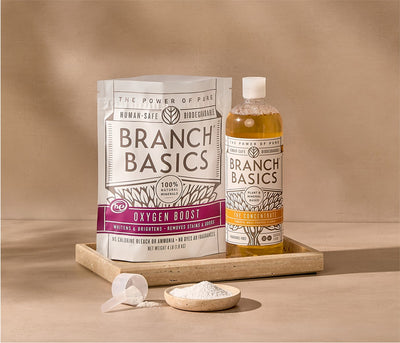
Looking for a semi-homemade version? Try Branch Basics All-Purpose.
There is no chance of leaving soap scum on a surface with Branch Basics, so there is no need to follow up with a water wipe, vinegar,or hydrogen peroxide wipe.
Related reading: How To Use Branch Basics All-Purpose Solution: Complete Guide
2: 1-Ingredient Homemade Glass Cleaner
There are many ways to make a good homemade glass cleaner, but we’re partial to this ultra-simple, one-ingredient version:
Ingredients:
- 3% hydrogen peroxide
How To Make:
- Affix a trigger sprayer to a bottle of 3% hydrogen peroxide.
- Spray directly on glass and wipe clean.
How it Works:
3% Hydrogen peroxide is 3% peroxide diluted with 97% water. It’s a strong yet gentle oxidizer that breaks up dirt, grime, greasy fingerprints, and germs, leaving behind a streak-free, germ-free clean.
Note: We recommend keeping peroxide in its brown bottle rather than transferring it to a spray bottle, as the dark brown bottle is designed to prevent degradation and will keep it fresher longer.
For a semi-homemade version, try Branch Basics Streak-Free, made using just 1 drop (yes, 1 drop!) of Branch Basics Concentrate in a bottle of water.
Related reading: How To Use Branch Basics Streak-Free: Complete Guide
3: Homemade Soft Scouring Cleaner
If you like a soft and creamy scouring solution for sinks and tubs that’s gentle on your skin, this recipe is perfect.
What you’ll need:
- A small bowl
- A spoon
- A small storage container with a lid
Ingredients:
- 1 cup baking soda
- 1/4 cup pure, unscented, liquid castile soap, or Branch Basics Concentrate
- 1-2 tablespoons water
How to Make:
- Mix the baking soda, liquid Castile soap or Branch Basics Concentrate, and 1 tablespoon of the water in a bowl.
- Note: Baking soda and surfactant-based cleaners like Castile soap and Branch Basics Concentrate mix well together because they are both alkaline.
- Note: Baking soda and surfactant-based cleaners like Castile soap and Branch Basics Concentrate mix well together because they are both alkaline.
- If the consistency is too dry, add more water until the desired creamy consistency is reached.
- Store in a clean, sealed container for use on sinks, tubs, stove tops, faucets, and more.
- Only use a clean spoon to dip it out of the container to avoid microbial contamination. Make small batches and use them within a couple of weeks.
How it works:
Baking soda has a natural bleaching and scouring action that effectively removes stubborn dirt and grime while neutralizing odors.
Castile soap acts as a surfactant, reducing the surface tension of water and allowing the solution to penetrate messes and remove dirt and germs.
This can be followed by a 3% peroxide spray, steam, or your favorite human-safe disinfectant for sanitizing.
Or Try Branch Basics For Semi-Homemade Cleaners
If you’re looking for a semi-homemade cleaning solution that’s completely human-safe, easy to use, and economical, you have to check out Branch Basics.
Our all-in-one EWG-Verified, MADE SAFE Certified, plant- and mineral-based cleaning system is designed to replace every single harsh cleaner with harmful chemicals in your home with just one Concentrate, water, and optional Oxygen Boost.
Here’s how it works.
Our Premium Starter Kits come with everything you need, including refillable bottles, to make All-Purpose, Bathroom, Streak-Free, Foaming Wash, and Laundry, as well as custom dilutions.
These dilutions take care of everything, from bathrooms and kitchens to your car, pet, hands, fridge, deck, jewelry, carpets, floors, stains, you name it. Branch Basics Concentrate can clean it safely and efficiently.
Want to learn more about how it works? Check out: How To Use The Branch Basics Kit for a full written and video tutorial.
Homemade Cleaning Solution FAQs
Q: What Is The Best Homemade Cleaning Solution?
A: The best homemade cleaning solution combines human-safe ingredients that remove germs, break up grease and grime, and leave surfaces clean with no residue.
These homemade cleaning solutions meet that criteria, and are easy and affordable to make.
Q: What’s A Good Substitute For Vinegar In Homemade Cleaning Solutions?
A: Lemon juice provides the same degreasing, deodorizing, destaining, and mild bleaching properties of vinegar without the smell or acetic acid.
Get more tips in: Why We Recommend These Substitutes for Vinegar in Cleaning
Q: What’s The Best Natural Disinfectant?
A: There are lots to choose from! See 9 Natural Alternatives To Bleach For Disinfecting for more information.
Q: Why Don’t You Recommend Rubbing Alcohol?
A: Rubbing alcohol is an effective and more natural disinfectant than Quats or bleach.
However, it’s less safe for humans and the environment than 3% hydrogen peroxide, which is why we generally don’t recommend it.
Get the details in: Hydrogen Peroxide Vs. Rubbing Alcohol: Which Is The Safest?
Q: Can I Use My Own Bottles For Branch Basics?
A: Absolutely! See Branch Basics Product Ratios: Using Your Own Bottles to learn how.
Q: Do Homemade Cleaners Need Preservatives?
A: Not typically, as long as you use them up within a few months. Making them in small batches can help them stay fresh.
References:
-
https://pubmed.ncbi.nlm.nih.gov/9713753/
-
https://www.foodsafetynews.com/2018/04/vinegar-can-help-home-cooks-battle-bacteria-on-leafy-greens/
-
https://ww2.arb.ca.gov/resources/fact-sheets/cleaning-products-indoor-air-quality
-
https://pmc.ncbi.nlm.nih.gov/articles/PMC8157593/
- https://www.medicalnewstoday.com/articles/321262

Marilee Nelson
Marilee Nelson is an Environmental Toxins expert who has spent nearly 30 years advocating for the chemically-sensitive and chronically-ill. She is a Board Certified Nutritionist, Certified Bau-Biologist and Bau-Biology Inspector and specializes in Food As Medicine. She has helped thousands of families and individuals identify, heal and recover from toxic exposures and is on a mission to revolutionize the way American families view their health.


