



Does Vinegar Sanitize? + Natural Disinfectant Alternatives

Vinegar is well-known for its versatile use around the home. You can use it to cook, soften laundry, clean surfaces, remove stains, neutralize odors, and so much more.
But can vinegar sanitize and disinfect surfaces and objects?
The answer is yes…and no.
Vinegar does have some sanitizing abilities thanks to its antimicrobial properties, but, unfortunately, is not a disinfectant as it does not meet the Environmental Protection Agency’s (EPA) standards.
Conventional disinfectants undergo rigorous testing to qualify and register as EPA-approved products.
The problem with using these conventional disinfectants is that, to pass the test, they must contain antimicrobial pesticides, which are extremely harmful to your home, indoor air quality, and your health.
So, if vinegar does not meet EPA standards as a natural disinfectant, what other safe and effective options are out there, if any?
In this article, we answer your most burning questions around this topic, including “Does vinegar sanitize?", “Does vinegar disinfect?”, and, “If not, then what natural and low-tox options are out there that I can use instead?”
Let’s get started.
Key Takeaways
- Vinegar is an excellent natural cleaning product for the home. It contains acetic acid, which has antimicrobial properties capable of killing and removing harmful pathogens that cause foodborne illnesses like E. coli, Salmonella, and Listeria monocytogenes.
- Despite having antimicrobial properties, vinegar is not considered a disinfectant as it does not meet EPA standards.
- Although vinegar is not considered a safe and effective disinfectant, there are several natural and low-tox alternatives, including hydrogen peroxide, sodium percarbonate, dry steam cleaners, boiling water, and vodka.
- Over-sanitizing can be harmful to your health. The best way to take care of germs safely without over-sanitizing is by removing them with a soap or surfactant-based cleaner like Branch Basics.
Vinegar: The Non-Disinfectant With Disinfecting Properties
Vinegar is a powerhouse when it comes to natural, safe, and low-tox cleaning. Its antimicrobial properties, found in the 4-7% acetic acid,* is what make it so powerful and effective against everyday germs.
*Note: The acetic acid found in vinegar can be a lung irritant when used as a spray. Care must be taken to avoid inhaling aerosolized vinegar. Open the windows while cleaning, use fans, and/or good ventilation until the vinegar smell is cleared. Avoid cleaning with vinegar when babies, young children, older people, or someone with asthma or chronic illness is in the room you are cleaning.
Here at Branch Basics, we regularly rave about vinegar and how versatile it is, from cleaning window blinds to naturally eliminating odors in the home.
Learn more in 12 Ways To Use Vinegar In Your Home.
With so many different ways you can use it around the house, you might be wondering, “Does vinegar sanitize?” and, “Can I use vinegar to disinfect my home?”
But before we answer those questions, let’s take a look at how vinegar’s acetic acid works.
Acetic acid has a relatively low pH. When it comes into contact with certain microorganisms, the acetic acid disrupts the cell membranes, denatures proteins, and alters their permeability. This, in turn, causes the cell to die, as proven by several scientific studies:
- Vinegar is especially useful in the kitchen, as it has been proven to sanitize surfaces containing certain foodborne illness-causing germs, including E. coli, Salmonella, and Listeria monocytogenes.[1]
- Another study from 2010 showed that a 10% solution of malt vinegar can kill the influenza A virus.[2]
- And in 2021, scientists studied the use of apple cider vinegar and its ability to eradicate methicillin-resistant Staphylococcus aureus and resistant E. coli.[3]
Speaking of apple cider vinegar, check out Apple Cider Vinegar Versus White Vinegar: Which is Better for Cleaning.
With all of these interesting and insightful findings, you’d think vinegar would be useful beyond its natural cleaning abilities as a disinfectant, but unfortunately, that’s not the case.
So What’s The Difference Between A Cleaner And A Disinfectant, And Where Does Vinegar Fall?
A “cleaner” is a product that removes dirt, debris, and germs from a surface or object.
A “disinfectant” destroys, kills, or inactivates germs on contact. This includes viruses, bacteria, and other harmful pathogens.
To qualify as a recognized disinfectant, a product must meet EPA standards. A disinfectant must:
- Be registered with the EPA,
- Kill viruses, bacteria, and fungi on surfaces using chemicals known as “antimicrobial pesticides,”
- Reduce the levels of bacteria, viruses, and fungi by 99.999% in 5 to 10 minutes.[4,5]
Unfortunately, vinegar does not meet these standards. Although it does contain antimicrobial properties, vinegar doesn’t kill all bacteria, viruses, fungi, and other harmful pathogens.
Because of this, vinegar is best classified and used as a natural cleaner.
So, with this knowledge, the question then becomes…
Is Vinegar Safe To Use As A Disinfectant Alternative?
We now know that using disinfectants in the home is not recommended unless someone in the house has a contagious illness.
Then it is recommended that all cleaning be done with soap and water to remove the germs, and only follow with a disinfectant on frequently used surfaces like door knobs.
Vinegar has many strengths and uses, especially for cleaning around the home. But because it doesn’t meet the EPA standards, vinegar is not the best choice for disinfecting your home.
Luckily, there are plenty of other natural and low-tox disinfectant alternatives you can choose from like hydrogen peroxide, sodium percarbonate, dry steam cleaners, boiling water, and vodka.
We explore each of these in depth below.
5 Natural or Low-Tox Sanitizers That Really Work
1: 3% Hydrogen Peroxide
When we think about natural, low-tox disinfecting, hydrogen peroxide is the first product that comes to mind.
It's is human-safe, fragrance-free, a bleach alternative, a powerful cleaning ingredient, a sanitizer, and an all-natural disinfectant.[6]
You can find 3% hydrogen peroxide at most grocery or big-box stores, which is strong enough to kill a wide range of pathogens, viruses, bacteria, and fungi for ultimate low-tox disinfecting power.
Just open the bottle and screw on a trigger sprayer for easy use. On its own, hydrogen peroxide is enough to disinfect just about any surface or object in your home.
But! One of our favorite ways to deep-clean and disinfect most surfaces is to use vinegar and hydrogen peroxide (stored in separate bottles and used separately, as combining them can create harmful fumes).
Here’s how:
- Clean and remove germs, dirt, dust, and debris from the surface or object with either Branch Basics All-Purpose or Bathroom. Spray well, let dwell for a few minutes, rinse away, or use a dry or damp microfiber cloth to wipe clean.
- Spray or apply vinegar to the surface. Let it dwell 5-10 minutes.
- After the vinegar dwells, wipe thoroughly, then spray or apply hydrogen peroxide to the surface or object. Again, let it dwell for 5-10 minutes or until dry.
- With a clean, damp microfiber cloth, wipe the surface thoroughly.
This method is great for use on pacifiers, cutting boards, toys, toilets, countertops, or any similar surface or object that you suspect could contain harmful germs.
Learn more in How to Clean With Hydrogen Peroxide: Safe, Natural Uses for Disinfecting, Laundry, Mold, & More.
2: Sodium Percarbonate (Branch Basics Oxygen Boost)
Sodium percarbonate is a white, water-soluble solid that is formed by combining sodium carbonate (also known as soda ash) and hydrogen peroxide. It’s a safe and natural antibacterial, antifungal, anti-algae, anti-mold, and highly effective deodorizing powder.
It’s so safe, in fact, that even organic aquaculture production approved it as one of the only disinfectants used for treating water and controlling unwanted algae growth.[7]
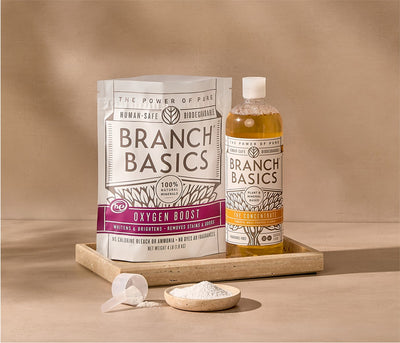
When sodium percarbonate is mixed with water, it becomes a natural, human-safe, biodegradable, and effective disinfectant alternative to chlorine bleach. This is why we use it as one of only two ingredients in our best-selling Oxygen Boost.
But because it's a powder, sodium percarbonate and Oxygen Boost are not designed to be used as surface disinfectants.
Instead, clean the surface first with Branch Basics All-Purpose or Bathroom, then dissolve Oxygen Boost or pure sodium percarbonate in water, and apply for a gentle, all-natural disinfectant.
Discover more about sodium percarbonate and how to use it around the house in The Power of Sodium Percarbonate for Cleaning.
3: Dry Steam Cleaners
You’ve probably heard of steam cleaners, which use high-temperature, pressurized vapor to clean and disinfect surfaces.
Dry steam cleaners, on the other hand, disinfect by using high-temperature, low-moisture vapor to kill bacteria, viruses, germs, and even mold on contact.
Our favorite, most effective dry steam cleaner is the Ladybug Dry Steam Cleaner, which cleans, degreases, deodorizes, and disinfects virtually any surface.
We highly recommend the Ladybug Dry Steam Cleaner because it:
-
Qualifies as a disinfection device for the EPA. The Ladybug disinfects virtually any hard surface through its proprietary TANCS® technology, thousands of times better than the standard that chemical disinfectants must meet to qualify as an EPA-registered disinfectant. [8,9]
- Kills an extensive range of bacteria and viruses, including MRSA, C. diff, norovirus, C. parvo, and COVID-19 in 7 seconds or less, leaving no residue behind and preventing the growth of new microbes.
-
Has been proven to eradicate hard-to-kill biofilms in three seconds.
- Can be used on virtually any surface, including hardwood, laminate, marble, carpet, stainless steel, upholstery, leather, and so much more!
To top it all off, the Ladybug Dry Steam Cleaner works well with Branch Basics to naturally and effectively deep clean your home.
Advap offers Branch Basics customers a 20% discount on their Ladybug Dry Steam Cleaner! Use coupon code BRANCHBASICS at checkout.
We do not receive affiliate commissions from this code.
4: Boiling Water
If your city or town has ever had a water leak, you might have been placed under a “boil water” advisory.
These are typically issued when the local or state health authorities suspect that drinking water may be contaminated with harmful pathogens.
They understand that when you boil water, the temperature reaches about 212 degrees Fahrenheit, which is hot enough to kill bacteria, viruses, and protozoa, according to the EPA. [10]
Not only is the water then safe to drink, but it’s also useful for disinfecting and sanitizing heat-resistant objects and surfaces like silverware, cutting boards, and even toothbrushes, so long as the temperature remains at or around 212 degrees Fahrenheit and stays in contact with the object for at least three minutes.
Do use caution, though, as boiling water is not recommended for any items that could melt or are battery-operated.
5: Vodka
Alcohol isn’t our first go-to when it comes to cleaning or disinfecting, but it certainly has its place!
It’s a cost-effective, less-toxic option and works as a natural deodorizer.
According to the EPA, alcohol qualifies as a registered disinfectant, but only if it’s 70% (140 proof) drinkable grain alcohol or 70% isopropyl alcohol.[11]
To use, clean and remove germs from the surface or object first with Branch Basics. Fill a spray bottle with alcohol or vodka and spritz the surface you’d like to sanitize. Allow the vodka or alcohol to dry completely.
How To Disinfect Properly & When It’s Appropriate
Society and witty marketing tactics have taught us that sanitizing our homes is the best and only way to stay healthy. But over-sanitizing – even with natural products – can often cause more harm than good.
The problems with over-sanitizing are:
- Killing all germs, the good and the bad, can have a negative impact on microbiome immune health.
- When you kill germs, the few left behind adapt to disinfectants, eventually creating superbugs.[12]
- Conventional chemical disinfectants are extremely toxic and have been linked to dozens of acute and chronic diseases and environmental problems.
Read more in Why Over-Sanitizing Is Harmful To Our Health.
Plus, there’s plenty of scientific research that shows how regular exposure to certain types of bacteria and germs can actually strengthen your gut microbiome and boost the immune system.[13]
So, what is the best way to safely manage germs without over-sanitizing?
The answer: Remove them!
Extensive testing conducted by the CDC has shown that cleaning with a soap or surfactant-based cleaner, like Branch Basics, removes germs without leaving behind resistant bacteria, or superbugs.[14]
For everyday cleaning, a natural soap-based cleaner should do the job.
But in some cases, following a cleaning with a natural disinfectant or sanitizer may be appropriate.
Some examples include:
- During or after a member of your household has been ill;
- You’ve had a new baby;
- You’ve used raw meat on a cutting board or kitchen counter;
- Or you’re concerned about the spread of harmful germs or pathogens.
In these cases, after you’ve removed the germs, it’s appropriate to choose your favorite natural or low-tox disinfectant from this article, apply it, and allow dwell time to properly kill any harmful pathogens, viruses, or bacteria.
Other Uses For Vinegar
Even though vinegar isn’t recommended for disinfection, there are many other ways you can use it around the house*.
Here are just a few examples:
- Vinegar can be used to remove dirt and dust from glass, mirrors, windows, and even window blinds.
- In the laundry room, use vinegar as a powerful natural laundry booster, eliminate odor-causing bacteria, break down residue buildup, naturally soften fabrics, brighten whites, and as a stain, mold, and mildew remover.
- Place a small bowl of vinegar in any room to absorb and neutralize odors.
- In the bathroom, use vinegar to dissolve soap scum on tubs and showers, clean grout, use as a natural drain cleaner, and clean the toilet bowl.
- Use vinegar as a pet-safe floor cleaner.
- In the kitchen, vinegar can be used to clean your garbage disposal, clean and descale your dishwasher, clean grease off kitchen cabinets, clean stainless steel, and use as a natural produce wash.
- Naturally control and kill weeds with vinegar.
-
Remove rust from metal.
- And so much more!
As you can see, there are many uses for vinegar. But which type of vinegar is best?
Learn which one to choose for your specific cleaning task in Cleaning Vinegar vs. White Vinegar: What’s The Difference? | Branch Basics.
And, if you’re looking for alternatives, check out Why We Recommend These Substitutes for Vinegar in Cleaning.
*Note: Although vinegar is a fairly versatile natural cleaning product, we recommend using caution (or completely avoiding use) when cleaning sensitive and porous surfaces such as wood, granite, marble, and soapstone, as it can cause irreparable damage.
Simplify Your Human-Safe Cleaning & Sanitizing With Branch Basics
When it comes to cleaning with natural products like vinegar, questions often arise: “Does vinegar disinfect?” “Is vinegar a sanitizer?” – and, although several options like hydrogen peroxide, sodium percarbonate, and even vodka work well, vinegar just doesn’t make the cut.
Just like vinegar, Branch Basics is not a sanitizer or disinfectant, but it works great to remove germs before you sanitize or disinfect!
Learn more in Is Branch Basics a Sanitizer or Disinfectant?.
Using plain soap and water or a human-safe cleaning soap product with surfactants like Branch Basics Concentrate is much more effective at removing the germs than conventional sanitizers, and preps the surface or object for proper disinfecting.
So if you’d like to try Branch Basics for human-safe cleaning without the harmful synthetic chemicals found in conventional sanitizers and disinfectants, be sure to explore our Premium Starter Kits.
Available in refillable plastic or glass, our Premium Starter Kits come with everything you need to replace dozens of harmful and toxic household cleaners with just one Concentrate. Combine our all-in-one, human-safe Concentrate with water to make All Purpose, Bathroom, Streak Free, Foaming Wash, and Laundry. You’ll also receive a full bag of our best-selling Oxygen Boost.
For more information on human-safe cleaning, sanitizing, and disinfecting, check out our Wellness Center, podcast, and Toss The Toxins Online Course.
Resources:
-
https://pubmed.ncbi.nlm.nih.gov/9713753/
-
https://pmc.ncbi.nlm.nih.gov/articles/PMC2813869/
-
https://www.nature.com/articles/s41598-020-78407-x
-
https://www.epa.gov/coronavirus-and-disinfectants/whats-difference-between-products-disinfect-sanitize-and-clean
-
https://www.epa.gov/sites/default/files/2020-04/documents/316485-c_reopeningamerica_guidance_4.19_6pm.pdf
-
https://link.springer.com/article/10.1186/s13756-018-0447-5#Sec13
-
https://www.globalseafood.org/advocate/pros-cons-sodium-percarbonate/
-
https://www.advap.com/pages/ladybug-2350-steam-cleaner
-
https://www.advap.com/pages/peer-reviewed-studies
-
https://www.epa.gov/ground-water-and-drinking-water/emergency-disinfection-drinking-water
-
https://www.epa.gov/sites/default/files/2020-04/documents/316485-c_reopeningamerica_guidance_4.19_6pm.pdf
-
https://medicalxpress.com/news/2021-11-common-disinfectant-superbug-mutation.html
-
https://www.sciencedaily.com/releases/2010/06/100614171907.htm
- https://www.cdc.gov/hygiene/about/when-and-how-to-clean-and-disinfect-your-home.html#:~:text=Clean%20first%20and%20clean%20regularly,sanitize%20or%20disinfect%20if%20needed.

Marilee Nelson
Marilee Nelson is an Environmental Toxins expert who has spent nearly 30 years advocating for the chemically-sensitive and chronically-ill. She is a Board Certified Nutritionist, Certified Bau-Biologist and Bau-Biology Inspector and specializes in Food As Medicine. She has helped thousands of families and individuals identify, heal and recover from toxic exposures and is on a mission to revolutionize the way American families view their health.


