

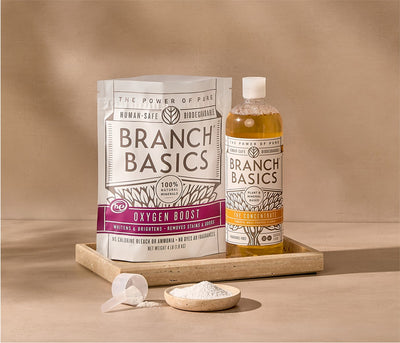


Cleaning Products Without Ammonia: Why We Avoid It in Branch Basics

Many of today’s chemical-based cleaners contain ammonia, or specifically, ammonium hydroxide. This easy-to-make, super-efficient cleaning chemical is known for its excellent degreasing, shining, stain-removing, disinfectant, and fast-drying properties.
Unfortunately, ammonia is extremely toxic to humans, and its use in cleaning products should be avoided at all costs.
In this article, we dive deep into the cleaning products with and without ammonia, and why we avoid it in Branch Basics products (and so should you!).
Key Takeaways
- Ammonia is an effective household cleaner, but it’s highly toxic. Exposure to ammonia, or ammonium hydroxide, can cause respiratory issues, skin irritation, and other serious health issues.
- “Natural” doesn’t always mean safe. Even though the body creates and excretes ammonia, the synthetic, human-made version used in cleaning and fertilizer products is very different and much more toxic.
- Safer ammonia-free cleaning products do exist! Plant- and mineral-based products, like Branch Basics, and other common household pantry items like vinegar, baking soda, and hydrogen peroxide, can clean just as well as ammonia without the health risks.
A Brief History Of Ammonia
Awareness of ammonia dates back decades, when farmers and agricultural scientists discovered the importance of nitrogen in soil created by the microbial breakdown of urea and amino acids in animal feces.
Ammonia is a naturally occurring byproduct of this nutrient cycling through animal waste decomposition.
Ammonia is a colorless gas with a pungent odor, and in enclosed environments like large-scale animal operations, exposure to ammonia poses significant health risks to animals.
Fast forward to the early 1900s, when production agriculture was taking off. Due to the rising world population, scientists were trying to figure out how to feed everyone without draining the earth’s resources. Two world-renowned scientists, Fritz Haber and Carl Bosch, joined forces and figured out how to synthetically create nitrogen, and ultimately ammonia, from the air in large quantities.[1]
For production agriculture, ammunition (fun fact: ammonia is a key component in gunpowder), and chemical cleaning companies, rapid production of ammonia helps keep these industries moving forward.
But for the health-conscious and natural-minded community, it should be avoided at all costs as it can be harmful if inhaled, ingested, or absorbed by the skin.
H2: What Role Does Ammonia Play in Cleaning Products?
All-purpose ammonia, known as ammonium hydroxide (5-10%), has been synthetically produced for decades and used in many chemical-based household cleaning products.
It’s the star ingredient because it’s cheap and effective. You’ll find ammonium hydroxide as the active ingredient in many conventional cleaning products like laundry and carpet stain removers, bathroom cleaners, jewelry cleaners, degreasing products, and, most commonly, glass cleaners.
Despite its excellent degreasing, shining, and streak-free cleaning abilities, ammonium hydroxide has a “dirty” secret.
Unfortunately, it’s widely marketed as safe, natural, and effective for household use – but that just isn’t the case. Ammonium hydroxide has been known to cause respiratory, skin, and reproductive issues, just to name a few. [2]
To dispel the “ammonia is safe” myth, we’ve written an entire article on What is Ammonia Used For & How to Avoid it.
Why Branch Basics Doesn’t Use Ammonia
At Branch Basics, we are dedicated to helping you live a healthier life by removing products with harmful chemicals from your home and replacing them with safe and effective alternatives.
Because ammonia is a harmful cleaning chemical, we do not use it in any of our products.
Exposure to ammonia has been known to cause abdominal pain, severe burns, skin and eye irritation, blindness, respiratory irritation, and even death. [3]
We are committed to creating products that are human-safe. Meaning, our formulas contain only the safest, non-irritating ingredients for humans, including the most vulnerable and sensitive.
Because of this, you can count on Branch Basics to create products made with ingredients you can trust. This includes no synthetic fragrances and no harsh or harmful chemicals – including ammonia.
Learn more about our story, human-safe promise, and what ingredients go into every product (and what doesn’t) in What is Human-Safe? Our Brand Promise.
Why Is Ammonia Commonly Included In Cleaning Products?
Ammonia is a cheap, readily available chemical compound that gets the job done, no matter how tough the stain or cleaning task.
Many conventional cleaning companies include ammonia in their products because it’s highly effective at breaking down dirt, grime, grease, and oils from nearly any surface.
Its most common use is in glass cleaners. Within seconds of spraying, the ammonia-based cleaner quickly evaporates, leaving behind streak-free mirrors, windows, and glass.
The problem, however, is that exposure to synthetic ammonia in conventional cleaning products – both short and long-term – compromises your health, your family’s health, and your home’s indoor air quality. [3]
What Are Some Ammonia Alternatives?
Smart marketing tactics might have you convinced that nothing else cleans as well as ammonia-based cleaners. But that couldn’t be any further from the truth!
In fact, there are several natural options available to you.
If you’re considering the switch to an ammonia-free cleaning system that’s safe, effective, and affordable, we recommend checking out Branch Basics.
As we mentioned above, Branch Basics cleaning products are made without ammonia (or any other harmful ingredients for that matter!), are human-safe, earth-friendly, plant- and mineral-based, and can tackle just about any household cleaning job, like:
- Branch Basics All-Purpose or Bathroom for stain removal, everyday household cleaning, shining up jewelry, degreasing, and much more.
- Branch Basics Oxygen Boost for stain removal. You can also combine it with Branch
- Basics Bathroom for a deeper clean on tubs, showers, toilets, and grout.
- Branch Basics Streak Free for shining up mirrors, windows, and glass.
All without ammonia.
To ensure a cleaning product is truly safe and effective, check the label. Branch Basics products are third-party tested, Made Safe certified, EWG Verified, and Leaping Bunny certified. These certifications and labels certify that our products are made with consciously clean formulas.
You can also use the following natural ammonia alternatives for various cleaning tasks around the house, some of which you might already have in your pantry:
- Baking soda
- Distilled white vinegar
- Hydrogen peroxide
- Liquid castile soap
- Natural baby powder
- Cornstarch
- Lemon juice
- Club soda
- Vodka
- Olive oil
- Dry steam cleaner
To learn how to use these ammonia-free cleaning products, check out 5 Ammonia-Free Alternatives for Safer Cleaning and What is Ammonia Used For & How to Avoid it.
What’s Marilee’s Take on Ammonia?
As you’ve learned in this article, ammonia has no place in a healthy, human-safe home. But what does Marilee, Branch Basics’ co-founder, think about this synthetic cleaning chemical?
“OSHA and U.S. law classify ammonia as highly hazardous and require it to be labeled with hazardous pictograms and the signal words: Danger. Warning of toxicity, if inhaled, and the potential for serious eye damage and severe skin burns are required.
“Many people are under the impression that if a product is being sold for use in the home, it must be safe. Don’t be fooled, as there is no safety standard for cleaning products. There is no requirement to list the ingredients.”
With its long industrial history in agriculture and even early pesticide formulations, synthetic, human-made ammonia is a highly toxic chemical that, sadly, has been marketed to well-meaning consumers as safe and effective for many decades.
“As a young mother, I experienced the harmful effects of pesticide exposure through my son, Douglas. At age 10, he was exposed to a cocktail of very high levels of both banned and currently legal pesticides, and I was told by doctors that he had irreversible brain and immune system damage.”
It was a long road to recovery. The removal of all products containing harmful ingredients from the home proved to be the key to his full recovery, which was considered a medical miracle.
“This applies to any and all harmful chemicals in the home, including ammonia. OSHA considers ammonia hydroxide a “high hazard” as it can cause severe burns, irritation to the mucous membranes, respiratory problems, and life-threatening pulmonary edema. It’s extremely toxic and has no place in a healthy home.”
From this experience, Marilee discovered the power of removal, which she now considers an unrecognized and underutilized weapon against chronic illness.
She developed a systematic process for removing products with harmful chemicals from her clients' homes. The course is what Marilee calls “human-laboratory tested” and is based on her recovery, her son’s recovery, and forty years of client recoveries facilitated by Tossing the Toxins.
You can read more in Marilee's Full Story.
H2: Ammonia FAQs
Want to learn more about ammonia in cleaning products? Check out these FAQs
Q: What to use instead of ammonia for cleaning?
A: There are many natural options you can use instead of ammonia for cleaning; it just depends on the job.
See the previous section "What Are Some Ammonia Alternatives " for the best human-safe ammonia alternatives.
H3: Q: Do disinfecting wipes have ammonia?
A: The short answer is no, disinfecting wipes do not contain ammonia in its purest form (NH3).
Many disinfecting wipes do, however, contain a type of ammonia-based disinfectant chemical, known as quaternary ammonium compounds, or quats…an equally toxic and concerning cleaning chemical.
In What are Quats? Risks, Facts, & More, we share everything you need to know about this extremely harmful chemical that has been known to cause respiratory, skin, and reproductive issues. [4]
And, yes, there are safer alternatives to quats, including a natural soap-based cleaner, like Branch Basics Concentrate, liquid castile soap, hydrogen peroxide, and even boiling water.
Q: Do all disinfectants have ammonia in them?
A: Many of the brand’s products contain quats, specifically benzalkonium chloride or ammonium hydroxide – but not pure ammonia.
These cleaning chemicals are commonly found in disinfectant sprays, sanitizers, and multi-surface cleaners.
Q: What glass cleaners don’t contain ammonia?
A: We have a few favorite ammonia-free glass cleaners for you to try, including:
- Branch Basics Streak Free
- Vinegar and water
- A hand-held steam cleaner
- Hydrogen peroxide
- Vinegar and castile soap
- Rubbing alcohol
Read more about each of these in The 6 Best Glass Cleaners Without Ammonia.
Resources:

Marilee Nelson
Marilee Nelson is an Environmental Toxins expert who has spent nearly 30 years advocating for the chemically-sensitive and chronically-ill. She is a Board Certified Nutritionist, Certified Bau-Biologist and Bau-Biology Inspector and specializes in Food As Medicine. She has helped thousands of families and individuals identify, heal and recover from toxic exposures and is on a mission to revolutionize the way American families view their health.


