



Cleaning Products Without Bleach: Why We Avoid It in Branch Basics

Cleaning your home and washing the laundry shouldn’t compromise your health.
But over time, we’ve been led to believe that cleaning and laundry products that contain harsh chemicals, like chlorine bleach (aka sodium hypochlorite), kill germs, creating a safer, healthier environment for all.
But yet, we’re told we shouldn’t touch it, breathe it in, or ingest it by the same people who tout bleach as a safe and effective cleaning substance.
How does that work?
The answer is, it doesn’t.
Put simply, bleach is so dangerous. It negatively impacts the body, the environment, and your indoor air quality and becomes a highly toxic gas if mixed with other organic or chemical-based substances (think ammonia and vinegar here).
At Branch Basics, we believe you can clean and disinfect your home without using bleach or any other harmful chemical-based cleaning products!
Here, we share several bleach-free cleaning products that you can opt for instead of the conventional chemical-based alternatives.
Ready to toss the toxic bleach cleaning products? We’re here to help!
Key Takeaways
- Used in many conventional cleaning products, bleach can be found in chemical-based laundry detergents, stain removal products, disinfectants, and many others.
- Chlorine bleach is a highly toxic, hazardous substance, which is why we choose to not use it as an ingredient in any Branch Basics product.
- A few of our favorite bleach-free cleaning products include baking soda, hydrogen peroxide, vinegar, and Branch Basics.
Why Is Bleach Commonly Included In Cleaning Products?
It’s unfortunate, but bleach is commonly included in many cleaning and laundry products because it’s an effective way of killing bacteria, viruses, and mold.[1]
For laundry stains, bleach is favored for its strong oxidizing properties, which break down stains and remove them while deodorizing the fabric.
Aside from cleaning and laundry products, chlorine bleach can also be found in pools, drain cleaners, oven cleaners, tampons (unless they’re labeled as “unbleached”), bleached paper products like coffee filters, toilet paper, and paper towels, disposable diapers, municipal water supplies, and other bleached products.
Why Branch Basics Doesn’t Use Bleach
Bleach is highly toxic, making it a very dangerous product to even have stored in the home. It’s also an EPA-registered “hazardous substance”, is classified as an antimicrobial pesticide, and is considered “extremely toxic to aquatic life with long-lasting effects.”[2]
The problem with cleaning or using bleach in any capacity is that even if not being used, harmful VOCs are constantly emitted from the bottle, impacting the air quality of your home, and it is a harsh irritant that can cause irritation and burns to the eyes, skin, and lungs when you’re exposed.
Bleach is especially harmful when mixed with other chemical cleaners and organic matter, such as ammonia and vinegar, as it creates highly toxic gases.[3]
And that's why, at Branch Basics, we don't use bleach in any of our products – and never will.
Instead, our products are made with human-safe ingredients, which means everything we put in our products, without compromise, is safe for humans, including the most sensitive groups such as babies, pregnant women, the elderly, those with chemical sensitivities, and those with chronic illnesses.
You can rest assured that all Branch Basics products contain no harsh chemicals, including endocrine disruptors, synthetic or natural fragrance, disinfectants (bleach!), harmful preservatives such as formaldehyde-releasing preservatives, neurotoxins, pesticides, etc.
Our products are 100% plant- and mineral-derived, and are safe for humans, pets, and the environment.
Read more about our story and what we define as human-safe in What is Human-Safe? Our Brand Promise.
Our Favorite Bleach-Free Cleaning Products
Bleach-Free Laundry Detergent
Bleach is commonly known for its uses in the laundry room – to whiten whites, for stain removal, and as a disinfectant, just to name a few.
But, as you now know, bleach is highly toxic.
It emits fumes of chlorinated compounds, which can produce organochlorines (OC) – known endocrine-disruptors, neurotoxins, and carcinogens.
Chlorine residues can be left on fabrics if not rinsed thoroughly and, because of this, no one should be wearing clothes washed and soaked in bleach.
So, how do you go about doing the laundry without it? Easy!
Here are a few bleach-free laundry detergents you can use instead:
-
Baking Soda: Great for cleaning, whitening, and deodorizing laundry. Just add half to 1 cup baking soda directly to your washer and launder as usual.
-
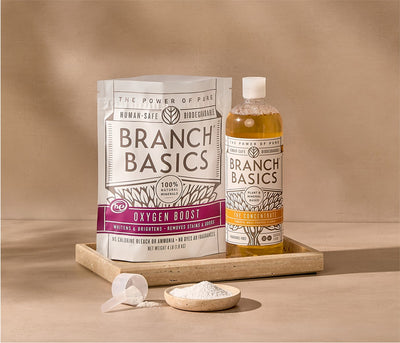
Branch Basics Laundry & Oxygen Boost: Just ¾ a cap-full of our Laundry dilution, or 1 scoop of Laundry Detergent, is enough to clean a normal-sized load of laundry. Add a scoop of Oxygen Boost for extra whitening and stain-fighting power; the perfect bleach-free laundry combination!
- Hydrogen Peroxide: An excellent bleach-free, fragrance-free disinfctant, that can be used on whites (not colors) in your washer. Just add 1 cup of 3% hydrogen peroxide to the bleach dispenser, coupled with your favorite natural detergent, and launder as usual.
But wait, there’s more! Check out our other ideas for Laundry Bleach Alternatives: 7 Human-Safe and Environmentally Safe Options.
Bleach-Free Bathroom Cleaner
The bathroom is often viewed as the “dirtiest (or germiest) room of the home.” But that’s no challenge for truly human-safe, natural bleach-free bathroom cleaners!
Below are a few options to try:
-
Branch Basics Concentrate: Our all-in-one, human-safe Concentrate replaces all sorts of harmful chemical cleaners, including bleach. In the bathroom, use All-Purpose or Bathroom dilutions to clean your shower, tub, toilet, sink, and floors. This removes grease, grime, and germs, which are then washed down the drain. Use our Streak Free dilution to clean mirrors, windows, and shower glass.
-
Hydrogen Peroxide*: If you desire to use a disinfectant on frequently touched surfaces, especially when someone in the family is ill,, hydrogen peroxide is a powerful odorless disinfectjng agent that works great as a follow-up to using our Branch Basics Bathroom or All-Purpose cleaner. Use on faucets, showers, tubs, toilets, and other bathroom surfaces.
- Oxygen Boost or Baking Soda: Especially useful for cleaning bathroom grout. Simply make a paste out of equal parts Oxygen Boost or baking soda. and water. Add a few drops of Concentrate. Scrub with an old toothbrush, let dwell, and rinse.
Bleach-Free Disinfectant
Disinfectants that contain bleach are extremely toxic and harmful to humans.
According to the CDC, bleach disinfectants can increase the rate of miscarriage and preterm birth. Unfortunately, they don’t know what concentration causes this to happen. So, it’s best to steer clear.[4]
And, when used to clean, bleach fumes create VOCs, which can trigger a myriad of health issues, including asthma, chronic respiratory problems, allergic reactions, brain fog, and headaches.
Needless to say, it’s best to swap the harmful chemicals for a bleach-free disinfectant that works and is safe for use around your home. Here are a few suggestions:
-
Oxygen-Based Bleach (aka Sodium Percarbonate): One of the ingredients found in our popular Branch Basics Oxygen Boost, sodium percarbonate is a great bleach-free disinfectant that can be used in lieu of chlorine bleach. Use on laundry, as a soaking agent, to disinfect bathrooms and even dishes without the harmful residue. Learn more about this natural ingredient in The Power of Sodium Percarbonate for Cleaning.
-
Branch Basics Concentrate*: Although Branch Basics isn’t a disinfectant, it is excellent at removing germs to prepare surfaces for a natural bleach-free disinfectant. Use Branch Basics to clean and wash away germs in the bathroom, on cutting boards, in the laundry room, and so much more.
- Boiling Water: Great for disinfecting heat-resistant objects and surfaces. Boiling water, at approximately 212 degrees Fahrenheit, will kill bacteria, viruses, and protozoa, according to the EPA.
Luckily, there are several other options you can rely on for bleach-free disinfectant alternatives. Read more in 9 Natural Alternatives To Bleach For Disinfecting.
*Note: Branch Basics is neither a sanitizer nor a disinfectant, but that’s by design. Our products rely on safe surfactants and proper cleaning methods to physically remove germs instead of using harsh chemicals, like bleach.
Check out Is Branch Basics a Sanitizer or Disinfectant? What You Need to Know for more.
Bleach-Free Cleaning Wipes
It’s fairly simple to replace liquid bleach, but what about those strong disinfecting wipes?
They’re easy and convenient. Just grab the tub, open it, and wipe (with gloves, of course!). But are they safe and effective?
Unfortunately, conventional chemical-based disinfecting wipes have been associated with various health and environmental concerns, including the spread of superbugs. Yikes!
Instead, we recommend replacing chemical-based cleaning wipes with these make-on-the-spot DIY bleach-free wipes.
What you’ll need:
-
Disposable Swiffer Dry Unscented Sweeping Pad Refills or microfiber cloths
- Branch Basics All-Purpose Cleaner
- 3% Hydrogen Peroxide (brown bottle)
How to make bleach-free cleaning wipes:
- Spray the disposable dry unscented Swiffer or microfiber cloth with 3 sprays of Branch Basics All-Purpose.
- Wipe the surface to remove dirt, grime, germs, and viruses. The surfactant in the Branch Basics All Purpose emulsifies and lifts dirt, grime, and grease, while the microfiber physically traps the bacteria. Discard the disposable dry Swiffer after using.
- Take another disposable Swiffer or microfiber and spray with 3% hydrogen peroxide. Wipe the surface to kill and lift off any remaining germs. Dispose of the cloth after using.
Bleach-Free All Purpose Cleaner
Everyday household messes can almost always be tackled with an all-purpose cleaner and microfiber cloth.
But it’s important that you choose a truly natural, human- and environmentally-safe cleaner that is free of chlorine bleach and other harmful chemicals.
Here are a few bleach-free all purpose cleaners you can buy or make at home:
-
Branch Basics Concentrate: Combine Branch Basics Concentrate with water in the All-Purpose bottle to make a natural, human-safe, bleach-free all-purpose cleaner. This versatile spray can be used on surfaces, dishes, floors, as a handwash, to remove stains, and much more.
-
Hydrogen Peroxide: 3% hydrogen peroxide kills germs.
-
Vinegar & Water: Vinegar lifts and removes dirt, grime, and certain germs. Mix equal parts distilled white vinegar with water in a spray bottle to use on surfaces, sinks, cooktops, stainless steel, cutting boards, some floor types, and more.
- Pure Castile Soap: Make your own bleach-free all-purpose cleaner with pure castile soap and 1 cup of water. Mix and spray on most surfaces to clean. Follow up with a hydrogen peroxide wipe, if desired for disinfecting.
Note: Never mix hydrogen peroxide with vinegar, as it can produce toxic fumes.
Learn more about truly natural and effective multi-purpose cleaners in 5 Best Natural All-Purpose Cleaners + Ingredients to Avoid.
What’s Marilee’s Take on Bleach?
For Marilee Nelson, co-founder of Branch Basics, bleach has no place in a healthy, human-safe, environmentally-conscious home.
“We have been led to believe that bleach is one of the only effective products for killing germs, so it must be safe and healthy. But nothing is further from the truth.”
In fact, over-sanitizing your home can negatively affect your microbiome and immune health, and even lead to the growth of superbugs.[5]
“A healthy home and body does rely on cleanliness,” Nelson continues. “And yes, there are moments when safe sanitizing is appropriate to prevent the spread of harmful pathogens. But the method and products you choose should be safe, sustainable, and never compromise your indoor air quality, immune system, or cause harm.”
With that said, bleach is harmful, dangerous, and hazardous,, and should not be used or stored inside the home…ever.
Instead, Nelson recommends removing germs with the natural, bleach-free cleaning products and ingredients listed above.
Bleach FAQs
We've covered the bleach basics, now let's go deeper with some FAQs.
Q: Is cleaning with bleach harmful?
A: Yes, bleach is harmful and highly toxic to humans, animals, and the planet.
Here are just a few reasons why:
- Chlorine bleach, among other disinfectants, can increase the rate of miscarriage and preterm birth, according to the CDC.[4]
- When combined with other chemicals or organic matter, bleach creates a toxic gas known as chloramine. This gas is extremely irritating and corrosive to the skin, lungs, and eyes.[6]
- Bleach negatively impacts the microbiome health, leading to a disrupted and less effective immune system.[7]
- A recent Taiwanese study showed an increased risk of cancer in those who showered in chlorinated water.[8]
Because of these reasons – and many others, which you can read up on in Is Sodium Hypochlorite (Bleach) Toxic? The Dangers & Alternatives – we believe bleach has no place in a healthy, human-safe home.
Q: Do you really need bleach to disinfect?
A: No, you don’t!
In fact, bleach-free cleaning products have been proven to work just as effectively as sodium hypochlorite.[9]
You might be surprised to know that it’s actually better to remove germs with a natural soap or all-purpose cleaner, like Branch Basics, instead of killing them with a chemical-based disinfectant most of the time.
Read more in How to Naturally Disinfect Surfaces [Complete Guide] and check out these 9 Natural Alternatives To Bleach For Disinfecting | Branch Basics.
Q: What to use instead of bleach for cleaning?
A: A surfactant-based soap is always recommended for the removal of bacteria and germs instead of killing them. This prevents the creation of antibiotic resistant superbugs.
If you’re on the hunt for a natural alternative to bleach for use after cleaning a surface with soap, hydrogen peroxide is the best option.
Hydrogen peroxide is capable of killing many bacteria, viruses, mold, and fungi while breaking down into harmless water and oxygen. Because of this, there’s never any harmful VOCs or residues left behind, just a clean, naturally disinfected surface.
Alternatively, cleaning surfaces with a natural soap-based cleaner is a great way of removing germs. Just apply, let dwell, then wipe away.
Other bleach-free cleaning products include baking soda, boiling water,traditional steam cleaners, vodka, vinegar, and dry steam cleaners.
Learn more in Is Sodium Hypochlorite (Bleach) Toxic? The Dangers & Alternatives.
Does baking soda disinfect?
On its own, baking soda does not disinfect surfaces.
But combine it with sodium percarbonate (also known as oxygen bleach or powdered peroxide) – the two ingredients found in Branch Basics Oxygen Boost – and you can clean and disinfect just like bleach, if not better*!
For disinfecting laundry, use 1 scoop of Oxygen Boost and your favorite natural laundry detergent in the washer with warm or hot water.
Use Oxygen Boost for extra disinfecting power in the bathroom. Spray All-Purpose or Bathroom, then add a sprinkle of Oxygen Boost on top. This method is best for deep cleaning and disinfecting the sink, tub, shower, and toilet bowl.
Baking soda also works great with 3% hydrogen peroxide for disinfecting and removing mold and mildew from tile grout.
*Note: Warm or hot water is required to activate Oxygen Boosts’ disinfecting properties.
Resources:
-
https://www.cdc.gov/hygiene/about/cleaning-and-disinfecting-with-bleach.html
-
https://pubchem.ncbi.nlm.nih.gov/compound/Sodium-hypochlorite#section=GHS-Classification
-
https://www.ncbi.nlm.nih.gov/books/NBK214356/
-
https://www.cdc.gov/niosh/reproductive-health/prevention/disinfectants.html
-
https://medicalxpress.com/news/2021-11-common-disinfectant-superbug-mutation.html
-
https://www.epa.gov/sites/default/files/2016-09/documents/chlorine.pdf
-
https://pmc.ncbi.nlm.nih.gov/articles/PMC4056765/
-
https://pubmed.ncbi.nlm.nih.gov/9718740/
-
https://www.coopmarket.com/blog/chlorine-vs-non-chlorine-bleach
Categories

Marilee Nelson
Marilee Nelson is an Environmental Toxins expert who has spent nearly 30 years advocating for the chemically-sensitive and chronically-ill. She is a Board Certified Nutritionist, Certified Bau-Biologist and Bau-Biology Inspector and specializes in Food As Medicine. She has helped thousands of families and individuals identify, heal and recover from toxic exposures and is on a mission to revolutionize the way American families view their health.


