



Natural Carpet Cleaning & Care 101

There’s nothing quite like the softness and comfort of plush carpet in a home. Not to mention, they are aesthetically pleasing and help make a room feel warm and inviting.
At the same time, carpets are like sponges, absorbing everything they come into contact with, from dust and dirt to spills and odors.
Over time, buildup can trap bacteria and other unwanted contaminants, making regular cleaning important for keeping your carpets fresh and cared for.
In this article, you’ll discover how to clean your carpets using natural, human-safe, and environmentally friendly products to keep them looking and feeling fresh without compromising the health of you and your home.
Why Synthetic Chemical Carpet Cleaners Are So Toxic
Many conventional carpet cleaners, both at-home versions and professional treatments, use harmful chemicals designed to break down dirt, stains, and odors.
While they may get the job done, these ingredients are highly toxic to human health and negatively affect indoor air quality.
Common chemicals, including harsh surfactants, solvents, disinfectants, fragrances, and preservatives, can trigger chronic health conditions, chemical sensitivities, asthma, autoimmune disorders, neurological symptoms, metabolic syndrome, weight issues, and more.
Some of the worst ingredients often found in synthetic chemical carpet cleaners include:
-
Ammonia: A highly toxic and corrosive chemical if inhaled, swallowed, or comes into contact with skin. Exposure can cause wheezing, difficulty breathing, damage to internal organs, severe burns, blindness, reduced lung function, and long-term health issues.
-
Bleach: A poisonous and hazardous substance that is corrosive to the skin and eyes and can cause burns. Fumes can cause DNA damage, cancer, asthma, headaches, respiratory problems, and many other illnesses [1][2]
- Perchloroethylene (aka tetrachloroethylene): Exposure may harm the nervous and reproductive systems, as well as the liver and kidneys. It can be toxic to unborn children and may increase the risk of certain types of cancers. [3]
- Butoxyethanol: A solvent that is a known respiratory irritant. Prolonged exposure to this chemical may cause nasal and eye irritation, headaches, and vomiting. [4]
-
Naphthalene: This possible human carcinogen, found in mothballs, is highly flammable and can cause damage to the liver, hemolytic anemia, cataracts, and neurological damage in infants. Naphthalene is used as a solvent and deodorizer in carpet cleaners and is a highly toxic chemical that should be avoided to preserve your indoor air quality. [5]
-
Synthetic fragrance: Synthetic fragrances negatively affect air quality and are associated with diabetes, obesity, autism, ADD/ADHD, and hormone disruption. Fragrance is also one of the world’s top allergens and is often made with hundreds of undisclosed chemicals, including carcinogens, asthmagens, neurotoxins, endocrine disruptors, phthalates, and obesogens. [6]
But the list doesn’t end there! We could go on and on about the many harmful and toxic chemicals found in conventional carpet cleaners, all of which we cover in 5 Carpet Cleaner Alternatives That Actually Work.
We also suggest searching carpet cleaner products on The Environmental Working Group’s Skin Deep database to make sure you’re buying a product that’s clean and safe for use in the home. We recommend that all ingredients in a product be EWG-rated 1 or 2.
This will help ensure that the products you bring and keep in your home are safe for use.
Natural Carpet Cleaning Solutions for Large Carpeted Areas
Now that you know how toxic conventional carpet cleaners are, let’s take a look at some natural alternatives that safely and effectively tackle large carpeted areas.
Before You Get Started
Before you get started cleaning, here are a few tips to prep your space:
-
Move furniture out of the way. Clearing the area gives you more room to work and ensures you can reach every bit of the carpet.
-
HEPA vacuum the entire space. Make at least three passes to remove dirt, debris, dust, and other contaminants from the carpet fibers.
- Do a pre-test. Before applying any of the cleaning methods below, test it on a small, inconspicuous area to ensure colorfastness and compatibility.
Now that the room is prepped, let’s take a look at a few natural carpet cleaning solutions.
1. Branch Basics
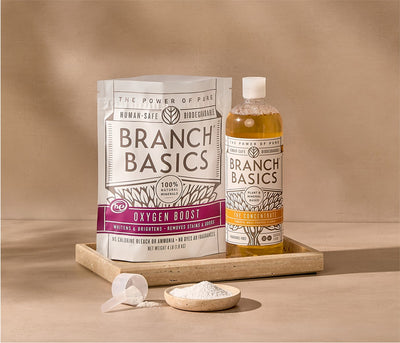
Branch Basics is an all-in-one human-safe cleaning system that is designed to replace all household cleaning and laundry products, including conventional carpet cleaners, with just one Concentrate diluted with water.
It’s so safe and gentle that it can be used in a carpet-cleaning machine and works on a variety of carpet fibers, including wool and synthetic fibers.
Here’s how to use Branch Basics in a carpet cleaner:
- Dilute the Branch Basics Concentrate with 1 to 2 teaspoons per gallon of water (we recommend distilled water).
- Pour the solution into the carpet cleaner according to the manufacturer’s instructions.
- Turn the machine on and clean.
Check out our Ultimate Guide to Natural Floor Cleaning for more tips on natural cleaning solutions for different floor types.
2. Vinegar + Natural Dish Soap
Vinegar has many uses around the home. From cooking to deodorizing to cleaning carpets, it’s an incredibly versatile and effective natural product to always have on hand.
When combined with natural dish soap, these two products help break down dirt, dust, and grime, while gently sanitizing carpet fibers.
The best part? This solution is safe to use in a carpet-cleaning machine for easy use.
Here’s how to clean your carpets using vinegar and natural dish soap:
- Heat a large pot of water on the stove until it’s very warm (about a gallon or slightly less).
- In a large bucket, combine ½ cup of distilled white vinegar and 1 tablespoon natural dish soap.
- Add the warm water and stir until combined.
- Pour the solution into the reservoir of the carpet cleaner.
- Turn on and clean!
Explore more ways to use vinegar for natural cleaning in 12 Ways To Use Vinegar In Your Home.
*Note: Although vinegar is a natural cleaning product, it contains acetic acid, a respiratory irritant, especially when it is made airborne by spraying.
Even though this method doesn’t involve spraying, it’s still best to ventilate the space when cleaning with vinegar – open the windows, use fans, and/or good ventilation until the vinegar smell is cleared.
Avoid spraying or cleaning with vinegar in the presence of babies, young children, the elderly, or someone with asthma or chronic illness.
3. Dry Steam Cleaning
Another option is to try dry steam cleaning with an Advap Ladybug Dry Steam Cleaner, the gold standard for chemical-free disinfecting and cleaning.
This easy-to-use, multi-purpose cleaner can be used on carpets (and many other uses around the home) for an extremely deep clean.
The Ladybug Dry Steam Cleaner cleans, deodorizes, sanitizes, kills dust mites and fleas, denatures allergens, and lifts pet hair, making it easier to vacuum up.*
*Note: Before cleaning an entire room, always test the dry steam cleaner on a hidden area first to make sure it is compatible with the carpet.
Here’s how to use it:
- After vacuuming and pre-treating any stains you find, dry steam clean according to the website instructions.
- Let the carpet dry for about 20 to 30 minutes.
- HEPA vacuum again to remove any pet or human hair that was loosened and lifted by the dry steam cleaner.
If you’re interested in purchasing a dry steam cleaner, Advap generously offers Branch Basics customers a 20% discount on their Ladybug Dry Steam Cleaner!
To claim this deal, use coupon code BRANCHBASICS at checkout.
Discover more natural carpet cleaners in: 5 Carpet Cleaner Alternatives That Actually Work.
Natural Carpet Cleaning Care 101: Stains
While cleaning, if you run into some carpet stains, don’t worry! Here are a few tried-and-true stain-removal methods to help you tackle everyday messes.
1. Baking Soda
Baking soda is an excellent carpet stain remover and odor absorber. It’s best used on light stains like pet urine, grease or oil stains, and for surface dirt.
Here’s how to use baking soda to remove carpet stains:
- If the stain is fresh, blot up as much as possible with a dry or slightly damp microfiber cloth.
- Apply a generous amount of baking soda to the stain. Gently agitate with an old toothbrush.
- Let dwell for 15 to 20 minutes.For odor removal, leave on overnight.
- Vacuum.
- Repeat as needed.
Straight baking soda is safe to use on all sorts of carpets, including synthetic, wool, and natural fiber. As always, be sure to test on an inconspicuous area to ensure colorfastness.
2. Branch Basics
Branch Basics is truly an all-in-one cleaning system. You can use it to deep clean your carpets AND treat many different types of carpet stains, among many, many other uses.
*Note: Before using Branch Basics for treating carpet stains, we recommend doing a pretest. Test it on an inconspicuous area to be sure it doesn’t affect the color or fibers of the carpet. Let it dry completely before making your determination.
Here are a few ways to use Branch Basics for carpet stains:
Branch Basics All-Purpose
Most carpet stains can be treated and removed using the All-Purpose dilution.
Here’s how to use it:
- For general stains, blot up as much as possible using a dry or damp microfiber cloth.
- Spritz the stain with Branch Basics All-Purpose.
- Let dwell for 1 to 5 minutes.
- Gently agitate with a scrub brush until the stain lifts.
- Blot dry with a clean, dry microfiber cloth.
Branch Basics Bathroom
For tougher, set-in carpet stains, you might need to use Branch Basics Bathroom, which is a more concentrated dilution. To use, follow the same directions as All-Purpose above.
Branch Basics Concentrate (undiluted)
If you’re dealing with very stubborn or set-in oil stains, we recommend using undiluted Branch Basics Concentrate.
Here’s how to use it:
- Blot up as much of the stain as possible using a dry or damp microfiber cloth.
- Apply a few drops of Branch Basics Concentrate to the stain.
- Let dwell for 10 minutes.
- Gently agitate with a scrub brush until the stain lifts.
- Rinse with clean water and blot the area with a dry microfiber cloth.
Oxygen Boost
Made with just two simple, biodegradable, and human-safe ingredients – sodium bicarbonate (baking soda) and sodium percarbonate (washing soda/powdered peroxide/oxygen bleach) – Branch Basics Oxygen Boost is a powerful cleaning solution that whitens, brightens, and tackles tough stains.
*Note: Oxygen Boost is a natural bleach alternative. Because of this, it is not recommended for use on colored carpets. Therefore, only use Oxygen Boost on very light-colored carpets and rugs, and be sure to test it on an inconspicuous area first.
Here’s how to use it:
- Blot up as much of the stain as possible using a dry or damp microfiber cloth.
- Combine ¼ a scoop of Oxygen Boost with 1 cup of warm water. Stir well until fully dissolved.
- Pour the solution into a spray bottle and generously spritz the stain.
- Let dwell for 1 to 5 minutes.
- Gently agitate with a scrub brush until the stain lifts.
- Rinse with clean water and blot the area with a dry microfiber cloth.
- Repeat as needed.
For more, check out our Branch Basics Stain Master Guide to learn how to remove all sorts of stains using the entire Branch Basics product line.
3. Cornstarch + Vinegar
Do you have food spills, pet urine, or oil and grease stains on your carpet? Give cornstarch and vinegar a try!
The natural acetic acid found in vinegar helps break down stains, while cornstarch absorbs moisture, oils, and grease, preventing them from spreading deeper into the carpet fibers.
To use, make a paste out of vinegar and cornstarch.
Here’s how:
- If the stain is fresh, blot up as much as possible with a dry or slightly damp microfiber cloth.
- Combine equal parts cornstarch and vinegar to make a creamy paste.
- Apply the paste to the stain using an old toothbrush.
- Let dwell for 5 to 15 minutes.
- Gently agitate with the brush or a microfiber cloth.
- Vacuum the area to remove any visible residue.
- Repeat the process as needed.
4. Liquid Castile Soap
If the smell of vinegar isn’t quite your speed, you might prefer 100% pure, fragrance-free liquid castile soap. This method works best for high-traffic and small dirt stains.
Here’s how to use it:
- Mix 1 teaspoon of liquid castile soap with 1 cup of warm water in a medium-sized bowl.
- Dip a clean microfiber cloth into the solution.
- Gently blot the stain, then rinse with clean water.
- Blot dry with a clean, dry microfiber cloth.
This gentle solution is safe for use around babies, pets, and those who are sensitive or chronically ill.
For more stain-removal tips, check out our 5 Go-To Natural Stain Removers for Carpets.
How To Maintain Naturally Clean & Fresh Carpets
Now that your carpets are clean and stain-free, how do you keep them that way? We’re glad you asked! Here are a few tips:
Vacuum Regularly
Regular vacuuming, especially with a HEPA vacuum, helps keep your carpets clean and fresh by removing dust, dirt, and other contaminants from indoor air rather than stirring them up.
This is especially important to do if anyone in your home has allergies, asthma, or other environmental sensitivities.
Learn more about the importance of regular vacuuming in HEPA Vacuum: Indoor Air Pollution’s Worst Enemy (& How to Choose One for Your Home).
Address Carpet Stains Immediately
To prevent stains from setting into your carpet, it’s essential to act quickly while they’re still fresh.
Blot up any excess liquid and remove solids before pre-treating. Fresh stains are much easier to remove than those over 24 hours old.
Next, pre-treat the area using one of the natural stain-removal methods listed above.
Use Doormats and Keep a No-Shoes Indoors Policy
To help keep dirt and mud out of your home, consider placing doormats outside all entry doors.
But even with doormats, shoes can still track in dirt, mud, bacteria, and harmful chemicals. That’s why adopting a “No Shoes Indoors” policy (so going barefoot or wearing socks inside) can make a big difference. Doing so will help keep your carpets cleaner and safer for much longer.
Learn how and why it’s important to keep a no-shoes indoors policy in Why We Keep a 'No Shoes Indoors” Policy At Home.
Remove Odors Naturally with Baking Soda
Baking soda is a simple and effective way to absorb and eliminate unwanted carpet odors.
Simply sprinkle it over the carpet, let it dwell for at least 30 minutes, and then vacuum it up.
Branch Basics Makes Natural Carpet Cleaning Simple
Keeping your carpets fresh and clean is easy when you use one of the natural carpet cleaning solutions listed in this article.
It’s so simple, you can do it all with environmentally friendly, human-safe, and effective products like baking soda, vinegar, and Branch Basics!
Our human-safe, all-natural cleaning products were designed to replace every cleaner and laundry product in your home with just one Concentrate.
And, yep, that includes carpet cleaning products, too!
If you’re ready to give Branch Basics a try, then we recommend checking out our Premium Starter Kits (available in refillable plastic or glass). Each Starter Kit comes with a bottle of Concentrate, a full bag of Oxygen Boost, and five refillable bottles to make your own All-Purpose, Bathroom, Streak Free, Laundry, and Foaming Wash.
For more tips on natural, human-safe cleaning, visit our Wellness Center for articles, podcasts, user guides, and more!
Natural Carpet Cleaning FAQs
Now that we’ve covered the basics, let’s dig deeper with some FAQs.
Q: Is it safe to use Branch Basics in carpet cleaning machines?
A: Yes! Branch Basics Concentrate is safe to use in carpet cleaning machines.
Its plant- and mineral-based formula creates very low foam, helping prevent buildup or issues inside the machine.
Note: If fragranced cleaners have been used in a carpet cleaning machine, it is important to thoroughly clean until there is no odor with a solution of Branch Basics so your cleaned carpet will not be contaminated.
Our formula contains only natural, human-safe ingredients, including:
-
Purified Water: Reverse osmosis (so it’s completely clean and safe)
-
Decyl Glucoside: A naturally-derived surfactant cleanser derived from coconut and/or corn
-
Organic Chamomile Flower Extract: With Allergen (IFRA) Certifications, which certifies it’s nonallergenic and is not a fragrance
-
Coco-Glucoside: A naturally-derived surfactant derived from coconut
-
Sodium Citrate: A plant-derived, biodegradable sodium salt that acts as a natural water softener
-
Sodium Bicarbonate: Also known as baking soda, this ingredient acts as a mineral-based water softener
-
Sodium Gluconate: A chelating agent that allows the surfactants to work more effectively.
When using the Concentrate in a carpet cleaning machine, be sure to dilute it properly. Add 1-2 teaspoons of Concentrate per gallon of water, then you’re ready to clean!*
*Note: Before cleaning an entire carpeted room, always test a hidden area first for colorfastness and compatibility.
Q: Are these natural carpet cleaning solutions pet-safe?
A: Yes, but even the most natural cleaning products like vinegar, baking soda, and Branch Basics could cause a problem if your pet attempts to eat them, or walks through some vinegar that’s still drying.
The best way to keep your pets safe while cleaning is to:
- Keep them in a separate room or outside (if possible) when cleaning.
- Ventilate the room by opening windows, running a fan, and/or purifier.
- Let floors and surfaces dry completely before letting your pet back in.
- Keep all cleaning products out of reach of your pets.
- If your pet ingests any cleaning product, natural or not, call your vet or poison control immediately.
Learn more about pet-safe cleaning in Our Guide To Pet-Safe Cleaning Products.
Q: What is the best way to deep clean my carpet at home?
A: To deep clean your carpets at home, refer to the instructions above.
For basic, everyday care, consider investing in a HEPA vacuum and vacuum at least once a week. Carpet fibers trap dust, SVOCs, and other contaminants that can be easily removed with a few passes of the vacuum.
For best results, use a sealed canister HEPA vacuum, as this will help maintain healthier indoor air quality.
Note: You should always HEPA vacuum before cleaning your carpet, making three passes over all areas before any cleaning procedure. This will ensure all loose contaminants are removed for a more effective deep clean.
Q: Why do my carpets get so dirty so quickly?
A: Carpet fibers are like magnets when it comes to accumulating dust, dirt, and debris. High-traffic areas and entryways are especially prone and will naturally get dirtier faster.
To help keep your carpets cleaner, vacuum regularly, change air filters frequently, adopt a no-shoes-indoors policy, and use an air purifier to reduce dust and allergens.
Q: Is it safe to use Branch Basics on rugs?
A: Yes! Branch Basics is safe for use on most rugs, but we recommend doing a small patch test first to check for colorfastness before you do a full stain removal
Some rugs, especially delicate or antique ones, may require professional cleaning; be sure to check the manufacturer’s recommendations.
If needed, follow our tips above to find a low-tox cleaner, or consider an organic dry cleaner that offers rug cleaning services.
Sources:
- https://pubchem.ncbi.nlm.nih.gov/compound/Sodium-hypochlorite#section=GHS-Classification
-
https://community.aafa.org/blog/cleaning-when-you-have-asthma-the-dirty-truth?nc=1
-
https://wwwn.cdc.gov/TSP/PHS/PHS.aspx?phsid=263&toxid=48
-
https://wwwn.cdc.gov/TSP/ToxFAQs/ToxFAQsDetails.aspx?faqid=346&toxid=61
-
https://www.epa.gov/sites/default/files/2016-09/documents/naphthalene.pdf
-
https://www.mdpi.com/2673-396X/5/3/27
-
https://pmc.ncbi.nlm.nih.gov/articles/PMC3404651/
- https://pmc.ncbi.nlm.nih.gov/articles/PMC3279464/
Categories

Marilee Nelson
Marilee Nelson is an Environmental Toxins expert who has spent nearly 30 years advocating for the chemically-sensitive and chronically-ill. She is a Board Certified Nutritionist, Certified Bau-Biologist and Bau-Biology Inspector and specializes in Food As Medicine. She has helped thousands of families and individuals identify, heal and recover from toxic exposures and is on a mission to revolutionize the way American families view their health.


