



How To Safely Disinfect After Raw Meat

With the holidays just around the corner, an oven roasted turkey or mouth-watering roast may be playing the starring role on your menu. However, cleaning up after preparing these dishes isn’t always easy. You might wonder how to safely disinfect your kitchen after handling raw meat, especially without the use of harmful chemicals.
While many people reach for bleach or Quat-based wipes after preparing raw meat, these chemicals pose risks to human health, and can also leave chemical residue on the surfaces where food is prepared. Luckily, there’s a way to thoroughly clean and disinfect your space after raw meat using a simple, two-step method that we’ll outline below.
In this article, you’ll learn the difference between cleaning and disinfecting, plus how to disinfect after raw meat has been handled without the use of harsh chemicals.
What’s the Difference Between Cleaning & Disinfecting?
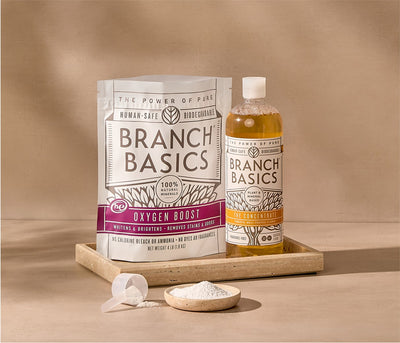
When you use a disinfectant, the aim is to kill germs. Using soap-based cleaners, like Branch Basics, is intended to remove germs. Let’s discuss the difference, and when each is needed.
A soap-based cleaner like Branch Basics uses surfactants and the mechanical action of wiping it away to lift and remove germs from surfaces. A disinfectant’s purpose is to kill germs. However, disinfectants don’t always kill 100% of the germs, and the ones they leave behind may contribute to antibiotic resistance.
For everyday cleaning, removing germs with a soap-based cleaner is recommended for removing germs.. However, in some cases—like if a family member is ill, you have a new baby, or in this case, you’re working with raw meat—a natural disinfectant can be added to your cleaning routine.
Why Skip Conventional Disinfectants in the Kitchen
When raw chicken juice hits the counter, it's natural to grab the strongest disinfectant under the sink. But many conventional disinfectants come with risks to your health, especially on surfaces where you chop vegetables, roll out dough, and set down your kids' snacks.
Quaternary ammonium compounds, or "Quats," are the active ingredients in many popular disinfecting sprays and wipes.
Quats have been linked to respiratory irritation and asthma, as well as skin irritation and allergic reactions. Researchers have also raised concerns that their widespread use may contribute to antimicrobial resistance, and animal studies have pointed to possible reproductive effects that are still being investigated.
Bleach is the other go-to people traditionally reach for to disinfect, and it comes with its own set of concerns. Its fumes can irritate the eyes, nose, throat, and lungs, particularly in a small kitchen without much ventilation. It's also dangerous to combine with other common cleaners: bleach mixed with ammonia or acids (including vinegar) can release toxic gases.
Disinfectants that contain harmful EPA registered pesticides, even when not being used, are emitting harmful VOCs 24/7 into your home’s air quality that you have to use energy to detoxify.
Human-Safe Disinfectant
The good news is that you don't have to choose between a germ-free kitchen and a toxin-free one. A simple two-step routine can tackle raw meat bacteria without leaving harsh residues behind: using Branch Basics to safely clean up before following up with a natural disinfectant such as hydrogen peroxide. Hydrogen peroxide
Hydrogen peroxide is very similar to water (H20) in its composition, except it has an extra oxygen molecule (H2O2). This extra oxygen molecule allows it to oxidize and kill germs, making it an excellent disinfectant for surfaces, sinks, tubs, and more.
Plus, according to studies from the CDC, 3% hydrogen peroxide is more effective at killing germs and viruses than Quat-containing cleaners.
How to Disinfect After Raw Meat
Let’s explore how to safely clean and then disinfect your kitchen using this combination. This method can be used to disinfect kitchen surfaces, cutting boards, sinks and faucets, and more. Here’s how it works.
What you’ll need:
-
Branch Basics All-Purpose Cleaner
-
Microfiber cloth
How to:
For cutting boards:
-
Spray Branch Basics All-Purpose Cleaner directly onto the surface.
-
Allow 2-5 minutes dwell time
-
Scrub with scrub brush and hot water.
-
Rinse thoroughly with hot water. Repeat if desired.
-
Spray cutting board liberally with food grade hydrogen peroxide and let the product dwell for 5-10 minutes.Rinse again with hot water.
For kitchen surfaces-countertops, sinks, faucets, etc.:
-
Spray Branch Basics All-Purpose Cleaner directly onto the surface.
-
Allow 2-5 minutes dwell time
-
Wipe the surface clean with a microfiber cloth that has been wetted with hot water.
-
Spray food grade hydrogen peroxide liberally on the surface and let it dwell for 5-10 minutes.
-
There is no need to wipe off as hydrogen peroxide breaks down into harmless byproducts - water and oxygen
It may go without saying, but in addition to disinfecting kitchen surfaces and cutting boards, don’t forget to thoroughly wash your hands after handling raw meat, too!
FAQs
Can I use hydrogen peroxide on marble or granite?
Yes you can use 3% hydrogen peroxide on light-colored marble or granite. Using it on darker colored marble or granite may lighten the stone.
How long should you let a natural “dwell” on a surface?
When you use hydrogen peroxide, you should let it dwell for 5-10 minutes to properly disinfect.
Is it safe to use hydrogen peroxide on surfaces that touch food?
Yes, food grade hydrogen peroxide is safe to use on surfaces that touch food. There is no reason to wipe food grade hydrogen peroxide off after the 5-10 minute dwell time as unlike chlorine bleach, hydrogen peroxide breaks down into water and oxygen without leaving harsh chemical residues behind. Note: 3% hydrogen peroxide in the brown bottle can be used, but it contains preservatives and stabilizers that you do not want on surfaces in contact with food. After the dwell time, spray with Branch Basics All Purpose, and wipe off.
A Clean Kitchen Doesn’t Require Toxic Chemicals
There’s no question that you should take care when cleaning up after raw meat, but you shouldn’t have to compromise your health with harmful chemicals to do it. Cleaning a surface with Branch Basics first and then disinfecting with a safe option like food grade hydrogen peroxide keeps your kitchen clean without harming your health.
Want to learn more about Branch Basics? Learn how it works or shop our kits, which can help you replace conventional cleaners with human-safe solutions for every room.

