



How To Clean A Fridge Naturally

As busy working mothers (and grandmother!), we know how easy it is to put off fridge cleaning in favor of more pressing to-dos.
However, an unclean fridge quickly becomes an unsanitary fridge, which can lead to spoiled food, awful smells, and, even worse, sickness in the family.
The good news is, fridge cleaning doesn’t have to take the better part of a morning. Once you get into a good routine, it should only take a few minutes.
Want to know how we clean a fridge naturally using only human-safe and environmentally-friendly products?
This detailed tutorial shows you how.
How Often Should You Clean Your Fridge?
Fridge cleaning only becomes a big ordeal when we leave it for too long.
Again, no judgments here (we’ve all been there, done that…and even still do that during busy seasons), but the best defense against this time thief is regular cleaning.
What does this look like? Think about it as easy as 1-2-3
- Clean up spills immediately. Don’t let them turn into sticky, slimy, mystery messes.
- Clean out the fridge weekly and give it a good spray & wipe. We like to do this the day before trash day so no old food gets left in the trash can to create odors.
- Give the fridge a good clean bi-monthly or monthly, depending on your family and needs.
When you follow these guidelines, fridge cleaning becomes a quick task rather than a long, drawn-out, sticky, stinky, and dreaded routine.
Which Natural Cleaners Work Best For Fridges?
Now that you have the 1-2-3 fridge cleaning routine in mind, let’s look at the best products to tackle the job.
Products to avoid when cleaning your fridge are any that contain poisonous or toxic ingredients, like chlorine bleach, ammonia, Quats, PFAS*, SLS/SLES, formaldehyde-releasing preservatives, and fragrance, to name a few.
*Note: PFAS (forever chemicals) are most commonly found in specialty cleaners, stain‑resistant treatments, and certain sprays, even though they rarely appear on labels.
The government continues to protect the PFAS industry and grant it proprietary rights in formulas.
Allowing the use of PFAS chemicals at this time is heinous, tantamount to the lead paint industry promoting products with lead paint, even though scientific evidence had proven the danger.
We recommend avoiding these harsh cleaning ingredients period, but especially when cleaning around food, as sprays can settle on foods and/or leave residues on fridge shelves and drawers.
You don’t want to be ingesting these in any concentration or form, and they are completely unnecessary for effective cleaning.
Learn more in: How to Identify and Avoid Teflon & Other PFAS
Instead, we recommend natural plant- and mineral-based products that are human-safe, non-irritating, not poisonous, and do not leave behind harmful residues, including:
Branch Basics
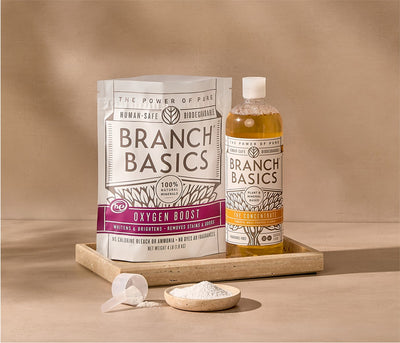
Our all-in-one refillable plant- and mineral-based cleaning line is designed to tackle any home cleaning projects, including refrigerators.
For fridges, we recommend:
All-Purpose: For spraying down the inside of the fridge and/or washing drawers and shelves in the sink.
Bathroom: For deep cleaning drawers or shelves in the sink. All-Purpose is usually sufficient, but use Bathroom for extra concentrated cleaning power.
Streak-Free: For cleaning the outside of the fridge, including stainless steel appliances.
Oxygen Boost: This natural bleach alternative and scouring agent is excellent for deep cleaning drawers and shelves and removing stubborn stains.
All-Purpose and Streak-Free are made using Branch Basics' signature Concentrate plus water. Oxygen Boost is a stand-alone product that comes in our Premium and Ultimate Starter Kits.
Branch Basics products can be used alone or combined with other natural methods, like the ones we’ll discuss next.
Note: Using a surfactant-based cleaner, such as Branch Basics, is always the first step in cleaning your refrigerator or any surface. Why? Because removal of dirt, grime, and germs is the goal.
Using just a disinfectant will not remove dirt and grime and kill all germs. Also, using only a disinfectant without removing germs first with soap and water or a surfactant-based cleaner can create superbugs.
Baking Soda
Baking soda, also known as sodium percarbonate, is an excellent and natural mineral-based product for natural fridge cleaning and deodorizing.
It can be used as a gentle scouring agent with a bit of water to remove stuck-on food and stains from interior shelves or drawers.
As you probably know, a box or dish of baking soda is also essential for absorbing fridge odors and keeping everything smelling fresh and clean.
Vinegar
Plain distilled white vinegar is a wonderful option for natural fridge cleaning.
Vinegar is not a surfactant, although its natural acetic acid does gently power through food and grease, without damaging fridge components.
It also has inherent antibacterial properties against the food-borne pathogens Listeria, Salmonella, and E. Coli, making it a star natural kitchen cleaner.[1-2]
Vinegar is also safe to use on stainless steel appliances, and cleaning vinegar works great too.
Note: Although vinegar is a natural product, it contains acetic acid, a respiratory irritant when made airborne by spraying. Ventilate when cleaning! If you’re sensitive, have CIRS, have a respiratory condition, have babies or young children in the house, etc., opt for another human-safe cleaning option.
This is true for food-grade vinegars, but especially for cleaning vinegar, given its higher acetic acid concentration.
Related reading: Cleaning Vinegar vs. White Vinegar: What’s The Difference?
Peroxide for Safe Disinfecting
Disinfecting is appropriate in areas where food is stored, eaten, and prepared. However, harsh disinfectants should be avoided, especially around food!
Instead, we recommend 3% hydrogen peroxide (in the brown bottle) for disinfecting the inside of your fridge after cleaning with a natural cleaner (we’ll cover this in more detail below).
Studies have shown 3% hydrogen peroxide performed better than harsh disinfectants, like Quats, even on tough germy surfaces, so it really does work![3]
3% hydrogen peroxide is also excellent for cleaning stainless steel appliances and is safe enough to be used as a mouthwash.
Learn more in: How To Clean With Hydrogen Peroxide: A Safer Alternative for Cleaning, Disinfecting, & More
What About Cleaning Stainless Steel Appliances?
All of the above natural cleaners are safe to use on stainless steel appliances, with Branch Basics Streak-Free, vinegar, and peroxide recommended.
Related reading: Cleaning Stainless Steel Naturally: 7 Simple & Effective Methods
How To Deep Clean Your Fridge Using Branch Basics & Other Natural Methods
You have your tools, so let’s tackle that fridge!
We’ll start with how to deep-clean your fridge naturally, giving you a clean slate for quicker future clean-ups.
We do this deep clean at least once every two or three months, or more often if we’ve had company, a “mystery smell”, or a lot spills.
This shouldn’t take more than 30 minutes to an hour, but could take longer if drawers or shelves need to soak.
Be patient, the results will be well worth it and save you so much time in the long run.
What You’ll Need
-
Branch Basics All-Purpose, Bathroom, Foaming Wash or your favorite human-safe dish soap, for cleaning drawers and sinks in hot soapy water
-
Branch Basics All-Purpose or Vinegar, for cleaning interior
-
Branch Basics Streak-Free, vinegar, or 3% peroxide, for the exterior
- Baking soda and/or Oxygen Boost, for scouring and deodorizing
- A non-scratch sponge or scrub brush, for scouring
- 3 microfiber cloths (one for the interior, one for the exterior, one for drying)
How To Deep Clean Your Fridge Naturally
Since you’ll be removing all food from the fridge, plan on doing this when you can dedicate at least 30 minutes or more. You don’t want to forget about food on the counter if you get distracted.
If you’re short on time, or have little ones at your feet, you can also break this into sections, starting with the top shelf and cheese drawer, for example, and moving on from there as you’re able.
Step 1: Unplug the fridge (optional) & remove the contents
Be sure to discard any spoiled, questionable, or “mystery” food in the garbage or compost.
Place dairy, meats, or prepared foods in a cooler with ice or a backup fridge (for those who have one) to keep things safe and fresh.
Unplugging helps reduce the risk of electric shock.
Step 2: Remove all drawers and shelves
As you remove these, have the trash can handy to brush off any crumbs or little bits of food before placing them in the sink.
Wash thoroughly using Branch Basics All-Purpose, Bathroom, or Foaming wash or your favorite human-safe dish soap.
For stains or really stuck-on food, soak shelves or drawers in a scoop of Oxygen Boost and warm water for at least 30 minutes. If your sink is too small, a clean bathtub works great for this!
Let dry completely in a rack.
Step 3: Clean the fridge interior.
With the drawers and shelves removed, spray down the entire interior with Branch Basics All-Purpose .
Wipe clean, paying special attention to any food spills or stains.
For extra scouring power, try making a paste with baking soda and a little water, and gently rub it on with a non-scratch scouring pad, then wipe clean.
For further freshening, wipe with vinegar or hydrogen peroxide.
Step 4: Clean the exterior
- Use Branch Basics Streak-Free, vinegar, or 3% hydrogen peroxide to spray and gently wipe down the fridge exterior, including the handles, knobs, and surfaces (front, sides, & top of the fridge).
- For stubborn or sticky messes, try making a paste with a baking soda and a little water and scour, using gentle pressure.
- Use a toothbrush, cotton swab, and/or skewers to get into hard to reach nooks and crannies.
- These products are safe to use on stainless steel and other refrigerator exteriors, but check the manufacturer’s instructions before using on refrigerator screens.
- Buff dry using a dry cloth.
Related reading: Cleaning Stainless Steel Naturally: 7 Simple & Effective Methods
Step 5: Check drips pans, coils, and water/air filters
These often neglected areas can build up with old food, dirt, and dust and should be cleaned/inspected every few months or so to prolong the fridge’s life.
Check your refrigerator manual for specific instructions on how to access and clean these areas.
A HEPA vacuum and Branch Basics All-Purpose work great for coils, and regular vacuuming around the fridge will help keep them clean.
Since it’s ultra-gentle and human-safe, Branch Basics All-Purpose can also be used on fridge water filters.
Again, consult your refrigerator manual for specific instructions.
Step 6: Reboot and Return the fridge contents
Plug in your fridge and return all the contents to their squeaky clean shelves and drawers.
Tip: We like putting natural paper towels in the crisper drawers to help absorb moisture and keep produce fresher longer.
To keep your fridge smelling fresh, consider adding an open box or dish of baking soda.
How To Quick-Clean Your Fridge Naturally
Once you’ve done the deep clean, weekly quick cleanings are super easy. Here’s how.
Quick-clean the interior
- Unplug the fridge to prevent electric shock.
- Remove food from a shelf at a time, and place it on another fridge shelf or in a cooler, discarding anything old, spoiled, or questionable.
- Alternatively, you can empty the whole fridge and place perishables in a cooler. However, if you time it right (like the night before grocery shopping) you can just move the food around the fridge.
- Alternatively, you can empty the whole fridge and place perishables in a cooler. However, if you time it right (like the night before grocery shopping) you can just move the food around the fridge.
- Spray All-Purpose and, wipe clean. Move onto the next shelf.
- Next, pull out the drawers and empty any bits of food into the trash or compost.
- Wipe clean using All-Purpose or wash in warm soapy water with All-Purpose, Bathroom, or Foaming wash & dry complete.
- Spot-disinfect as-desired using 3% hydrogen peroxide or vinegar, taking care not to use at the same time as vinegar (use one, wipe completely, use the other).
Quick-clean the exterior
- Spray the exterior with Branch Basics Streak-Free,wipe clean, and buff dry.
- Plug in the fridge.
You’re done!
Aim to do this once a week to prevent bacteria and germs from building up and keep your food fresh and safe to eat.
How To Remove Odors From Your Fridge
A good deep clean will take care of any fridge odors, so start there.
If the fridge was very dirty with lots of spoiled food, letting it air out for an hour or two before replacing the drawers and shelves, will help a lot.
If you’ve recently deep-cleaned and notice an odor, do the quick-clean method to identify the source. Once you’ve found it, discard and clean the area around it with Branch Basics, vinegar, and/or baking soda.
Place a dish of baking soda in the fridge to help absorb the rest of the odor.
For more tips, see: Fridge Smelling Like Fish & Other Gross Smells? Try These Solutions
Tips For Keeping Your Fridge Cleaner Between Cleanings
When it comes to fridges, a little preventative maintenance goes a long way toward keeping things clean and odor-free.
Here are some additional tips:
- Store food properly, in sealed containers (preferably glass)
- Remove produce from plastic packaging, this extends their shelflife and prevents leaching of plastic chemicals into your food
- Label and date your prepared food
- Keep food that needs to be eaten at the front of the fridge
- Consider storing perishable food, like cut fruit, soups, leftovers, etc. in tall glass jars. This makes them easier to see and harder to forget about
- Clean up spills as soon as they happen
- Keep your fridge organized, there are tons of online tutorials on how to do this
- Line your drawers with natural paper towels to absorb moisture and help food stay fresher
- Vacuum around your fridge regularly to help prevent build-up on coils
- Wipe down the fridge handle every day; it gets germy!
- Wipe down the top of your fridge weekly; it’s a hotbed trap for dust
- Use natural deodorizers, like baking soda, charcoal packets, or even coffee grounds, to keep things smelling fresh
Related reading: How to Keep Produce Fresh Longer [Complete Guide]
Put Branch Basics To Work In Your Fridge & Kitchen
If this article has inspired you to try Branch Basics, we invite you to check out our Premium Starter Kit (plastic or glass) and Ultimate Starter Kit (plastic or glass).
Each kit contains Branch Basics Concentrate (our signature cleaner) plus refillable glass or plastic bottles to make all the cleaning products you need to clean your entire home, including the fridge and kitchen.
The Premium Starter Kit will get you started with Branch Basics Concentrate + bottles to make All-Purpose, Bathroom, Foaming Wash, Streak-Free, and Laundry, plus our best-selling Oxygen Boost.
The Ultimate Starter Kit contains our waterless Laundry Detergent, plastic-free Dishwasher Tablets, Oxygen Boost, Branch Basics Concentrate + bottles to make All-Purpose, Bathroom, Foaming Wash, and Streak-Free.
Check out How To Get Started With Your Branch Basics Kit for a video and written tutorial on how our award-winning cleaning system works.
All our Branch Basics products are plant- and mineral-based, MADE SAFE Certified, EWG-Verified, Leaping Bunny Verified cruelty-free, and environmentally responsible.
The ultra-safe and gentle ingredients make them suitable to use around babies, pets, older people, the chronically ill, and those with chemical sensitivities.
Shop all Branch Basics Starter Kits today.
For more kitchen cleaning tips, see:
-
Best Human-Safe Kitchen Cleaning Tips
-
The Most Effective Kitchen Cleaners Without Bleach
-
3 Best & Natural Produce Wash Recipes (That Really Work!)
-
How to Naturally Clean Grease Off Kitchen Cabinets
-
Get Rid of Kitchen Sink Smells Permanently With These Solutions
References:
Categories

Marilee Nelson
Marilee Nelson is an Environmental Toxins expert who has spent nearly 30 years advocating for the chemically-sensitive and chronically-ill. She is a Board Certified Nutritionist, Certified Bau-Biologist and Bau-Biology Inspector and specializes in Food As Medicine. She has helped thousands of families and individuals identify, heal and recover from toxic exposures and is on a mission to revolutionize the way American families view their health.


