



Cleaning Products Without Endocrine Disruptors: Why We Avoid Them in Branch Basics

Finally, the word is getting out about endocrine disruptors in cleaning products!
At Branch Basics, we have been recommending removing endocrine disruptors from food and products used in the home since our inception.
Before Branch Basics was born, co-founder Marilee Nelson. reversed Stage 4 Endometriosis and many other chronic health issues just by removing harmful chemicals (including endocrine disruptors) from her diet.
After her son’s chemical injury, she learned how ingredients in products used can impact the brain, lungs, liver, digestion, hormones, and metabolic function.
Endocrine disruptors are chemicals that disrupt normal hormonal balance in adults and children, and should be actively avoided!
Here, we’ll discuss endocrine-disrupting ingredients to watch out for in cleaning products (green and conventional), why Branch Basics products are endocrine-disruptor-free, where these chemicals hide in cleaning products (they’re not always labeled), and answer some FAQs.
Key Takeaways
- Endocrine-disruptors or EDCs are chemicals and chemical compounds that disrupt normal hormonal function
- Cleaning products, laundry products, fragranced products, and personal care products are all typically hotbeds of EDCs
- EDCs are also found in “green” cleaning products and even natural products containing essential oils or “natural fragrance”
- Endocrine disruptors aren’t always obvious on labels, so knowing how to spot them is crucial
What Ingredients Are Considered Endocrine Disruptors?
Conventional and even non-toxic cleaning products often contain a toxic soup of endocrine-disrupting chemicals, in addition to other harmful ingredients.
A short list of common endocrine disruptors found in cleaning and laundry products includes:
-
Phthalates: A plasticizer chemical commonly used in fragrances.
-
Glycol esters: Derived from petroleum, these are used as solvents, degreasers, detergent enhancers, and stain removers in cleaning products.
-
Chlorine bleach: This ultra-common and trusted cleaner and disinfectant has been linked to fertility issues, including preterm birth and infertility.[1]
-
Parabens: Synthetic preservatives linked to various hormonal effects, including reproductive toxicity in men, women, and boys.[2][3]
-
Some non-ionic surfactants like Alkylphenols (nonylphenols, octylphenols), ethanolamides (monoethanolamine, diethanolamine): Surfactants are the primary ingredients in detergents or foaming cleaners. Some are safe, some are not.
- Get the facts in: Are Surfactants Toxic? The Dangers + Safe and Natural Alternatives
- Get the facts in: Are Surfactants Toxic? The Dangers + Safe and Natural Alternatives
-
Triclosan: A semi-banned sanitizing chemical still allowed in many cleaning and oral care products.
-
BPA and other plastic chemicals: These often leach from packaging into various cleaners.
-
Quats: Powerful disinfectants used in household disinfectant sprays, wipes, and cleaners.
-
Certain essential oils: Although many pure, 100% organic/wild-crafted essential oils are therapeutic, emerging research suggests some varieties, such as tea tree and lavender, may have endocrine-disruptive properties.[4]
- Natural and synthetic fragrance: These fragrances can contain dozens of undisclosed synthetic or naturally-derived compounds, such as phthalates, that have been linked to endocrine disruption.[5]
Click the links above to learn more about these individual EDCs, and check out: Endocrine Disruptors In Cleaning Products.
Why Branch Basics Avoids Endocrine Disruptors
At Branch Basics, we avoid endocrine disruptors because they’re harmful to humans, pets, wildlife, and the environment, and have no place in a healthy home.
Plus, they’re completely unnecessary to achieve a high-quality, high-performing, human- and environmentally-safe cleaning and laundry product.
This means every ingredient we use has been thoroughly vetted as a non-EDC, non-irritant, and is never sourced from petroleum products or animals.
We’re also proud to be leading the way in end-product and third-party verification testing.
Our Concentrate is verified as non-irritant to skin, eyes, and lungs, and all our products are MADE SAFE certified, and/or EWG Verified, and Leaping Bunny Certified (cruelty-free).
Discover more about our human-safe, EDC-free standards in: What Is Human Safe? Our Brand Promise
Where Do Endocrine Disruptors Hide In Cleaning Products?
Sometimes endocrine disruptors are obvious, such as bleach- or disinfectant-based cleaning products.
However, other times they’re hiding in unlabeled places, mainly fragrances.
Again, our best advice is to avoid fragranced products, including natural fragrances and essential-oil-scented products suspected of being EDCs, such as tea tree and lavender, as well as those stored in plastic containers, which can leach plastic chemicals into the formula.
What’s Marilee’s Take on Endocrine Disruptors?
Our co-founder, Marilee Nelson, has been championing the removal of endocrine disruptors from food and cleaning products for decades.
In her nutritional practice and at home with her chemically-injured son, she’s helped thousands of people remove these toxic chemicals from their food and homes and educate the public on their harms.
“Many times, I’ve had clients come to me frustrated that they were doing “all the right things” with their diets, exercise, and lifestyle, but had been unable to fully heal from hormone-driven ailments or even nervous system, cognitive, and neurological problems.
“So, I’d ask them about their cleaning, personal care, and other household products. And nine times out of ten, they were unintentionally exposing themselves and their families to endocrine-disrupting chemicals.
“The other points I want to emphasize are that there was a study done of the most popular cleaning products, and they found the “green” cleaning products contained just as many harmful chemicals as the synthetic, including EDCs.”[5]
It was discovered that synthetic and natural fragrances, including essential oils, are often processed with solvents and leach hormone-disrupting plasticizers from plastic tubing and packaging.
“One of the best ways to lower your exposure to these chemicals is to go fragrance-free, cut way back on plastic, especially for food storage, and switch to human-safe cleaning, laundry, and personal care products.”
Nelson outlines exactly how to do this, using the same method she’s taught thousands of clients, in our free Toss the Toxins Online Course.
Why Branch Basics is Different
Branch Basics is committed to offering 100% EDC-free, plant- and mineral-based, biodegradable cleaning products.
This means no synthetic or natural fragrance, no harmful disinfectants, no petroleum products, no ethoxylated or harmful surfactants, no essential oils, no irritants, and no harmful preservatives.
Our human-safe standard ensures our ingredients and formulas are carefully chosen and designed for even the most sensitive individuals, including babies, pets, older people, those with chemical sensitivities, and people with chronic conditions.
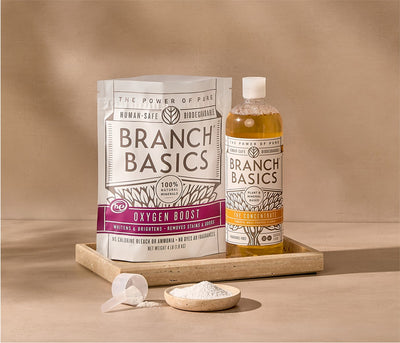
Learn all about our human-safe line, which uses just one Concentrate plus optional Oxygen Boost to replace every single synthetic cleaner in your home, for less than many other green or natural brands.
We also offer Laundry Detergent, Plastic-free Dishwasher Tablets, Gel Hand Soap, and natural cleaning tools and accessories.
Shop Branch Basics Starter Kits Here.
Endocrine Disruptor FAQs
There’s a lot to learn about EDCs in cleaning products, so let’s dive into some FAQs.
How Can I Be Sure A Cleaning Product Is Free From Endocrine Disruptors?
Checking labels, researching the company’s policies, and avoiding fragranced products can all help you avoid endocrine-disrupting chemicals.
Get more tips in: 3 Tools You Need To Become Your Own Product Advocate
Are All Synthetic Fragrances Considered Endocrine Disruptors?
Unfortunately, fragrances are proprietary “trade secrets,” so we don’t know what’s in them. Nor are companies required to disclose their ingredients.[7-9
However, research suggests that the majority contain at least one endocrine-disrupting chemical. We also know fragrances are considered one of the world’s top allergens, and many contain carcinogens (cause cancer, asthmagens (cause asthma), obesogens (cause metabolic syndrome and can make it difficult to lose weight regardless of diet or exercise), and neurotoxins (impact brain function).
Do Natural Ingredients Act As Endocrine Disruptors?
Some can, which is why “natural” doesn’t always mean safe.
For example, as discussed in Is Natural Fragrance Safe? , natural fragrances may contain dozens of harmful or potentially irritating and sensitizing chemicals, including endocrine disruptors. As mentioned previously, some essential oils are even considered endocrine-disruptive.
The essential oil issue is complex, as we know that pure essential oils can be highly medicinal in small therapeutic doses and can even help balance hormones, as they have been used safely for centuries. We recommend consulting with an expert in the medicinal use of essential oils if someone is dealing with chronic illness.
More research is needed, but for now, we err on the side of caution, especially around babies, children, teens, pregnant women, or anyone with chronic illness or a hormonal issue.
Why Doesn’t Branch Basics Use Fragrance?
As mentioned previously, fragrances, even “natural fragrances,” are a prime source of endocrine-disrupting chemicals, like phthalates.
For this reason, and because we want our products to be safe for the environment and very sensitive individuals, we do not use fragrance (and never will!).
References:
-
https://www.cdc.gov/niosh/reproductive-health/prevention/disinfectants.html?CDC_AAref_Val=https://www.cdc.gov/niosh/topics/repro/disinfectants.html
-
https://pubmed.ncbi.nlm.nih.gov/29433019/
-
https://www.sciencedirect.com/science/article/abs/pii/S0048969721012171
-
https://pmc.ncbi.nlm.nih.gov/articles/PMC9152575/
-
https://www.sciencedirect.com/topics/materials-science/fragrance
-
https://pmc.ncbi.nlm.nih.gov/articles/PMC3018511/
-
https://www.mdpi.com/2673-396X/5/3/27
-
https://pubmed.ncbi.nlm.nih.gov/35642859/
-
https://chemtrust.org/news/designerfragrancesendocrinedisruptors/

Marilee Nelson
Marilee Nelson is an Environmental Toxins expert who has spent nearly 30 years advocating for the chemically-sensitive and chronically-ill. She is a Board Certified Nutritionist, Certified Bau-Biologist and Bau-Biology Inspector and specializes in Food As Medicine. She has helped thousands of families and individuals identify, heal and recover from toxic exposures and is on a mission to revolutionize the way American families view their health.


