

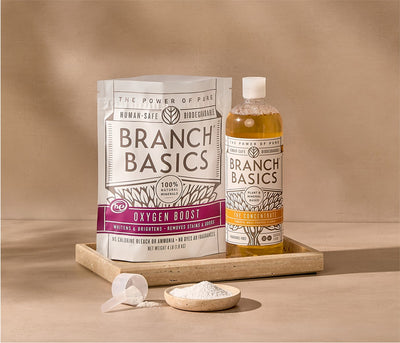


Cleaning Products Without Chlorine: Why We Avoid It in Branch Basics

Chlorine, specifically chlorine bleach, is a common ingredient in many cleaning, disinfecting, and laundry products.
And although it is an effective disinfectant cleaner and whitener, it’s also highly toxic, with studies suggesting that even passive exposure can increase the risk of miscarriage and pregnancy complications, microbiome disruption, asthma and respiratory disease, and sickness in children.
Plus, chlorine bleach is completely unnecessary to create a clean, germ-free, and healthy home.
Ready to ditch the chlorine bleach for safer alternatives? Let’s get into how to do this with some of our favorite chlorine bleach alternatives for cleaning, disinfecting, whitening, removing mold and mildew, and more.
Key Takeaways
- Chlorine bleach, also known as sodium hypochlorite, is added to cleaning products to kill germs, whiten surfaces and fabrics, and remove stains.
- Branch Basics does not use chlorine bleach because it is a poisonous substance with serious short- and long-term health implications.
- There are many safe substitutes for bleach, including 3% hydrogen peroxide or dry steam heat for disinfecting, sodium percarbonate for whitening clothes, and Branch Basics for everyday cleaning and removal of germs.
Why Is Chlorine Commonly Included In Cleaning Products?
We all know chlorine bleach is highly toxic, yet its use in cleaning and laundry products is ubiquitous, and most people use it without a second thought.
So why does bleach have such a hold on us?
I believe the three main reasons are:
- Most of us grew up with bleach in the house, and believe it’s a necessity.
- We believe that bleach works really well to kill germs, whiten whites, and clean our bathrooms, kitchens, home exteriors, and floors.
- Chlorine bleach is cheap and versatile, making it a popular addition to synthetic chemical cleaners and laundry products.
I’ve also observed that most people simply don’t realize how harmful using chlorine bleach is, especially for people with chronic illness, respiratory disease, children, babies, and during pregnancy.
This is unfortunate but understandable, given how chlorine-based bleach products are marketed as safe, effective, and even life-saving.
Why Branch Basics Doesn’t Use Chlorine
At Branch Basics, we have never and will never use chlorine bleach in our cleaning products for several reasons:
1. Our all-in-one cleaning line is not designed to disinfect. Instead, the naturally derived ingredients work to break down and remove germs completely, rather than killing them. This reduces the spread of superbugs, making our products safe to use as often as you like.
2. Chlorine bleach is inherently toxic and unsafe. This chemical, and its byproducts, trihalomethanes (THMs) and chloramines, can cause severe burns and are skin, eye, and lung irritants. Bleach has been linked to several health issues, including:
-
- An increased rate of miscarriage and preterm birth
- Asthma
- COPD
- DNA damage
- Cancer
- Microbiome disruption
- An increased risk of respiratory and other diseases in children
3. We offer an effective bleach alternative in Oxygen Boost. This human-safe product whitens, boosts laundry detergent, removes stains, scrubs away mold and mildew, and acts as a natural scouring agent—without harmful chemicals. Once you try it, you’ll never miss chlorine bleach again!
4. Chlorine bleach encourages the spread of superbugs. How? When disinfectants are sprayed on a contaminated surface, they always leave some germs behind (which is why no disinfectant can claim to kill 100% of germs). These germs adapt and become increasingly resistant to disinfectants, creating stronger, more dangerous superbugs you don’t want in your home.
5. Branch Basics contains only human-safe and biodegradable ingredients. Chlorine bleach products are not safe for pets, children, babies, people with chemical sensitivities, or those with chronic illness. They also degrade our soil, air, and waterways.
Cleaning products aside, we also recommend, as you’re able, taking steps to avoid chlorine bleach in other areas of your home, including swimming pools and your drinking and bathing water.
Find helpful tips and advice in:
-
How To Minimize Chlorine Exposure At The Pool
-
How To Start Drinking And Bathing In Clean Water Right Away
Our Favorite Chlorine-Free Cleaning Products
So, what can you use to clean, disinfect, whiten, and kill mold without chlorine bleach? Here are some of our top low-tox, healthy-home-approved bleach alternatives.
Chlorine-Free Laundry Bleach & Brightening Products
Bleach can feel hard to give up in the laundry room, especially if you have kids and pets, or just really like the whitest whites. The good news is, you can have your ultra-bright whites and clean clothes without the harmful chlorine fumes and lingering by-products. Here are a few of our favorite laundry bleach and brightening alternatives:
1. 3% Hydrogen Peroxide
Plain old hydrogen peroxide in the brown bottle can be added to your wash just like chlorine bleach to safely whiten whites, remove stains on light-colored clothing, and disinfect.
Simply add 1 cup to the bleach compartment for white or light-colored clothes, then wash.
For instruction on using hydrogen peroxide for stains, see: How To Use Hydrogen Peroxide For Stains.
2. Branch Basics Oxygen Boost
Oxygen Boost is our very favorite laundry booster, stain remover, and soaking aid. Just one scoop in the washer brightens, whitens, and deodorizes clothes while improving the effectiveness of your favorite natural laundry soap or detergent.
We love using it with Branch Basics Laundry dilution or Laundry Detergent on whites or dingy loads.
It’s also game-changing for removing stains on colors or whites, either as a soak (our favorite method), or directly on lights or whites with Branch Basics All-Purpose or Laundry dilution.
Learn more in: How To Use Branch Basics Oxygen Boost: Complete Guide
3. Distilled White Vinegar
If you like vinegar for cleaning, you will love it for whitening and softening laundry, and removing stains.
Just 1 cup of vinegar added to the rinse cycle acts as a natural fabric softener and bleach alternative. It’s also excellent for whitening dingy whites.
Vinegar’s natural acetic acid is also a powerful weapon against various types of stains, especially oil, grease, food, or protein stains. And thanks to the heat of the dryer or the sun, your clothes won’t smell like vinegar after washing.
Chlorine-Free Floor-Cleaning Products
Synthetic chemical-based floor cleaners are dangerous for pets, babies, and young children who spend a lot of time on the floor. Here are some safer, more natural alternatives.
1. Dry Steam and Steam Mopping
It doesn’t get much simpler than using pure dry steam to clean your floors. A dry steam mop, like the Advap Ladybug Dry Steam Cleaner is a star in the cleaning and disinfecting arena. For those who have a hard time not using a powerful disinfectant, the Advap Ladybug offers a completely non-toxic option without the consequences.
The dry steam cleaner provides a mechanical kill of bacteria in 2 to 7 seconds. The bacteria all die without the danger of creating superbugs or toxic fumes. The dry steam heat does not leave moisture on the floor, so it works even on wood floors.
For those who want guaranteed safe disinfection and are uncomfortable with the concept of removing bacteria without killing them, a dry steam cleaner is the perfect answer. We recommend a traditional steamer like the Hoover Steam Mop as a non-toxic floor cleaning alternative to bleach, with reservations.
A steam cleaner can be used safely as a disinfectant on non-porous flooring such as porcelain and ceramic tile. It is not suitable for wood floors, natural stone, or other softer surface floors, unless carefully applied, as it takes time for the steam to kill. There is too much moisture and heat released, which can damage flooring, break down sealers, and also increase the potential for mold in some situations.
Note: To avoid severe burns and injuries, always use extreme caution around children or pets, and store them out of reach. They often find dry and traditional stream cleaners fascinating and can easily get hurt.
2. Branch Basics Concentrate or All-Purpose
Branch Basics Concentrate can be used at various dilutions to clean hard floors and remove carpet stains. It’s completely human- and pet-safe and free of harmful chemicals, including chlorine bleach.
For tile, stone, and concrete floors (check manufacturer’s cleaning recommendations), mix 1/4 to 3/4 teaspoon Branch Basics Concentrate with 2-8 cups water in a spray mop or spray bottle with a mopping pad. Dilute further if the floor is sticky after drying.
For vinyl and LVP, mix 1/8 to 1/4 teaspoon of Concentrate with 2 - 8 cups of water, and use in a spray mop or spray bottle. Dilute further if the floor is sticky after drying.
For the mop-and-bucket method, dilute 1/8 to 1/2 teaspoon of Concentrate with 8 cups of water for larger surface areas, and mop away! Dilute further if the floor is sticky after drying.
For wood floors, use just 1/8 -1/4 teaspoon Branch Basics Concentrate per 4 cups of water. Do not spray the floor directly. Spritz a mop or Swiffer to lightly dampen the floor. Wipe the floor dry after use.
Learn more in: Our Ultimate Guide To Natural Floor Cleaning
3. Use Vinegar Or Lemon Juice
Once again, vinegar’s versatility shines through! Vinegar can be diluted and used as a chlorine-bleach-free clean on non porous porcelain and ceramic tile floors, ideally with a mopping bucket to avoid spraying the vinegar.
Vinegar contains acetic acid, which is a lung irritant when sprayed. If you find it irritating, pure lemon juice, which contains natural citric acid, is an excellent alternative.
Both can be diluted 50:50 with water for use on most floor types (check manufacturer’s guidelines).
Chlorine-Free Disinfecting
If you’re keeping a bottle of bleach around for disinfecting, it’s time to trade it in for these safe and effective alternatives.
1. 3% Hydrogen Peroxide
Research has shown 3% hydrogen peroxide, which breaks down to hydrogen and oxygen, disinfects just as well as synthetic quat-containing disinfectants and is strong enough to kill bacteria, fungi, viruses, and other pathogens per the Centers for Disease Control.
Start by removing germs with Branch Basics or a natural soap, then follow up with 3% peroxide and 5-10 minutes of dwell time. That’s it!
2. Dry Steam Cleaning
Natural dry steam cleaning is the safest, most eco-friendly disinfectant. The LadyBug Dry Steam Cleaner qualifies as an EPA registered disinfecting device and can be used on all types of surfaces, including wood floors.
Get more advice on natural disinfecting in: 9 Alternatives To Bleach For Disinfecting
Chlorine-Free Mold and Mildew Removal
Chlorine bleach was once considered the standard for killing mold and mildew. However, that’s no longer the case as the U.S. Environmental Protection Agency (EPA) doesn’t recommend chlorine bleach or any biocide to be used to kill mold. Instead a surfactant based cleaner like Branch Basics is recommended to remove the mold.
If desired, after removing surface mold with a surfactant based cleaner, hydrogen peroxide at 3% (or higher) can be used as a safe wipe down instead of chlorine bleach. After mold has been removed, hydrogen peroxide helps to oxidize and break down mold stains, serves as brightener, deodorizer, and mop up disinfectant.
Always leave significant mold removal to the experts. But for minor mold and mildew in the shower, tub, tile, or on clothing, follow this guide for safe removal.
Chlorine-Free/Low-Chlorine Swimming
Most people can tolerate occasional exposure to chlorine from swimming pools, but some cannot or do not wish to.
Fortunately, there are several low-chlorine and chlorine-free swimming pool systems.
Some examples include:
- Saltwater pools
- Peroxide-treated pools
- Low-chlorine pools utilizing ionizers or UV light
You can learn more about this in: How To Minimize Chlorine Exposure At The Pool
What’s Marilee’s Take On Chlorine?
Branch Basics co-founder, Marilee Nelson, has spent decades helping people with chemical sensitivities, chemical injuries, and chronic illness regain their health by tossing the toxins, using food as medicine, and changing their lifestyles.
According to Marilee, remove all chlorine bleach from your home to immediately improve your air quality, as even unopened bottles emit harmful VOCs 24/7. “The short- and long-term effects of chlorine and bleach can be devastating. You don’t realize how much it impacts you until it is removed.
“I also highly recommend investing in a high-quality water filter for drinking and bathing as soon as you’re able. Studies suggest we absorb more chlorine and chlorine by-products, like chloroforms from bathing from inhalation and skin absorption than from drinking, so this is very important. Shower and bath filters aren’t expensive, and they can make a huge difference.”
Marilee recommends reverse osmosis water in glass bottles for an inexpensive option. See How To Start Drinking & Bathing in Clean Water Right Away if a high-quality water filter isn’t feasible.t
“Vitamin C (ascorbic acid) powder can also be added to baths to neutralize chlorine.
“Finally, I encourage mothers and parents to research and help spread the word about how chlorine bleach and other disinfectants can negatively affect fertility, reproductive health, and pregnancy outcomes, as this is well-documented and preventable, but we have to know the facts so we will be motivated to take action.”
Chlorine FAQs
Feeling like you know everything there is to know about why you should avoid chlorine and what to use instead? No? Then let’s answer some FAQs.
Is cleaning with chlorine harmful?
Yes, as mentioned previously, even passive exposure to chlorine bleach can increase the risk of illness, microbiome disruption, and chronic respiratory ailments.
It’s also indicated in pregnancy complications, including miscarriage, is an asthmagen, a VOC, and encourages the spread of superbugs.
Chlorine is rated an 8 on EWG Skin Deep. We recommend that, ideally, all ingredients in products kept in the home be rated 1-2 on EWG Skin Deep.
What to use instead of chlorine for cleaning?
There are numerous chlorine alternatives, including peroxide and steam for natural disinfecting, vinegar or Branch Basics Oxygen Boost for whitening and brightening clothes, and surfactant-based cleaners, like Branch Basics and liquid castile soap for removing germs. See the previous section on chlorine bleach alternatives for more information.
Are chlorine-free cleaners as effective as traditional bleach-based products?
Yes. Chlorine-free cleaners can be as effective as bleach-based cleaners but without the harmful fumes, creation of superbugs, or environmental impacts. See the previous sections for recommendations for chlorine-free cleaning, laundry, floor cleaning, dishwashing, and more.
Are chlorine-free cleaning products better for the environment?
Absolutely. In addition to killing all microbes (good and bad), bleach-based cleaners react with organic matter, such as dirt, soil, and excrement, forming toxic chloroforms that are harmful to the environment and people.
Toss The Toxins With Branch Basics
Chlorine’s out, and human-safe, environmentally-friendly cleaners, laundry products, and disinfectants are in!
If you’re looking for a safe and effective plant- and mineral-based cleaning line that’s free from chlorine and other harmful ingredients, you will love Branch Basics.
Our all-in-one cleaning system requires only two products:
- Branch Basics Concentrate: Just add water to create All-Purpose, Bathroom, Foaming Wash, Streak-Free, and Laundry dilution.
- Oxygen Boost: A laundry booster, stain remover, natural scouring agent, bleach alternative.
These two products are part of our best-selling kits that can replace every harmful cleaner and laundry product in your home—from surfaces to floors, hand soap, and laundry. They truly do it all, without harmful bleach.
Shop Branch Basics chlorine-free cleaning products and start creating a healthier home today with our free Toss the Toxins course.
Want to see more tips like the ones in this article? Add Branch Basics as a preferred source in Google search results!

Marilee Nelson
Marilee Nelson is an Environmental Toxins expert who has spent nearly 30 years advocating for the chemically-sensitive and chronically-ill. She is a Board Certified Nutritionist, Certified Bau-Biologist and Bau-Biology Inspector and specializes in Food As Medicine. She has helped thousands of families and individuals identify, heal and recover from toxic exposures and is on a mission to revolutionize the way American families view their health.


